
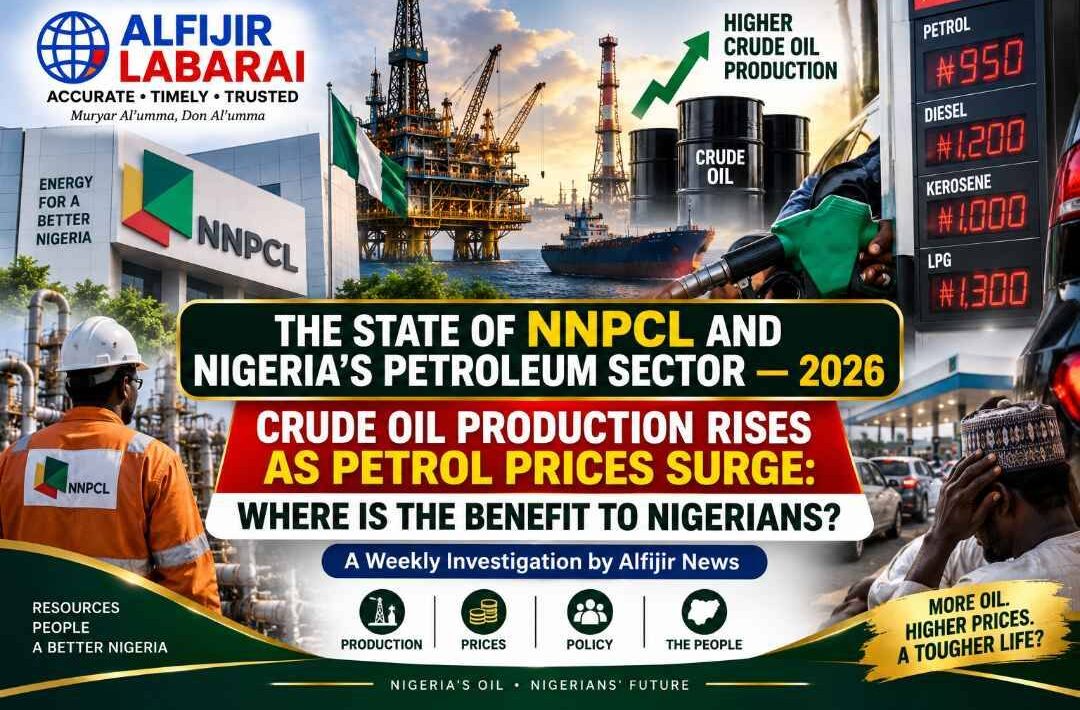
A Weekly Investigation by Alfijir News
What changed this week: Crude oil production, NNPCL, Dangote Refinery, petrol prices and the impact on the public
By Alfijir Labarai
Accurate • Timely • Trusted
In our report last week, we examined NNPCL’s role in crude oil production, the condition of Nigeria’s refineries, its relationship with Dangote Refinery, revenue generation, and the broader question of whether changes in the petroleum sector are benefiting Nigerians.
This week, our investigation focuses on what has changed and what the latest available information shows.
1. CRUDE OIL PRODUCTION RISES AGAIN
New data from the Nigerian Upstream Regulatory Commission (NUPRC) shows that Nigeria produced 1,677,777 barrels of crude oil and condensate per day in August 2026.
Excluding condensate, crude oil production alone stood at 1,500,190 barrels per day.
NUPRC said this represented a 0.4 per cent increase compared with July, while Nigeria met its OPEC production quota for the fourth consecutive month. The Commission attributed part of the increase to the resumption of Single Buoy Mooring operations at the Erha field.
This represents an important development in Nigeria’s upstream oil sector.
But Alfijir Labarai’s question is:
Does increased crude oil production translate into greater economic benefits for Nigeria and its citizens?
2. NNPCL AND DANGOTE REFINERY
Dangote Refinery is increasingly using crude oil sourced from Nigeria.
Data contained in the refinery’s IPO prospectus shows that during the 12 months ending June 2026, the refinery sourced approximately 116 million barrels of crude oil from Nigeria, representing about 60 per cent of the crude it received during the period.
The report stated that the supplies came from NNPCL, international and local oil companies, and other crude oil suppliers.
This further highlights the importance of NNPCL in supplying crude oil to Dangote Refinery, which now plays a major role in Nigeria’s petroleum market.
3. DANGOTE RAISES PETROL PRICE TO ₦1,350
On September 12, 2026, Dangote Refinery increased the gantry price of Premium Motor Spirit (PMS) from ₦1,265 to ₦1,350 per litre.
This was the fourth price increase by the refinery since August, with the price rising from ₦1,165 to ₦1,350 in approximately 22 days.
The increase came amid fluctuations in global crude oil markets and energy supply concerns linked to developments in the Middle East.
4. PETROL PRICE REACHES ₦1,500 IN SOME PARTS OF NIGERIA
This week, the increase became more visible at filling stations.
A THISDAY report indicated that petrol prices reached about ₦1,500 per litre in some locations, while in Kano, prices of between ₦1,450 and ₦1,470 per litre were reported at some filling stations.
The report also stated that some Kano residents had reduced their use of vehicles because of the rising cost of petrol.
This is where the petroleum issue directly affects ordinary Nigerians: transportation, commercial activities and the prices of essential goods.
5. NNPCL ALSO RAISES PRICES AT SOME FILLING STATIONS
Following Dangote Refinery’s price increase, reports indicated that NNPCL also raised PMS prices at some of its filling stations in Abuja and surrounding areas.
This suggests that changes in the downstream market are affecting different petroleum marketers, not only Dangote Refinery.
However, prices announced or observed in one location should be distinguished from nationwide prices, as filling-station prices can vary from one area to another.
6. NLC CALLS FOR URGENT ACTION OVER RISING PETROL PRICES
The Nigeria Labour Congress (NLC) called on the Federal Government to take urgent measures to reduce the impact of rising petrol prices on workers and other Nigerians.
Reports indicate that the price increase has already begun affecting transportation costs and public mobility. The NLC also called for measures that would reduce the burden of higher fuel prices on citizens.
7. GLOBAL CRUDE OIL PRICES FALL AGAIN
On Friday, crude oil prices in the international market fell again.
Brent crude declined by $2.14, or about 2 per cent, to $102.68 per barrel, while West Texas Intermediate (WTI) fell to $100.08.
Reuters reported that the decline was linked to easing concerns over a severe disruption to Saudi Arabia’s crude supply, as the country increasingly uses alternative export routes.
However, a decline in global crude prices does not necessarily mean petrol prices in Nigeria will fall immediately, because several other factors contribute to the final price paid by consumers at filling stations.
8. GOVERNMENT REFINERIES: QUESTIONS REMAIN
With petrol prices rising, attention has once again returned to the condition of government-owned refineries.
Some petroleum marketers have called on the Federal Government and NNPCL to revive government refineries that are not operating effectively, in order to increase domestic refining capacity.
This issue is important because greater domestic refining capacity could reduce dependence on external sources of refined petroleum products and reduce exposure to fluctuations in the international market.
9. SO, WHAT HAVE NIGERIANS GAINED?
The information available this week presents two contrasting developments.
On the upstream side, crude oil production increased, and Nigeria met its OPEC quota for the fourth consecutive month.
However, on the downstream side, petrol prices increased, with prices reaching as high as ₦1,500 per litre in some locations, including reports of ₦1,450–₦1,470 at some filling stations in Kano.
Therefore, the central question of our investigation is:
If crude oil production is increasing, how does this additional production translate into tangible benefits for ordinary Nigerians?
10. WHAT ALFIJIR LABARAI WILL CONTINUE TO INVESTIGATE
Next week, we will continue monitoring:
1. The volume of crude oil produced by Nigeria.
2. How much of Nigeria’s crude oil is supplied to domestic refineries.
3. How much crude Dangote Refinery receives from Nigeria.
4. The condition and operational status of the Port Harcourt and Warri refineries.
5. Petrol prices in Kano and other states.
6. The impact of petrol prices on transportation and the cost of essential goods.
7. The revenue generated by NNPCL.
8. How developments in Nigeria’s petroleum sector are affecting the daily lives of Nigerians.
CONCLUSION
This week’s investigation shows that Nigeria has recorded a modest increase in crude oil production, while Dangote Refinery is increasingly using crude sourced from Nigeria.
However, on the side of the petroleum sector that Nigerians experience most directly, petrol prices have risen significantly in some locations.
At the same time, international crude oil prices fell again on Friday, but the decline has not yet translated into lower petrol prices at filling stations.
Therefore, the question for Alfijir Labarai is not simply:
“How much crude oil is Nigeria producing?”
The bigger question is:
“How are increased crude oil production and changes in Nigeria’s petroleum sector affecting the lives of ordinary Nigerians?”
Alfijir Labarai will continue to follow this issue on a weekly basis, using official data, market information and the experiences of Nigerians on the ground.
ALFIJIR LABARAI
Accurate • Timely • Trusted
CONNECT WITH ALFIJIR LABARAI
Stay connected with Alfijir Labarai / Alfijir News for the latest news, reports, investigations, programmes and important updates from Kano, Nigeria and around the world.
📞 CONTACT US
For enquiries, news tips, partnership, advertising, sponsorship and more information:
+234 803 207 7835
📰 Have a story, development or important information to share?
Send your news tips, press releases, announcements and community stories to Alfijir Labarai.
🤝 PARTNER WITH US
We welcome individuals, organisations, institutions and businesses interested in:
• Media Partnership
• Advertising
• Programme Sponsorship
• Corporate Partnerships
• Special Reports & Features
• Event & Programme Promotion
📞 Contact us:
+234 803 207 7835
🌐 FOLLOW ALFIJIR LABARAI
🐦 X (Twitter):
“Follow us on X” https://twitter.com/Musabestseller?s=09
📘 Facebook:
“Follow us on Facebook” https://www.facebook.com/profile.php?id=100089640289165
🧵 Threads:
“Follow us on Threads”https://www.threads.net/@alfijirlabarai
▶️ YouTube:
“Subscribe on YouTube” https://www.youtube.com/@BestsellerChannel12
📸 Instagram:
“Follow us on Instagram” https://www.instagram.com/musa_bestseller?utm_source=qr&r=nametag
📲 JOIN OUR WHATSAPP GROUP
Get our latest news updates, programmes, reports and important announcements directly on WhatsApp.
👇👇 Join the Alfijir Labarai / Alfijir News WhatsApp Group:
“Join our WhatsApp Group” https://chat.whatsapp.com/Ilj1iz8v3sa3nBfrCz9U6f?s=cl&p=a&mlu=4&ilr=4
ALFIJIR LABARAI MEDIA SERVICES
Accurate • Timely • Trusted
📰 News • Reports • Investigations • Programmes • Public Awareness
© 2026 Alfijir Labarai Media Services