
ALFIJIR NEWS | SECURITY OPERATIONS AND ANTI-CORRUPTION REPORT
Wednesday, 11 November 2026
Nigeria’s security agencies have continued operations against terrorism, kidnapping, arms trafficking and other criminal activities across different parts of the country.
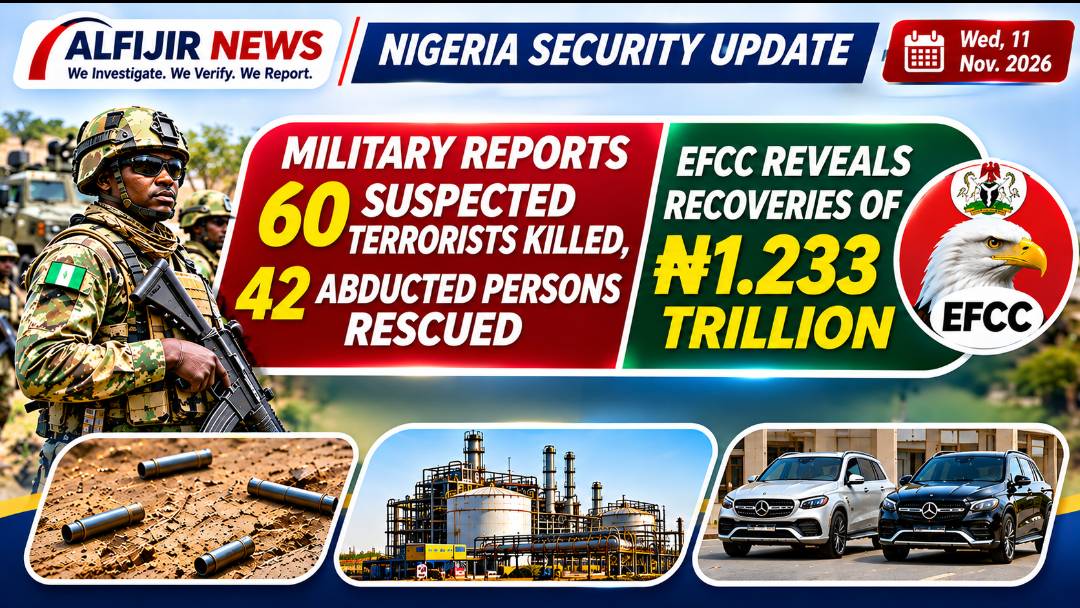
In a weekly operational update, the Nigerian Army said its troops killed 60 suspected terrorists, rescued 42 kidnapped persons and arrested 56 individuals suspected of providing support to terrorist groups.
Meanwhile, the Economic and Financial Crimes Commission (EFCC) has reported recovering more than ₦1.233 trillion, alongside foreign currencies, and securing 10,872 convictions during its 34-month operational reporting period.
These figures highlight the scale of activities being reported by the agencies. However, an important question remains: how effectively are these operations improving public safety, protecting public resources and strengthening the rule of law in Nigeria?
1. Nigerian Army reports 60 suspected terrorists killed, 42 people rescued
In a report published on 8 November 2026, the Nigerian Army said its troops killed 60 people suspected of being terrorists, rescued 42 kidnapped persons and arrested 56 individuals suspected of supporting terrorist groups through arms trafficking and the supply of logistics.
The Army’s Director of Defence Media Operations, Major General Michael Onoja, said the operations were conducted across the North-East, North-West, North-Central and South-East regions.
According to the military, troops also recovered weapons, ammunition and other items allegedly used by criminal groups.
Highlights of the operations
In Buni Yadi, Yobe State, the Army said troops repelled an attack on their position. Following the engagement, the military reported recovering 48 bodies of suspected terrorists and seizing AK-47 rifles and other weapons.
In Bitta, Borno State, the military separately reported recovering seven bodies during another operation. The report also mentioned three additional bodies recovered during a separate follow-up operation. These incidents should not be presented as if all the bodies were recovered at one location.
In Kebbi State, troops reportedly conducted rescue operations following attacks affecting Ribah and surrounding routes, leading to the rescue of kidnapped victims.
In Niger State, the military said 15 kidnapped persons were rescued during an operation in the Kontagora area.
In Taraba State, six civilians, including an infant, were reportedly rescued following a kidnapping incident.
The Army also reported operations in Kogi, Kwara, Abia and Anambra States, involving the rescue of kidnapped persons, arrests of suspected criminals and recovery of weapons.
The military said the operations were carried out in collaboration with other security agencies.
2. EFCC reports over ₦1.233 trillion recovered and 10,872 convictions
The Economic and Financial Crimes Commission (EFCC) has reported recovering more than ₦1.233 trillion, in addition to foreign currencies, in its 34-month operational performance report under the leadership of Ola Olukoyede.
The EFCC chairman presented the performance figures covering the period from 1 October 2023 to 31 July 2026.
According to the commission, it secured 10,872 convictions from 14,476 cases filed in court during the reporting period.
The agency also reported receiving 49,673 petitions, investigating 39,615 cases and filing 14,476 cases in court.
The reported recoveries include:
– Nigerian Naira: ₦1,233,612,040,411.11
– US Dollars: $684,478,457.32
– British Pounds: £373,905.78
– Euros: €9,343,803.66
The breakdown of the Naira recoveries indicated that approximately ₦397.26 billion represented funds recovered directly for the Federal Government, while about ₦836.35 billion related to recoveries made on behalf of individuals, companies, ministries, government agencies, state governments and other beneficiaries.
It is important to distinguish between funds recovered and funds actually returned to their rightful beneficiaries.
The report indicated that approximately ₦661.32 billion and $492.37 million had been returned to eligible beneficiaries, while other funds were still subject to verification and further processes.
There is also a reporting-period distinction: some of the recovery figures relate to a period ending on 30 June 2026, while other operational statistics extend to 31 July 2026. The figures should therefore not be interpreted as having been recorded within exactly the same reporting period.
3. EFCC uncovers suspected illegal refinery in Ogun State
In a separate operation, the EFCC announced the discovery of a suspected illegal petroleum refinery in Ogere, Ogun State.
The commission said the facility was discovered on 31 October 2026 during an investigation.
The operation must be distinguished from the arrest of 14 Chinese nationals and one Nigerian on 23 October 2026. Those arrests were linked to a separate investigation involving alleged unauthorised lithium-processing facilities.
The 15 individuals were not arrested at the Ogere petroleum refinery, and the available information does not establish that they operated the facility.
According to the EFCC, its operatives found underground storage tanks and equipment suspected to have been used in processing petroleum residue.
The commission said no one was present at the facility when its operatives arrived. Consequently, no arrests were made during that particular operation.
Investigations are continuing to identify those responsible for operating the facility and establish the full extent of its activities.
4. Court orders final forfeiture of luxury vehicles and electronic devices
On 9 November 2026, the Federal High Court in Lagos ordered the final forfeiture of two luxury vehicles and electronic devices to the Federal Government.
The assets were linked to Ifeanyi Franklyn Arinze, whom the EFCC identified as a person previously convicted in connection with internet fraud.
The vehicles included a Mercedes-Benz GLE 53 AMG and a Mercedes-Benz GLC 300 AMG. Other items included mobile phones and a tablet device.
The EFCC had sought the forfeiture, alleging that the assets were reasonably suspected to have been acquired with proceeds of unlawful activities.
The court granted the final forfeiture order after considering the evidence presented and the absence of any interested party who came forward to challenge the interim forfeiture order.
The development illustrates the use of asset-forfeiture proceedings in the recovery of suspected proceeds of crime. However, an asset-forfeiture order should be distinguished from a separate criminal conviction.
5. The bigger question: How can these gains be sustained?
Despite the figures reported by the security agencies, there is a need to assess the long-term impact of their operations.
In the security sector, attention should focus on whether communities previously affected by terrorism and kidnapping are experiencing lasting peace, whether rescued victims are receiving appropriate support, and whether the supply networks providing weapons and logistics to armed groups are being disrupted.
For the EFCC, important accountability questions include how much of the recovered money has actually been returned to eligible beneficiaries, how forfeited assets are being managed and whether cases filed in court are progressing through due legal processes.
The rights of suspects must also be protected. An arrest or asset seizure does not, by itself, establish criminal guilt.
Conclusion
The Nigerian Army’s reported operations indicate continued military pressure on terrorist groups and kidnapping networks in different parts of the country.
Meanwhile, the EFCC’s reported figures highlight the scale of financial recoveries and court convictions recorded during its operational reporting period.
However, the success of security and anti-corruption agencies should not be measured solely by the number of arrests, weapons seized or funds recovered.
It should also be measured by sustained reductions in crime, improved protection of lives and property, respect for due process and the transparent return of recovered assets to their rightful beneficiaries.
Alfijir News will continue monitoring the activities of Nigeria’s security agencies and the EFCC, distinguishing official statements, allegations and matters established through court judgments.
📢 FOLLOW ALFIJIR LABARAI
Stay connected with Alfijir Labarai / Alfijir News for credible news, reports, investigative journalism, and important updates from Kano, Nigeria, and around the world.
📩 CONTACT US & PARTNERSHIP ENQUIRIES
Call/WhatsApp: +234 701 1 11 3809
+234 803 207 7835
🌐 OUR SOCIAL MEDIA PLATFORMS
X: https://twitter.com/Musabestseller?s=09
Facebook: https://www.facebook.com/profile.php?id=100089640289165
Threads: https://www.threads.net/@alfijirlabarai
YouTube: https://www.youtube.com/@BestsellerChannel12
Instagram: https://www.instagram.com/musa_bestseller?utm_source=qr&r=nametag
📲 JOIN OUR WHATSAPP GROUP
https://chat.whatsapp.com/Ilj1iz8v3sa3nBfrCz9U6f
ALFIJIR LABARAI MEDIA SERVICES
Truth • Timeliness • Trust
© 2026 Alfijir Labarai Media Services