CLIMATE CHANGE INVESTIGATION SERIES: NORTHERN NIGERIA
EDITION TWO
Investigation Date: 11 November 2026
Flooding and windstorms remain major environmental hazards in Nigeria, causing loss of lives, destruction of homes, damage to farmlands and disruption of essential infrastructure.
In Northern Nigeria, particularly Kano and Jigawa States, communities have experienced the effects of heavy rainfall, flooding and destructive windstorms.
However, this investigation by Alfijir News goes beyond documenting the number of people affected. It examines the preparedness measures announced by relevant authorities, the emergency response arrangements put in place, and whether government commitments have translated into practical assistance for affected communities.
The investigation also examines the importance of translating weather and flood forecasts into effective early-warning systems capable of protecting lives and livelihoods.
1. NIGERIA: FLOODS AFFECT 673,350 PEOPLE
The National Emergency Management Agency (NEMA) reported that as of 20 October 2026, flooding had affected 673,350 people across 134 local government areas in 28 states.
The reported figures included:
– 214,997 people displaced from their homes.
– 245 reported deaths.
– 673,350 people affected by flooding.
These are nationwide figures and should not be interpreted as statistics for Northern Nigeria alone.
The figures highlight the scale of the flooding challenge and the importance of effective early-warning systems, emergency preparedness and coordination among government agencies.
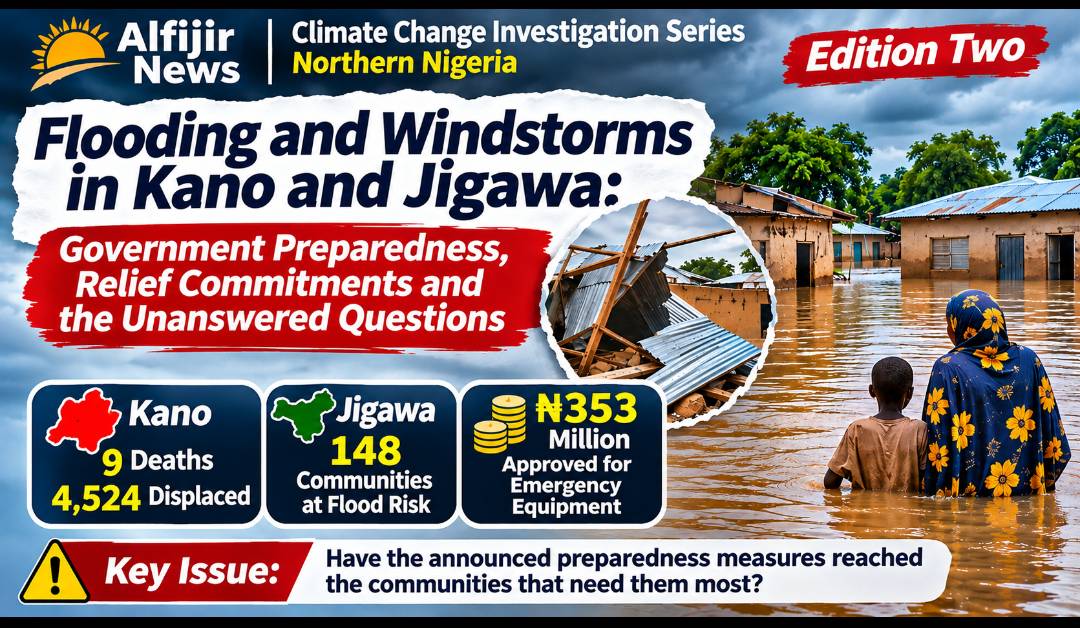
2. KANO: NINE DEATHS, 49 INJURED AND 4,524 DISPLACED
On 4 September 2026, Nigerian newspaper The Punch published figures attributed to the Executive Secretary of the Kano State Emergency Management Agency (KSEMA), Isyaku Kubarachi.
According to the official, windstorms and heavy rainfall between January and August 2026 resulted in:
– Nine deaths.
– 49 people injured.
– 4,524 people displaced from their homes.
The incidents affected eight local government areas: Gaya, Ajingi, Rimin Gado, Minjibir, Kabo, Bichi, Shanono and Kibiya.
These figures illustrate the impact of severe weather events on communities across the state.
However, important questions remain about the assistance provided to affected households, the number of beneficiaries reached and the measures taken to reduce the risk of similar incidents in the future.
As of the completion of this report, Alfijir News had not received a response to its enquiries sent to KSEMA.
3. JIGAWA: 148 COMMUNITIES IDENTIFIED AS FLOOD-RISK AREAS
Reports published in 2026 indicated that the National Emergency Management Agency identified 148 communities across 17 local government areas in Jigawa State as being at risk of flooding.
The Executive Secretary of the Jigawa State Emergency Management Agency (JISEMA), Hannafi Yakubu, reportedly disclosed that 20 boats had been deployed to support rescue operations and the evacuation of residents in vulnerable locations.
He also indicated that relief materials had been prepared to support communities that might be affected by flooding.
These announcements point to preparedness measures reported by the relevant authorities.
However, further information is needed to establish where the boats were deployed, whether they were operational and how many residents benefited from the preparedness and relief arrangements.
4. ₦353 MILLION: FROM GOVERNMENT APPROVAL TO ACTUAL IMPLEMENTATION
On 26 April 2026, The Guardian reported that the Jigawa State Government had approved ₦353 million for the procurement of emergency response equipment.
The reported plan included:
– 20 motorised boats.
– Emergency rescue equipment.
– Emergency relief supplies.
– Support for temporary accommodation for displaced households.
The report also mentioned 11 trucks intended to transport food and other relief materials when required.
However, there is an important distinction between approving funds and confirming that the money was released, the equipment purchased and the materials delivered to the communities that need them.
Alfijir News is therefore seeking clarification on the following:
1. How much of the approved ₦353 million has actually been released?
2. Have all 20 boats been procured?
3. Where are the boats currently stationed?
4. Have the boats been tested and confirmed operational?
5. What quantities of relief materials have been distributed?
6. How many people have benefited from the intervention?
At the time of completing this report, we had not obtained sufficient documentary evidence to establish that the entire allocation had been spent or that all the proposed equipment had been procured.
We therefore do not present these matters as confirmed achievements.
5. THE 2026 FLOOD OUTLOOK: WHAT NIHSA IDENTIFIED
The Nigeria Hydrological Services Agency (NIHSA) published its 2026 Annual Flood Outlook, identifying communities across Nigeria that face varying levels of flood risk.
According to the figures presented during the outlook’s launch, 14,118 communities were classified as being at high risk, 15,597 at moderate risk and 923 at low risk.
However, NIHSA’s online mapping information displays a total of 26,224 communities identified as being at risk.
The difference between these figures requires clarification from the agency to establish the methodology and classification used in each presentation.
The importance of such forecasts lies in their potential to help government agencies identify vulnerable locations and implement preventive measures before flooding occurs.
6. DOES EARLY WARNING REACH VULNERABLE COMMUNITIES?
One of the major challenges in disaster management is ensuring that weather and flood warnings reach people living in rural communities, riverbanks and other vulnerable locations.
This investigation seeks to establish:
– How are early warnings communicated to rural communities?
– Are emergency alert systems available for residents in high-risk locations?
– Have evacuation centres been identified and prepared?
– Have local emergency response personnel received adequate training?
– What assistance is available to farmers who lose their farmlands?
– What arrangements exist for families whose homes are destroyed?
It is also important to recognise that not every flood or windstorm can automatically be attributed to climate change. Establishing a direct scientific link requires specific evidence and appropriate climate research.
7. OFFICIAL RESPONSES: ENQUIRIES REMAIN UNANSWERED
As part of this investigation, Alfijir News sent enquiries to relevant government agencies to obtain additional information and verify the preparedness and response measures reported.
The agencies contacted include:
– National Emergency Management Agency (NEMA).
– Nigeria Hydrological Services Agency (NIHSA).
– Nigerian Meteorological Agency (NiMet).
– Kano State Emergency Management Agency (KSEMA).
– Jigawa State Emergency Management Agency (JISEMA).
As of the completion of this report, Alfijir News had not received responses to its enquiries from these agencies.
We are making this disclosure in the interest of transparency and responsible journalism, not as an allegation of wrongdoing against any institution.
We remain open to receiving official explanations, relevant documents and additional information that could clarify the measures taken.
Any response received after publication will be assessed and incorporated into an appropriate update to this investigation.
8. CONCLUSION: PREPAREDNESS MUST GO BEYOND ANNOUNCEMENTS
This investigation has identified official warnings and preparedness commitments intended to reduce the impact of flooding and windstorms in Kano and Jigawa States.
However, the critical issue is whether these measures have reached the communities most exposed to the risks.
Protecting lives does not begin after a disaster occurs. It begins before the rains through effective early warnings, public awareness, improved drainage systems, properly equipped rescue teams and designated evacuation centres.
Alfijir News will continue to investigate the gap between official preparedness announcements and their actual implementation, with particular attention to the experiences of vulnerable communities.
Our objective is to establish what has been promised, what has actually been delivered and what more needs to be done to protect lives and livelihoods across Northern Nigeria.
ALFIJIR NEWS — INVESTIGATIVE JOURNALISM, EVIDENCE, ACCOUNTABILITY AND PUBLIC INTEREST.
📢 FOLLOW ALFIJIR LABARAI
Stay connected with Alfijir Labarai / Alfijir News for credible news, reports, investigative journalism, and important updates from Kano, Nigeria, and around the world.
📩 CONTACT US & PARTNERSHIP ENQUIRIES
Call/WhatsApp: +234 701 1 11 3809
+234 803 207 7835
🌐 OUR SOCIAL MEDIA PLATFORMS
X: https://twitter.com/Musabestseller?s=09
Facebook: https://www.facebook.com/profile.php?id=100089640289165
Threads: https://www.threads.net/@alfijirlabarai
YouTube: https://www.youtube.com/@BestsellerChannel12
Instagram: https://www.instagram.com/musa_bestseller?utm_source=qr&r=nametag
📲 JOIN OUR WHATSAPP GROUP
https://chat.whatsapp.com/Ilj1iz8v3sa3nBfrCz9U6f
ALFIJIR LABARAI MEDIA SERVICES
Truth • Timeliness • Trust
© 2026 Alfijir Labarai Media Services