
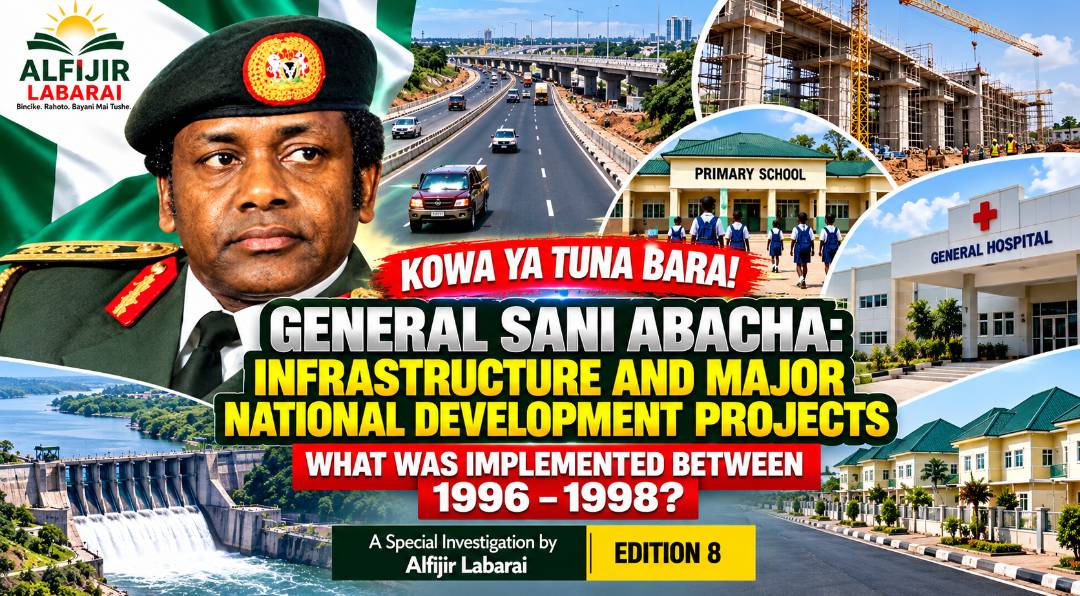
KOWA YA TUNA BARA!
A Special Investigation by Alfijir Labarai
EDITION 8
INTRODUCTION
Infrastructure plays a major role in national development. Roads, schools, hospitals, housing, water supply and electricity affect economic activity, public services and the daily lives of citizens.
Between 1996 and 1998, during the administration of General Sani Abacha, the Nigerian government pursued programmes aimed at rehabilitating infrastructure and improving public services. Some projects were initiated during this period, some were continued, while others were completed or commissioned after having been planned or started earlier.
This edition examines the available documentary evidence to establish what was reported, what was completed during the period and what cannot be conclusively attributed to the administration.
1. THE PETROLEUM TRUST FUND AND INFRASTRUCTURE DEVELOPMENT
One of the major programmes associated with infrastructure spending during the Abacha administration was the Petroleum Trust Fund (PTF), commonly referred to in discussions of the period alongside the Petroleum Special Trust Fund (PSTF).
In his Independence Day address on 1 October 1997, Abacha stated that the PTF had committed more than ₦30 billion to road rehabilitation nationwide. He also identified education, healthcare, water supply, transportation and other social services among the areas receiving attention.
This figure represents the administration’s reported commitment to road rehabilitation. It should not automatically be interpreted as proof that the entire amount had been spent or that all planned roadworks had been completed.
Source: “Abacha’s 1997 Independence Day Speech — Archivi.ng” (https://archivi.ng/the-archivist/stories/issue-4/independence-day-speeches-nigeria/1997-independence-day-speech)
An International Monetary Fund (IMF) report also documented significant revenue received by the PSTF during the 1995–1997 period. The fund supported capital investment in infrastructure and social services, including health, education, water supply, food storage and security.
The important distinction is between money received by the fund, money committed to projects, actual expenditure and completed work. These are different measures and should not be treated as interchangeable.
Source: “IMF — Nigeria: Selected Issues, 1998” (https://www.elibrary.imf.org/view/journals/002/1998/078/article-A004-en.xml)
2. ROAD REHABILITATION AND TRANSPORTATION
Road rehabilitation was a prominent part of the infrastructure programme publicly presented by the administration.
Improved roads can reduce transport difficulties, help farmers move produce to markets, facilitate the distribution of goods and support trade between communities.
The 1997 Independence Day address provides evidence that the government reported committing substantial funds to road rehabilitation. However, the speech does not provide a complete, independently verified list of all the roads rehabilitated, the amounts spent on individual routes or their subsequent condition.
A comprehensive assessment would require project records showing the locations, contractors, contract values, completion dates and independent inspections.
Finding: Road rehabilitation was a stated priority and received reported financial commitments. The precise extent of completed work cannot be established from the presidential speech alone.
3. EDUCATION AND PRIMARY-SCHOOL REHABILITATION
Education was another area covered by PTF-supported programmes.
A World Bank report on Nigeria discussed support for primary-school rehabilitation, including sanitation facilities, furniture and instructional materials. The report recorded an allocation of approximately ₦1.6 billion for primary education-related activities in 1997.
However, the report also noted limitations in the available information about actual expenditure. Consequently, the allocation should not be presented as proof that the entire amount was spent or that every intended school received the planned support.
Source: “World Bank — Nigeria education-sector report” (https://documents1.worldbank.org/curated/en/334211468775589200/pdf/multi-page.pdf)
To determine the full impact, further records would be needed on the schools selected, the facilities repaired, the materials delivered and the number of pupils who benefited.
4. HOUSING PROJECTS COMPLETED OR COMMISSIONED
Housing provides another documented example of development activity during the period.
The Federal Housing Authority (FHA) lists several housing projects as completed or commissioned in 1997 and 1998.
Abesan II, Lagos
– 62 housing units.
– Recorded as completed in 1997.
– Most houses were allocated to the Federal Government Staff Housing Loan Board.
Sharada Estate, Kano
– 178 housing units.
– Recorded as completed and commissioned in October 1998.
Aladinma and Egbeada Estates, Owerri, Imo State
– 186 housing units.
– Recorded as completed and commissioned in October 1998.
Source: “Federal Housing Authority — Past Projects” (https://fha.gov.ng/past-projects)
These records establish that the listed housing units were recorded as completed or commissioned during the relevant period. They do not, by themselves, establish when each project was first conceived, approved or funded.
For that reason, the report does not claim that the Abacha administration initiated all these projects. Establishing responsibility for their original planning and financing would require additional project documentation.
5. GWARINPA II: A HOUSING SCHEME INITIATED IN 1996
Gwarinpa II in Abuja was another significant housing development initiated during this period.
According to a report from the Federal Ministry of Works and Housing, the Federal Housing Authority initiated the Gwarinpa II Housing Scheme in 1996 in response to growing demand for accommodation in the Federal Capital Territory.
The report describes a development covering approximately 1,090 hectares, with plans for more than 5,000 housing units. Other FHA documents record different totals for the scheme, reflecting differences in the scope or classification of the project.
Source: “Federal Ministry of Works and Housing — Housing report” (https://worksandhousing.gov.ng/themes/front_end_themes_01/images/uploads_images/1598990131.pdf)
The evidence supports the conclusion that Gwarinpa II was initiated in 1996, during the Abacha administration. It does not establish that all the planned units were completed before his administration ended in 1998.
This distinction matters because the development continued beyond the period under review.
6. THE NATIONAL ROLLING PLAN AND CAPITAL EXPENDITURE
Nigeria’s National Rolling Plan for 1996–1998 provided a framework for government development planning and expenditure across different sectors.
Budget documents from the period help explain the government’s stated priorities and proposed capital projects. Nevertheless, inclusion in a budget or development plan does not automatically mean that a project received all its funding, was completed on schedule or delivered the expected benefits.
A full assessment requires a comparison of budget provisions with actual releases, expenditure records, project completion reports and evidence of the facilities delivered to the public.
Source: “National Library of Nigeria Repository — 1996 Budget of Consolidation” (https://nigeriareposit.nln.gov.ng/items/f6094ffb-0e0a-48b9-90f5-7ae16691e707)
7. WATER, ELECTRICITY AND OTHER PUBLIC SERVICES
Water supply, electricity, roads and other public services remained important infrastructure concerns during the period.
Abacha’s 1997 address identified several of these sectors among the areas where the PTF was expected to contribute. The IMF’s account of PSTF spending also identified infrastructure and social services as important expenditure areas.
However, evidence that a sector received funding does not prove that conditions improved in every state or community. Establishing the extent of improvement would require reliable information about individual projects, their costs, completion dates, service coverage and operational performance.
This edition therefore recognises the documented programme commitments without claiming that the country’s wider infrastructure challenges were resolved.
8. DID THE INFRASTRUCTURE CHALLENGES END?
The available evidence does not support the conclusion that Nigeria’s infrastructure problems were eliminated between 1996 and 1998.
In a statement published in 1999, the IMF described roads, water supply, sewerage and electricity infrastructure as severely deteriorated and questioned the viability of some priority projects.
Source: “IMF — Nigeria: Letter of Intent and Memorandum, 1999” (https://www.imf.org/external/np/loi/1999/022299.htm)
This assessment provides important context about the country’s infrastructure challenges around the transition period. It was published after Abacha’s tenure and should not be treated as a project-by-project evaluation of every initiative undertaken during his administration.
The evidence points to two facts that must be considered together: infrastructure rehabilitation and public-facility projects received attention and funding, while serious problems in infrastructure and service delivery remained.
9. WHAT THE DOCUMENTS ESTABLISH
The records reviewed for this edition support the following conclusions:
1. The PTF and PSTF supported infrastructure-related and social-service spending during the period.
2. In October 1997, Abacha stated that the PTF had committed more than ₦30 billion to road rehabilitation nationwide.
3. Primary-school rehabilitation and related educational facilities were included in PTF-supported programmes.
4. FHA records list housing units in Lagos, Kano and Owerri as completed or commissioned during 1997 and 1998.
5. The FHA initiated Gwarinpa II in 1996, although the development extended beyond the period under review.
6. Government plans, financial commitments and project completions are separate measures; evidence of one does not automatically prove the others.
7. The available evidence does not establish that Nigeria’s wider infrastructure problems had been solved by the end of 1998.
ABIN DA YA KAMATA MU TUNA
History should be documented through evidence, not assumptions.
During General Sani Abacha’s administration, the PTF and PSTF supported infrastructure-related spending, road rehabilitation was publicly presented as a major priority, and FHA records show housing projects completed or commissioned in 1997 and 1998. Gwarinpa II was also initiated in 1996.
At the same time, responsible reporting requires us to distinguish between projects initiated before the administration, those undertaken during it and those completed later. It also requires us to separate government announcements and budget allocations from verified expenditure, completed work and long-term results.
Remembering history accurately means recognising documented developments while being honest about what the evidence cannot prove.
KOWA YA TUNA BARA!
ALFIJIR LABARAI — Research, Evidence and Accountable Reporting.
SOURCES
1. Archivi.ng — 1 October 1997 Independence Day Speech:
https://archivi.ng/the-archivist/stories/issue-4/independence-day-speeches-nigeria/1997-independence-day-speech
2. International Monetary Fund — Nigeria: Selected Issues, 1998:
https://www.elibrary.imf.org/view/journals/002/1998/078/article-A004-en.xml
3. World Bank — Nigeria education-sector report:
https://documents1.worldbank.org/curated/en/334211468775589200/pdf/multi-page.pdf
4. Federal Housing Authority — Past Projects:
https://fha.gov.ng/past-projects
5. Federal Ministry of Works and Housing — Housing report:
https://worksandhousing.gov.ng/themes/front_end_themes_01/images/uploads_images/1598990131.pdf
6. National Library of Nigeria Repository — 1996 Budget of Consolidation:
https://nigeriareposit.nln.gov.ng/items/f6094ffb-0e0a-48b9-90f5-7ae16691e707
7. International Monetary Fund — Nigeria, 1999:
https://www.imf.org/external/np/loi/1999/022299.htm
CONNECT WITH ALFIJIR LABARAI
Stay connected with Alfijir Labarai / Alfijir News for the latest news, reports, investigations, programmes and important updates from Kano, Nigeria and around the world.
📞 CONTACT US
For enquiries, news tips, partnership, advertising, sponsorship and more information:
+234 803 207 7835
📰 Have a story, development or important information to share?
Send your news tips, press releases, announcements and community stories to Alfijir Labarai.
🤝 PARTNER WITH US
We welcome individuals, organisations, institutions and businesses interested in:
• Media Partnership
• Advertising
• Programme Sponsorship
• Corporate Partnerships
• Special Reports & Features
• Event & Programme Promotion
📞 Contact us:
+234 803 207 7835
🌐 FOLLOW ALFIJIR LABARAI
🐦 X (Twitter):
“Follow us on X” https://twitter.com/Musabestseller?s=09
📘 Facebook:
“Follow us on Facebook” https://www.facebook.com/profile.php?id=100089640289165
🧵 Threads:
“Follow us on Threads”https://www.threads.net/@alfijirlabarai
▶️ YouTube:
“Subscribe on YouTube” https://www.youtube.com/@BestsellerChannel12
📸 Instagram:
“Follow us on Instagram” https://www.instagram.com/musa_bestseller?utm_source=qr&r=nametag
📲 JOIN OUR WHATSAPP GROUP
Get our latest news updates, programmes, reports and important announcements directly on WhatsApp.
👇👇 Join the Alfijir Labarai / Alfijir News WhatsApp Group:
“Join our WhatsApp Group” https://chat.whatsapp.com/Ilj1iz8v3sa3nBfrCz9U6f?s=cl&p=a&mlu=4&ilr=4
ALFIJIR LABARAI MEDIA SERVICES
Accurate • Timely • Trusted
📰 News • Reports • Investigations • Programmes • Public Awareness
© 2026 Alfijir Labarai Media Services