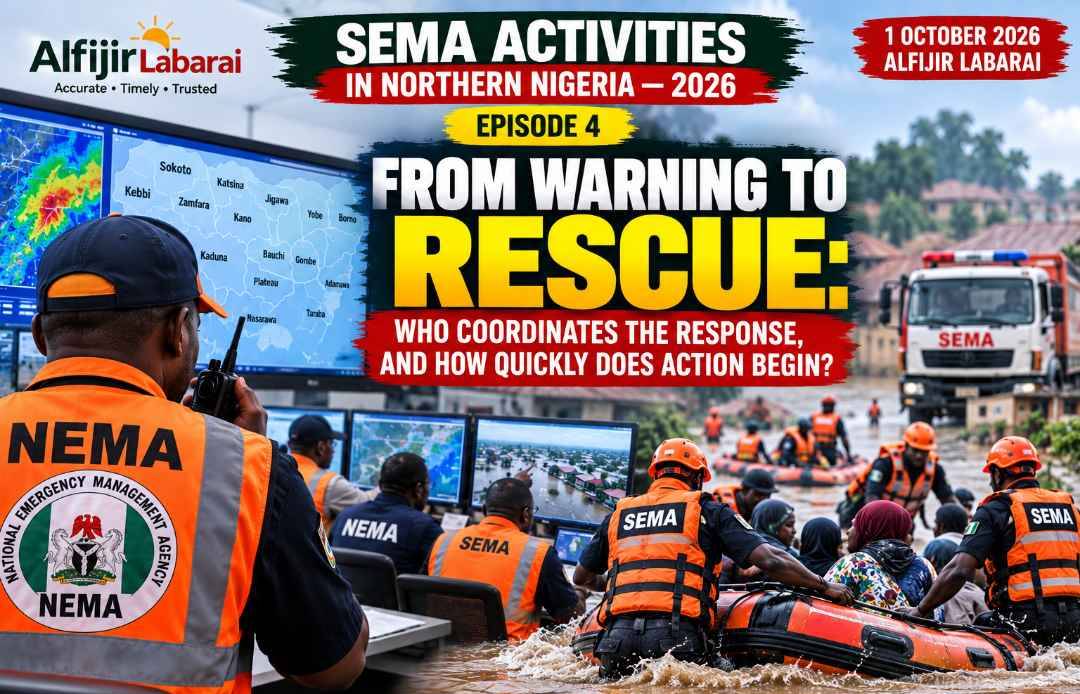
SEMA ACTIVITIES IN NORTHERN NIGERIA — 2026
EPISODE 4
FROM INFORMATION TO ACTION
After examining in Episode 3 whether states have the equipment, personnel, plans and preparedness measures required to respond to disasters, Alfijir Labarai is now moving to another critical question:
When a warning is received and a disaster occurs, who coordinates the response?
Who gathers and verifies information?
Who determines what resources are required?
Who deploys rescue teams?
And how quickly can a warning be converted into an actual rescue response?
These are the central questions of Episode 4.
FROM INFORMATION TO ACTION
In disaster management, receiving information is not the end of the process.
On 5 August 2026, the National Emergency Management Agency (NEMA) activated its National Emergency Operations Centre (NEOC) to strengthen the collection, processing and coordination of reliable information on the 2026 flood situation.
NEMA said the centre would serve as a central hub for monitoring developments, harmonising information from relevant sources and supporting timely decision-making and coordinated response during the flood season.
This raises an important question:
When information about a hazard is received, what happens next?
Does the information reach the relevant State Emergency Management Agency (SEMA) in time?
Is there a system for notifying Local Government Areas and communities at risk?
And when rescue is required, how is the response activated?
COMMAND AND INTER-AGENCY COORDINATION
Nigeria’s disaster-management framework provides for coordination among different levels of government and response agencies.
NEMA’s Search and Rescue Department is responsible for coordinating and facilitating search-and-rescue activities, coordinating the Agency’s Emergency Response Teams with those of other response stakeholders, mobilising critical resources and determining when additional response capacity may be required.
The National Disaster Response Plan provides a framework for systematic and coordinated Federal assistance during major disasters and identifies response activities including direction and control, early warning, evacuation and emergency services.
The National Disaster Management Framework also provides that response coordination involves NEMA, SEMA and LEMA within their respective areas of responsibility, with NEMA taking responsibility where a coordinated Federal response is required.
This leads to an important question for Alfijir Labarai:
WHEN A DISASTER OCCURS, IS IT CLEAR:
WHO COORDINATES THE RESPONSE?
WHO DEPLOYS THE RESCUE TEAMS?
WHO REQUESTS ADDITIONAL ASSISTANCE?
AND WHO COORDINATES THE AGENCIES THAT ARRIVE AT THE SCENE?
WHEN DISASTER STRIKES MULTIPLE LOCATIONS AT THE SAME TIME
A major challenge can arise when a disaster affects several locations simultaneously.
For example, if flooding affects several Local Government Areas, the question is not only whether boats, vehicles or rescue equipment are available.
It is also necessary to know:
Which location requires the most urgent assistance?
Where are the rescue teams?
What response capacity is currently available?
Where is additional equipment needed?
And how are resources prioritised for communities facing the greatest risk?
NEMA’s Search and Rescue responsibilities include identifying and mobilising critical resources and determining the level of disaster that may require additional response capacity.
This means that response is not simply about having equipment.
It is also about how quickly available resources are deployed, where they are deployed and whether they reach the people who need them.
WHEN STATE CAPACITY IS NOT ENOUGH
Nigeria’s disaster-response system provides for cooperation between different levels of government and agencies involved in emergency response.
The National Disaster Response Plan is designed to provide Federal assistance that can augment State and local efforts during major disasters.
NEMA has also emphasised the importance of collaboration with security agencies and other stakeholders in flood preparedness, evacuation and search-and-rescue operations. In July 2026, for example, NEMA highlighted the role of the Nigerian Army’s engineering assets, logistics capabilities, Disaster Response Units and personnel in supporting emergency operations.
This raises another question:
If the capacity of a SEMA is insufficient to handle a disaster, is there a clear mechanism for requesting additional assistance?
After assistance is requested:
How quickly does it arrive?
Who determines what additional resources are required?
And who coordinates their deployment to the affected location?
TIME: FROM REPORT TO RESCUE
At this stage, Alfijir Labarai wants to examine one issue that is often less discussed:
TIME.
It is not enough to say:
“Rescuers arrived and people were rescued.”
The questions are:
When was the incident reported?
When was the information verified?
When were the relevant authorities notified?
When was the rescue team deployed?
When did the team arrive at the scene?
And if there was a delay, what caused it?
Alfijir Labarai will not attribute blame to any agency for a delay without evidence.
What we are seeking are verifiable records.
If there is an established response-time standard, we want to understand it.
If no such standard is publicly available, we want the relevant authorities to explain how response speed is measured.
AN EXAMPLE FROM NEMA’S 2026 RESPONSE ACTIVITIES
An example of an emergency response mechanism being activated followed the collapse of a six-storey building under construction along Dr. Peter Odili Road in Port Harcourt, Rivers State, on 24 June 2026.
In a report published on 1 July 2026, NEMA said that after receiving reports of the incident, the Director General activated the Agency’s emergency response mechanism, leading to the deployment of emergency responders in collaboration with other relevant stakeholders and response agencies.
NEMA said its response team remained at the site and coordinated search-and-rescue operations with other emergency response agencies.
The example illustrates the type of response chain that Alfijir Labarai wants to examine:
REPORT → RESPONSE ACTIVATION → DEPLOYMENT → INTER-AGENCY COORDINATION → SEARCH AND RESCUE
For flooding, the chain may involve:
WARNING → RISK ASSESSMENT → PUBLIC ALERT → EVACUATION → SEARCH AND RESCUE → RELIEF
But the question remains:
HOW DOES THIS SYSTEM WORK IN NORTHERN NIGERIAN STATES WHEN AN ACTUAL DISASTER OCCURS?
DOES THE SYSTEM WORK IN PRACTICE?
A written plan is one thing.
Implementing it during an actual emergency is another.
Alfijir Labarai will therefore examine whether the arrangements contained in national disaster-management plans are reflected in actual response activities at state level.
We will ask:
Is there an Emergency Operations Centre or comparable coordination mechanism that is actually being used?
Is there a system for receiving emergency reports?
Can the location of an incident be identified quickly?
Are there established communication channels for the relevant agencies?
Is there a system for deploying equipment and personnel?
Is there a mechanism for requesting NEMA assistance when State capacity is insufficient?
Is there effective coordination among SEMA, Local Emergency Management structures, Fire Service, NSCDC, Police, FRSC, Red Cross and other response agencies?
And when a disaster exceeds the capacity of a state, is the next step clearly understood?
THE SYSTEM IS ALSO UNDER REVIEW
There is another development that deserves attention.
On 24 June 2026, NEMA announced that it had commenced a review of the National Disaster Management Framework and the National Disaster Response Plan.
The Agency said the review was necessary because of changing disaster risks, including increasingly severe floods, climate-related hazards, urban emergencies, transportation accidents, disease outbreaks and conflict-induced displacement.
NEMA said the review was intended to ensure that the national disaster-management architecture remains relevant, practical and responsive to emerging risks.
This creates another important question:
AS THE NATIONAL FRAMEWORK IS BEING REVIEWED, WHAT LESSONS FROM RECENT DISASTERS SHOULD BE USED TO IMPROVE RESPONSE AT STATE AND LOCAL LEVEL?
WE WILL NOT MAKE A JUDGMENT BEFORE THE EVIDENCE
This investigation is not about declaring that any particular SEMA has failed.
We will distinguish between:
WHAT THE SYSTEM PROVIDES
AND
WHAT IS ACTUALLY IMPLEMENTED.
Where evidence shows that a planned response has been properly implemented, we will report it.
Where a gap is identified, we will ask the relevant authority to explain the gap and what is being done to address it.
Where the available information is insufficient, we will not fill the gap with assumptions.
THE CENTRAL QUESTION OF EPISODE 4
IF A MAJOR DISASTER OCCURRED IN NORTHERN NIGERIA TODAY, FROM THE MOMENT THE INCIDENT IS REPORTED TO THE MOMENT RESCUE TEAMS ARRIVE:
WHO COORDINATES THE RESPONSE?
WHO DEPLOYS THE RESOURCES?
WHO BRINGS THE RELEVANT AGENCIES TOGETHER?
AND CAN THE SYSTEM TURN A WARNING INTO A RESCUE RESPONSE WITHIN THE TIME REQUIRED?
This is the question Alfijir Labarai will continue to seek answers to.
OUR INVESTIGATION CONTINUES
In the next episode, we will move to another important stage:
AFTER PEOPLE ARE RESCUED, WHAT HAPPENS NEXT?
We will examine emergency shelters, assistance to affected communities, relief distribution, identification and registration of affected persons, and how authorities can ensure that assistance reaches those it is intended for.
ALFIJIR LABARAI
SEMA ACTIVITIES IN NORTHERN NIGERIA — 2026
“We Investigate. We Ask Questions. We Report What We Find.”
Accurate • Timely • Trusted
SOURCES
National Emergency Management Agency (NEMA)
National Emergency Operations Centre for 2026 Flood Response — August 2026.
NEMA Search and Rescue.
National Disaster Response Plan.
National Disaster Management Framework.
NEMA — Search and Rescue Operations at Rivers Building Collapse Site — July 2026.
NEMA — Review of National Disaster Management Framework and Response Plan — June 2026.
CONNECT WITH ALFIJIR LABARAI
Stay connected with Alfijir Labarai / Alfijir News for the latest news, reports, investigations, programmes and important updates from Kano, Nigeria and around the world.
📞 CONTACT US
For enquiries, news tips, partnership, advertising, sponsorship and more information:
+234 803 207 7835
📰 Have a story, development or important information to share?
Send your news tips, press releases, announcements and community stories to Alfijir Labarai.
🤝 PARTNER WITH US
We welcome individuals, organisations, institutions and businesses interested in:
• Media Partnership
• Advertising
• Programme Sponsorship
• Corporate Partnerships
• Special Reports & Features
• Event & Programme Promotion
📞 Contact us:
+234 803 207 7835
🌐 FOLLOW ALFIJIR LABARAI
🐦 X (Twitter):
“Follow us on X” https://twitter.com/Musabestseller?s=09
📘 Facebook:
“Follow us on Facebook” https://www.facebook.com/profile.php?id=100089640289165
🧵 Threads:
“Follow us on Threads”https://www.threads.net/@alfijirlabarai
▶️ YouTube:
“Subscribe on YouTube” https://www.youtube.com/@BestsellerChannel12
📸 Instagram:
“Follow us on Instagram” https://www.instagram.com/musa_bestseller?utm_source=qr&r=nametag
📲 JOIN OUR WHATSAPP GROUP
Get our latest news updates, programmes, reports and important announcements directly on WhatsApp.
👇👇 Join the Alfijir Labarai / Alfijir News WhatsApp Group:
“Join our WhatsApp Group” https://chat.whatsapp.com/Ilj1iz8v3sa3nBfrCz9U6f?s=cl&p=a&mlu=4&ilr=4
ALFIJIR LABARAI MEDIA SERVICES
Accurate • Timely • Trusted
📰 News • Reports • Investigations • Programmes • Public Awareness
© 2026 Alfijir Labarai Media Services