
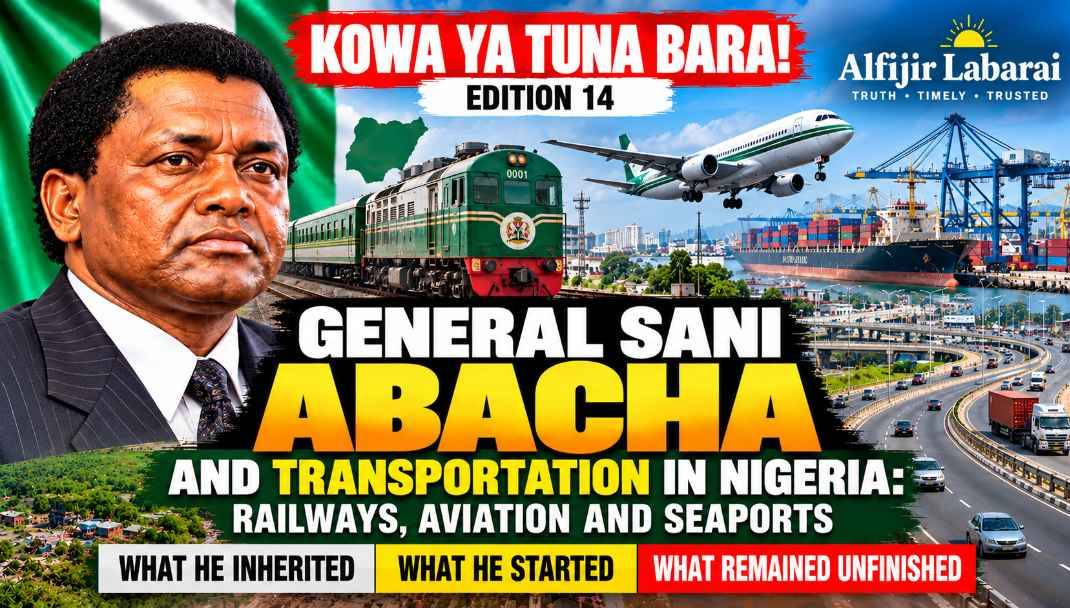
KOWA YA TUNA BARA!
EDITION 14
GENERAL SANI ABACHA AND TRANSPORTATION IN NIGERIA: RAILWAYS, AVIATION AND SEAPORTS — WHAT HE INHERITED, WHAT HE STARTED AND WHAT REMAINED UNFINISHED
We Investigate. We Examine. We Report What History and the Evidence Show.
Transportation is one of the foundations of any modern economy. It connects farmers to markets, industries to consumers, cities to communities, and facilitates the movement of people and goods.
When General Sani Abacha assumed power in November 1993, Nigeria had already inherited significant challenges in transportation, particularly in the railway system, aviation and seaport operations.
So, what did the Abacha administration inherit?
What did it begin?
And what remained unfinished?
These are the questions examined in this 14th edition of KOWA YA TUNA BARA!
TRANSPORT BUDGET: WHAT DO THE IMF FIGURES SHOW?
IMF data on the Federal Government’s budget show that allocations under Transport and Communications were projected as follows:
1993 — ₦2.021 billion
1994 — ₦1.516 billion
1995 — ₦3.592 billion
1996 — ₦9.817 billion
1997 — ₦3.203 billion
1998 — ₦9.965 billion
The combined figure for the six years was approximately ₦30.114 billion.
However, there is an important qualification: these were budgeted figures, not evidence that all the money was actually spent. The IMF distinguishes budgetary allocations from actual expenditure. [IMF — Nigeria Statistical Appendix](https://www.elibrary.imf.org/view/journals/002/2000/006/article-A001-en.xml?utm_source=chatgpt.com)
Also, 1993 included the period before Abacha assumed power, while 1998 included the period after his death in June. Therefore, these figures should not all be attributed directly to the Abacha administration.
RAILWAYS: AN ATTEMPT TO REVIVE THE NIGERIAN RAILWAY
One of the major transportation problems inherited by the Abacha administration was the deteriorating condition of the Nigerian Railway Corporation.
The railway system had suffered from ageing locomotives and rolling stock, inadequate funding, deteriorating tracks and declining passenger and freight operations.
In 1995, the Abacha administration entered into a major railway rehabilitation initiative with the China Civil Engineering Construction Corporation (CCECC).
Historical reports indicate that the contract was signed on 9 December 1995, with a reported value of approximately US$528.6 million. The project involved rehabilitation of railway lines and the provision of coaches, locomotives, wagons and guard vans. [BusinessDay — Nigeria-China relations and the railway contract](https://businessday.ng/analysis/article/how-tidy-is-nigeria-china-relations-1/?utm_source=chatgpt.com)
The initiative represented a major attempt to restore rail transportation at a time when road transport had already taken a dominant position in the movement of people and goods.
WAS THE PROJECT COMPLETED?
This is where the distinction between launching a major project and completing it becomes important.
The CCECC project was not completed by the original deadline.
BusinessDay reported that the project faced delays, including problems involving the supply of some railway materials. However, the report also indicated that more than 80 percent of the work was estimated to have been completed by September 1998. [BusinessDay report](https://businessday.ng/analysis/article/how-tidy-is-nigeria-china-relations-1/?utm_source=chatgpt.com)
Therefore, it would be inaccurate to say that the railway system was completely revived under Abacha.
At the same time, it would also be inaccurate to suggest that nothing was achieved.
The evidence supports a more measured conclusion:
A major railway rehabilitation programme was launched, a substantial portion of the work was undertaken, but the project did not reach full completion within the planned period.
Historical information from the Bureau of Public Enterprises also shows that the NRC continued to face serious structural problems, including inadequate funding, ageing equipment and weak freight operations.
This indicates that the 1995 CCECC contract, while significant, was not enough by itself to completely transform Nigeria’s railway system. [Bureau of Public Enterprises — Nigerian Railway Corporation](https://www.bpe.gov.ng/nigerian-railway-corporation/?utm_source=chatgpt.com)
AVIATION: REORGANISING THE SECTOR
The Abacha administration also introduced a significant institutional restructuring of Nigeria’s aviation sector.
Towards the end of 1995, the government reorganised several aviation institutions.
According to the official history of the NCAA, the Federal Civil Aviation Authority (FCAA) was scrapped, while new directorates responsible for safety regulation and economic regulation were established within the Federal Ministry of Aviation.
The Air Traffic Services and Aerotels Department were also merged with the former Nigerian Airports Authority to form the Federal Airports Authority of Nigeria (FAAN). [NCAA — History of NCAA](https://www.ncaa.gov.ng/about/history-of-ncaa/?utm_source=chatgpt.com)
FAAN’s official history confirms that the Civil Aviation reform of August 1995 resulted in the restructuring of the former Nigerian Airports Authority and its emergence as FAAN. [FAAN — Our History](https://faan.gov.ng/our-history/?utm_source=chatgpt.com)
The Federal Airports Authority of Nigeria Act 1996 subsequently provided the statutory framework for the authority.
This institutional restructuring remains one of the important developments in Nigeria’s aviation history from that period. [Federal Airports Authority of Nigeria Act](https://placng.org/lawsofnigeria/print.php?sn=164&utm_source=chatgpt.com)
BUT AVIATION SAFETY CHALLENGES CONTINUED
The institutional reforms should not be confused with a complete solution to Nigeria’s aviation problems.
Some of the aviation safety challenges had begun before Abacha came to power.
The United States suspended direct flights between Lagos and the United States on 11 August 1993 because Murtala Muhammed International Airport did not meet relevant FAA security standards.
The airport did not regain the relevant certification until December 1999, after the Abacha era. [U.S. State Department — Nigeria Background Information](https://2009-2017.state.gov/outofdate/bgn/nigeria/61887.htm?utm_source=chatgpt.com)
Therefore, it would be inaccurate to claim that the Abacha administration completely resolved Nigeria’s international aviation safety challenges.
What can be established is that the administration restructured the institutional framework of civil aviation, while some major operational and safety challenges continued beyond 1998.
NIGERIA AIRWAYS AND THE CHALLENGE OF THE NATIONAL CARRIER
At the same time, Nigeria Airways was facing serious financial and management challenges.
This demonstrates that restructuring airport institutions alone could not solve all the problems within Nigeria’s aviation sector.
The national airline’s performance depended on several interconnected issues, including finance, fleet management, safety, operational capacity and international regulatory requirements.
Nigeria Airways therefore remained part of the wider aviation challenges confronting the country during the period.
SEAPORTS: AN ATTEMPT TO IMPROVE OPERATIONS
Transportation was not limited to rail and aviation.
The 1996 Budget of Consolidation also addressed the operation of Nigerian ports.
The budget document included measures described as “Streamlining Operations at the Nigerian Ports” as well as Pre-shipment Inspection. [National Library of Nigeria — 1996 Budget of Consolidation](https://nigeriareposit.nln.gov.ng/items/f6094ffb-0e0a-48b9-90f5-7ae16691e707?utm_source=chatgpt.com)
These measures reflected the government’s recognition of the importance of ports to Nigeria’s import and export system.
The reforms were aimed at improving the movement and processing of goods while addressing some of the congestion and administrative problems affecting port operations.
WHAT DOES OUR INVESTIGATION SHOW?
After examining the available evidence, KOWA YA TUNA BARA! identifies three important conclusions.
First: the Abacha administration inherited a transportation system facing serious structural problems, particularly in railways and parts of the aviation sector.
Second: the administration launched several major reform and rehabilitation initiatives, particularly the CCECC railway project, the restructuring of civil aviation and the establishment of FAAN, as well as measures aimed at improving port operations.
Third: not all of these initiatives were fully completed or capable of resolving the underlying problems before the end of the administration.
So, if the question is:
Did the Abacha administration completely revive Nigeria’s transportation system?
No.
But if the question is:
Did the administration initiate significant transportation reforms and rehabilitation programmes?
Yes.
That distinction is important when examining the history of the administration through evidence rather than through praise or criticism alone.
CONCLUSION
The history of transportation during the General Sani Abacha era is neither simply a story of success nor a story of failure.
It is the story of an administration that inherited major transportation challenges, initiated significant projects and institutional reforms, achieved progress in some areas, but left some projects incomplete and some major problems unresolved.
In Railways, a major rehabilitation programme was launched with CCECC, but the entire programme was not completed as originally planned.
In Aviation, a significant institutional restructuring created FAAN and changed the framework for managing civil aviation.
In Seaports, the government introduced measures aimed at streamlining operations and improving the import and export process.
That is what the evidence shows.
We are not saying everything worked.
We are not saying everything failed.
We examined what was inherited, what was started, and what remained unfinished.
KOWA YA TUNA BARA!
ALFIJIR LABARAI
Truth • Timely • Trusted
📢 FOLLOW ALFIJIR LABARAI
Stay connected with Alfijir Labarai / Alfijir News for credible news, reports, investigative journalism, and important updates from Kano, Nigeria, and around the world.
📩 CONTACT US & PARTNERSHIP ENQUIRIES
Call/WhatsApp: +234 803 207 7835
🌐 OUR SOCIAL MEDIA PLATFORMS
X: https://twitter.com/Musabestseller?s=09
Facebook: https://www.facebook.com/profile.php?id=100089640289165
Threads: https://www.threads.net/@alfijirlabarai
YouTube: https://www.youtube.com/@BestsellerChannel12
Instagram: https://www.instagram.com/musa_bestseller?utm_source=qr&r=nametag
📲 JOIN OUR WHATSAPP GROUP
https://chat.whatsapp.com/Ilj1iz8v3sa3nBfrCz9U6f
ALFIJIR LABARAI MEDIA SERVICES
Truth • Timeliness • Trust
© 2026 Alfijir Labarai Media Services