
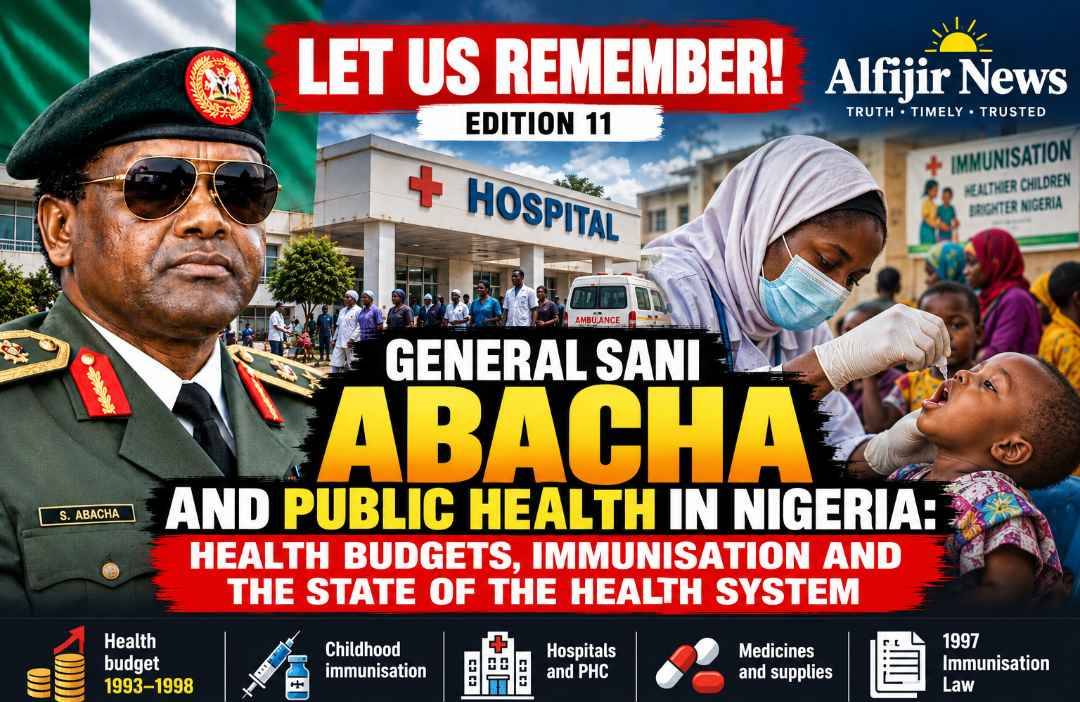
LET US REMEMBER!
EDITION 11
By Alfijir News
Nigeria’s public healthcare system remains a major subject of national discussion, particularly when examining the policies, public spending and development priorities of past administrations. In this eleventh edition of “Let Us Remember!”, Alfijir News examines public health during the administration of General Sani Abacha, from 1993 to 1998, focusing on federal health budgets, childhood immunisation and the challenges confronting the healthcare system.
The central question is not simply how much money was allocated to health, but what the available historical records tell us about public health priorities and the condition of healthcare services during that period.
FEDERAL HEALTH BUDGETS: WHAT DO THE FIGURES SHOW?
Figures published in Nigeria’s statistical records provide the following planned federal health expenditure amounts for the years under review:
– 1993: ₦2.568 billion
– 1994: ₦2.843 billion
– 1995: ₦4.633 billion
– 1996: ₦4.835 billion
– 1997: ₦6.718 billion
– 1998: ₦13.641 billion
The figures indicate an increase in the planned federal health budget over the period, particularly in 1998.
The 1998 figures included approximately ₦5.334 billion in recurrent expenditure and ₦8.307 billion in capital expenditure.
However, these figures must be interpreted carefully. Budgeted expenditure is not the same as money actually released or spent. Nor does an increase in a budget automatically demonstrate that hospitals improved, medical supplies became more accessible or more Nigerians received quality healthcare.
There is also an important historical qualification: General Abacha died in June 1998. Therefore, the full-year 1998 budget figure covers a period extending beyond his death and should not be attributed entirely to his administration’s activities.
IMMUNISATION: A MAJOR PUBLIC HEALTH CHALLENGE
Childhood immunisation is one of the most important indicators used to assess a country’s public health system. Vaccination protects children against preventable diseases and depends on reliable funding, vaccine availability, functioning cold-chain equipment, effective coordination and public participation.
A World Bank assessment of Nigeria’s health system identified serious weaknesses affecting immunisation, including funding difficulties, vaccine shortages, inadequate coordination, challenges with community mobilisation and problems involving cold-chain equipment.
These challenges illustrate that public health performance depends on more than government announcements or budgetary allocations. Effective implementation, distribution systems and access to services are equally important.
The 1999 Nigeria Demographic and Health Survey reported that 17 per cent of children aged 12–23 months had received all recommended vaccinations, compared with 30 per cent in 1990.
The figures raise important questions about the country’s immunisation performance over the period. Nevertheless, the 1999 survey was conducted after Abacha’s death, and its findings alone cannot establish that his administration was solely responsible for the decline. Public health outcomes can reflect long-term institutional problems, earlier policies, funding conditions and developments under successive governments.
THE 1997 IMMUNISATION LAW
Another important development was the enactment of the National Programme on Immunisation Act, 1997, No. 12.
The legislation provided a statutory framework for Nigeria’s immunisation programme. It is a relevant part of the historical record when examining the institutional and legal arrangements for protecting children against vaccine-preventable diseases.
However, the existence of legislation does not, by itself, prove that implementation was effective nationwide. Assessing its impact requires further evidence on funding, vaccine availability, service coverage and the performance of the institutions responsible for carrying out the programme.
It is also important to clarify that Nigeria’s National Primary Health Care Development Agency existed before the Abacha administration. It would therefore be inaccurate to claim that his government established the agency without supporting historical evidence.
HOSPITALS AND PRIMARY HEALTHCARE: WHAT CAN BE VERIFIED?
Hospitals, primary healthcare centres, trained health workers, essential medicines and reliable medical equipment are central to an effective healthcare system.
Yet a responsible historical assessment must distinguish between projects announced, projects funded, facilities under construction and projects actually completed and put into service.
The records examined for this report do not provide sufficient primary evidence to establish a comprehensive list of hospitals or primary healthcare centres initiated or completed specifically between 1993 and 1998, together with their costs, completion dates and operational status.
Alfijir News therefore does not present an unverified list of facilities or attribute projects to the administration without adequate documentary support.
Further examination of federal and state budgets, project records, ministry reports and hospital commissioning documents would be necessary to establish a fuller picture of infrastructure development during the period.
WHAT DOES THE HISTORICAL RECORD TELL US?
The available evidence presents a mixed picture.
Federal health budget figures show increases in planned expenditure over the years examined, while the historical health-system assessments point to significant weaknesses in immunisation funding, vaccine supply, coordination and service delivery.
The 1997 immunisation legislation also demonstrates that a formal legal framework was being established. However, the evidence presented here does not, on its own, establish the overall quality of healthcare services, the number of facilities successfully delivered or the extent to which increased budget allocations translated into improved health outcomes.
A fair assessment must consider both policy decisions and measurable results.
CONCLUSION: BEYOND BUDGET FIGURES
The history of public healthcare under General Sani Abacha should be examined through verifiable records rather than nostalgia, political arguments or unsupported claims.
The key questions remain: How much money was budgeted and actually released? Which projects were completed? Were medicines and vaccines consistently available? Did immunisation coverage improve? And how effectively did healthcare facilities serve ordinary Nigerians?
These questions require documentary evidence and careful comparison of health outcomes across different administrations.
For Alfijir News, remembering the past is not about praising or condemning a government without evidence. It is about examining the historical record, identifying what can be established and recognising what still requires further investigation.
“LET US REMEMBER!” — because history deserves evidence, not assumptions.
SOURCES
1. International Monetary Fund (IMF), Nigeria: Statistical Appendix
https://www.elibrary.imf.org/view/journals/002/2000/006/article-A001-en.xml
2. World Bank, Nigeria Health-System Assessment
https://documents1.worldbank.org/curated/en/199231468288984855/pdf/341770v20NG.pdf
3. National Programme on Immunisation Act, 1997, No. 12
https://placng.org/lawsofnigeria/view2.php?sn=333
4. National Library of Nigeria, Abacha’s 1996 Budget Address
https://nigeriareposit.nln.gov.ng/items/f6094ffb-0e0a-48b9-90f5-7ae16691e707
📢 FOLLOW ALFIJIR LABARAI
Stay connected with Alfijir Labarai / Alfijir News for credible news, reports, investigative journalism, and important updates from Kano, Nigeria, and around the world.
📩 CONTACT US & PARTNERSHIP ENQUIRIES
Call/WhatsApp: +234 803 207 7835
🌐 OUR SOCIAL MEDIA PLATFORMS
X: https://twitter.com/Musabestseller?s=09
Facebook: https://www.facebook.com/profile.php?id=100089640289165
Threads: https://www.threads.net/@alfijirlabarai
YouTube: https://www.youtube.com/@BestsellerChannel12
Instagram: https://www.instagram.com/musa_bestseller?utm_source=qr&r=nametag
📲 JOIN OUR WHATSAPP GROUP
https://chat.whatsapp.com/Ilj1iz8v3sa3nBfrCz9U6f
ALFIJIR LABARAI MEDIA SERVICES
Truth • Timeliness • Trust
© 2026 Alfijir Labarai Media Services