
KOWA YA TUNA BARA!
EDITION 15
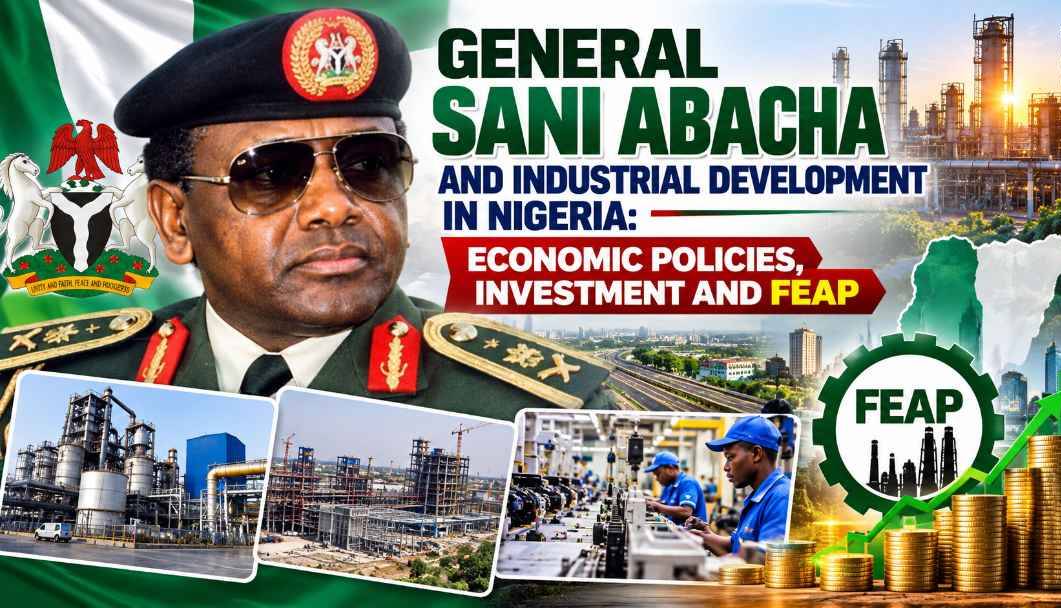
GENERAL SANI ABACHA AND INDUSTRIAL DEVELOPMENT IN NIGERIA: ECONOMIC POLICIES, INVESTMENT AND FEAP — WHAT WAS STARTED, WHAT WAS ACHIEVED, AND WHAT REMAINED UNFINISHED?
We Investigate. We Examine. We Report What History and the Evidence Show.
Industries are among the foundations of a country’s economy. A strong industrial sector can create employment, reduce dependence on imported goods, add value to local resources and broaden the country’s economic base.
When General Sani Abacha assumed power in November 1993, Nigeria was already facing serious industrial challenges, including limited access to capital, inadequate electricity supply, high production costs, dependence on imported inputs and difficulties within government-owned enterprises.
However, the Abacha administration also introduced a number of economic policies and programmes aimed at changing the country’s economic direction.
The question is:
Did these policies revive Nigeria’s industrial sector?
Or did some of them remain major initiatives whose full impact could not be achieved before the end of the administration?
FROM ECONOMIC CONTROLS TO “GUIDED DEREGULATION”
At the beginning of the Abacha administration, economic policy involved significant government intervention in several areas.
By 1995, however, the government moved towards what it described as “guided deregulation” — a system that relaxed some restrictions while retaining government oversight.
The government restructured the foreign exchange market through the Autonomous Foreign Exchange Market (AFEM) and relaxed some restrictions affecting foreign investors.
Some tariffs and import restrictions were also reviewed.
This shows that the economic policy of the Abacha administration was not static between 1993 and 1998. It changed in response to prevailing economic conditions.
The important point is that these were policy measures. Their existence alone does not prove that they produced the intended economic results.
NIPC: AN ATTEMPT TO ATTRACT INVESTMENT
In 1995, the government established the Nigerian Investment Promotion Commission (NIPC).
This represented an important change in Nigeria’s investment framework.
The new system relaxed some restrictions previously placed on foreign investors.
In many non-petroleum sectors, foreign investors were allowed to own up to 100 percent of a business, except in areas specifically excluded by the regulations.
The objective was to attract investment, technology and expertise into Nigeria.
However, there is an important distinction between creating a framework designed to attract investment and demonstrating that the framework actually generated substantial investment.
Therefore, the establishment of NIPC should be viewed as an important policy reform rather than automatic evidence of a major investment boom.
INDUSTRIES: WAS THERE A REAL INDUSTRIAL REVIVAL?
This is where the 1998 WTO assessment becomes particularly important.
The WTO reported that Nigeria’s manufacturing sector continued to face significant difficulties.
According to the figures presented in the report, manufacturing growth declined from 1.02 percent in 1996 to 0.72 percent in 1997.
The report also identified several problems affecting major government industrial projects, including:
– construction delays;
– budget overruns;
– low capacity utilisation;
– high production costs;
– inadequate working capital; and
– closure of some industrial plants.
These findings are important.
If the question is whether the Abacha administration achieved a complete industrial revival, the available evidence does not support such a conclusion.
BUT NOT ALL INDUSTRIES PERFORMED THE SAME WAY
The available evidence also shows that the situation was not identical across all industrial sectors.
The WTO reported that industries such as food, beverages and textiles benefited from aspects of trade liberalisation and reduced government intervention.
This means that the impact of the economic reforms varied across sectors.
Some industries gained opportunities from the changing policy environment.
Others continued to struggle with structural problems.
Therefore, it would be inaccurate to describe the entire industrial sector as either a complete success or a complete failure during the period.
The evidence presents a more complex picture.
FEAP: AN ATTEMPT TO STRENGTHEN SMALL-SCALE INDUSTRIES
One of the programmes that attracted significant attention towards the end of the Abacha administration was the Family Economic Advancement Programme (FEAP).
FEAP was established on 12 August 1997 through Decree No. 11 of 1997.
The programme was designed to support the production of goods and services within Nigeria, particularly through cottage and small-scale industries.
Its objectives included:
– providing working capital for small-scale agricultural production and processing;
– providing equipment and machinery for Nigerians;
– encouraging local production of machinery and equipment;
– creating employment opportunities at the local level;
– strengthening cooperative societies; and
– promoting the use of local resources for production.
The programme therefore represented an attempt to move beyond large government-owned industries and support smaller producers, entrepreneurs and community-based economic activities.
However, there is an important limitation.
FEAP was launched in 1997, only about a year before the end of the Abacha administration.
Therefore, it would be difficult to claim that the programme produced a comprehensive transformation of Nigeria’s industrial sector or employment system within such a short period.
What can be established is that:
FEAP was created as a major programme intended to strengthen small-scale industries and household-level economic activity, but the period available for implementation before the end of the administration was relatively short.
PRIVATISATION AND COMMERCIALISATION
Another major element of the economic policy of the period was privatisation and commercialisation.
The 1996 Budget of Consolidation included privatisation and commercialisation among the government’s economic policy priorities.
The government also addressed the role of the organised private sector and broader economic reforms.
By 1998, the government had introduced what it described as a “Guided Privatization and Commercialization Policy.”
The objective was to reduce the financial burden placed on government by some public enterprises and encourage enterprises to operate more commercially.
However, there is again an important distinction between announcing a privatisation policy and completing the privatisation process.
Therefore, the existence of the policy should not automatically be presented as proof that all the intended reforms were completed.
THE BIG QUESTION: WHY DID INDUSTRY NOT FULLY RECOVER?
The evidence suggests that several structural problems continued to constrain industrial development.
Electricity
Unreliable electricity increased the cost of production and made it difficult for manufacturers to operate efficiently.
Working Capital
Some industries faced difficulties obtaining sufficient funds to maintain production and expand their operations.
Cost of Inputs
Dependence on imported machinery and some imported production inputs increased the cost of manufacturing.
Low Capacity Utilisation
Some industrial plants were unable to operate at their full productive capacity.
Problems within Government-Owned Enterprises
Several major government industrial projects experienced delays, cost overruns and management problems.
These challenges demonstrate that economic policy announcements alone were not enough to create a strong industrial base.
A successful industrial sector also requires reliable infrastructure, affordable finance, stable energy supply, efficient institutions and a predictable business environment.
OIL REMAINED THE DOMINANT FOUNDATION OF THE ECONOMY
Another important finding from our investigation is that, despite attempts at economic diversification, Nigeria remained heavily dependent on crude oil.
The WTO reported in 1998 that crude oil accounted for more than 95 percent of Nigeria’s export receipts and more than three-quarters of government revenue.
This indicates that Nigeria had not achieved a fundamental shift from oil dependence to a broadly diversified industrial economy by the end of the Abacha era.
There was therefore a significant gap between the policy objective of diversification and the actual structure of the economy.
WHAT DOES OUR INVESTIGATION SHOW?
After examining the available policies and evidence, KOWA YA TUNA BARA! identifies four major findings.
First: the Abacha administration changed aspects of Nigeria’s economic policy, moving from stronger controls towards what it called “guided deregulation.”
Second: NIPC was established to facilitate investment and attract investors from within and outside Nigeria.
Third: FEAP was launched in 1997 to support small-scale industries, cooperatives, local production and employment creation.
Fourth: despite these initiatives, the available evidence from the late 1990s does not show a complete industrial revival, nor a significant reduction in Nigeria’s dependence on crude oil.
CONCLUSION
The history of industrial development during the General Sani Abacha era is neither an entirely successful story nor an entirely failed one.
The administration introduced important policies.
It opened new channels for investment.
It established NIPC.
It launched FEAP to support small-scale industries.
It also began implementing privatisation and commercialisation policies.
At the same time, Nigerian industries continued to face serious structural challenges, and the available manufacturing data do not demonstrate a major industrial transformation that can be attributed entirely to these policies.
Nigeria’s dependence on crude oil also remained very high.
Therefore, if the question is:
Did the Abacha administration introduce important policies that were intended to support industrial development?
Yes.
But if the question is:
Did it achieve a complete industrial revival before the end of the administration?
The available evidence does not support that claim.
We are not saying everything worked.
We are not saying everything failed.
We examined what was started, what was achieved, and what remained unfinished.
📢 FOLLOW ALFIJIR LABARAI
Stay connected with Alfijir Labarai / Alfijir News for credible news, reports, investigative journalism, and important updates from Kano, Nigeria, and around the world.
📩 CONTACT US & PARTNERSHIP ENQUIRIES
Call/WhatsApp: +234 803 207 7835
🌐 OUR SOCIAL MEDIA PLATFORMS
X: https://twitter.com/Musabestseller?s=09
Facebook: https://www.facebook.com/profile.php?id=100089640289165
Threads: https://www.threads.net/@alfijirlabarai
YouTube: https://www.youtube.com/@BestsellerChannel12
Instagram: https://www.instagram.com/musa_bestseller?utm_source=qr&r=nametag
📲 JOIN OUR WHATSAPP GROUP
https://chat.whatsapp.com/Ilj1iz8v3sa3nBfrCz9U6f
ALFIJIR LABARAI MEDIA SERVICES
Truth • Timeliness • Trust
© 2026 Alfijir Labarai Media Services