
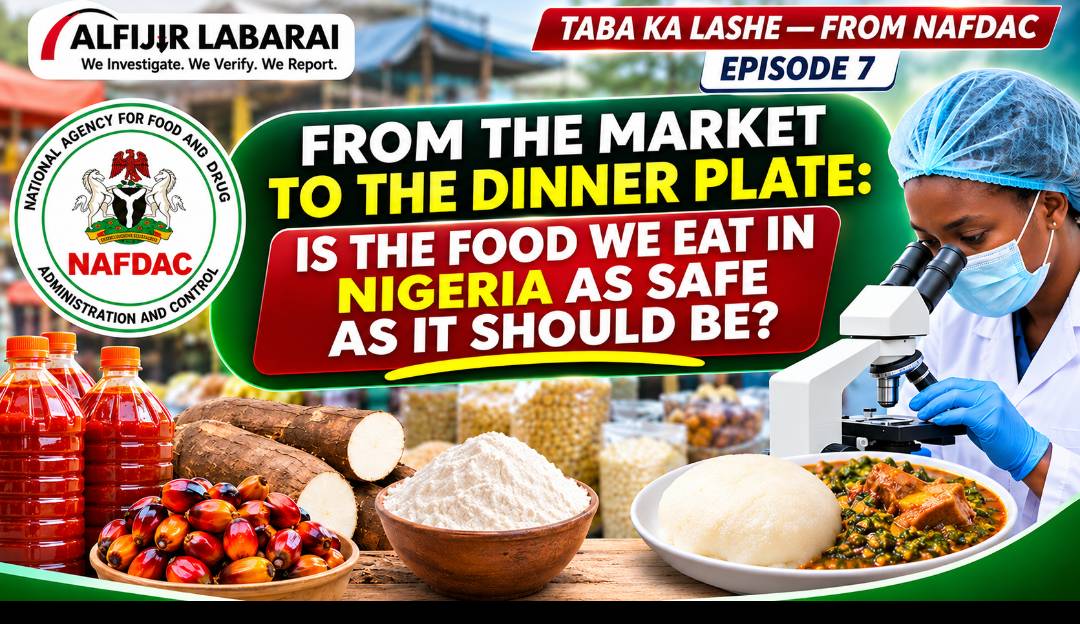
TABA KA LASHE — FROM NAFDAC | EPISODE 7
ALFIJIR LABARAI | 4 NOVEMBER 2026
Special Investigation
Food is one of the basic necessities of human life. Across Nigeria, millions of people purchase food from open markets, shops, small-scale food-processing businesses and other commercial outlets.
But an important question deserves public attention: Can Nigerians be confident that the food they buy and consume every day meets the required safety and quality standards?
This question has become increasingly important following concerns raised by the National Agency for Food and Drug Administration and Control (NAFDAC) about reports of possible food contamination, particularly allegations involving the adulteration of red palm oil with unsuitable substances and the use of potentially harmful chemicals in the processing of fufu and other traditional foods.
1. What NAFDAC Has Said
On 7 September 2026, NAFDAC Director-General, Professor Mojisola Adeyeye, addressed public complaints concerning products suspected to be counterfeit or substandard.
According to a report by TheCable, the agency disclosed that it received 225 complaints in August 2026 concerning products suspected to be counterfeit or of poor quality.
The agency also expressed concern about allegations that red palm oil was being mixed with Azo dyes and other contaminants. It further referred to reports of bleach and other chemicals allegedly being used in the processing of fufu and other traditional foods.
However, it is important to emphasise that these are concerns and allegations reported by the agency. They do not establish that all red palm oil or fufu sold in Nigerian markets is contaminated.
Determining whether a particular food product poses a health risk requires appropriate scientific testing and reliable laboratory findings.
2. NAFDAC Removes 7,210 Products from the Market
On 7 September 2026, NAFDAC announced that it had removed 7,210 products found not to meet the required quality standards from the market following surveillance activities conducted between May and July 2026.
The agency said its officials inspected 6,233 locations across Nigeria’s 36 states and the Federal Capital Territory, Abuja.
Food and water products accounted for 3,633 of the products removed, reportedly identified across 1,808 locations.
These figures indicate that the agency is conducting market surveillance. However, they also raise important questions: What specific products were removed? Where were they discovered? What action was taken against those responsible for processing or distributing them? And how does the agency ensure that such products do not re-enter the market?
The number of products removed is an important indicator, but enforcement should not be measured by seizures alone. Investigation outcomes, corrective action and measures to prevent repeated violations also matter.
3. Who Is Responsible for Monitoring Food Sold in Open Markets?
One important issue raised by NAFDAC concerns its direct monitoring of certain traditional food products that do not carry formal manufacturers’ labels and are processed or sold through informal channels in open markets.
The agency has also highlighted the need for state and local government authorities to play their roles in monitoring such products.
This raises a critical question: If food sold in a market is suspected of containing substances that could endanger public health, which authority is responsible for collecting samples for testing, tracing the source of production and taking appropriate enforcement action?
How effective is cooperation between federal, state and local authorities in preventing the sale of contaminated food?
It would be inaccurate to conclude that no public authority has responsibility for these products. What is needed is clearer information about the division of responsibilities and how those responsibilities are implemented in practice.
4. Food Hygiene Regulations 2025: What Do They Provide?
The NAFDAC Food Hygiene Regulations 2025 are among the important regulatory instruments governing food hygiene in Nigeria.
The regulations provide requirements concerning food-processing premises, personal hygiene among food handlers, access to clean water, equipment, food storage, temperature control, prevention of contamination, transportation and food sampling.
They also provide for complaint-handling procedures, product investigations and the withdrawal of products found not to meet applicable standards.
This shows that regulatory requirements exist to protect consumers. However, an important question remains: How effectively are these requirements enforced, particularly among small-scale food processors and traditional market operators?
Are there sufficient inspection officers and laboratory facilities? Are inspections conducted regularly? And what action is taken when violations are established?
5. Social Media Claims: Is Everything Circulating Online True?
Another important concern is the circulation of information on social media claiming that certain food products are counterfeit or dangerous.
On 23 October 2026, Africa Check published a fact-check examining a list of products circulating online and being attributed to NAFDAC as counterfeit products.
The fact-check reported that NAFDAC denied issuing the list and warned the public against treating it as an official agency notice.
This illustrates why not every claim circulating about food products should be accepted as reliable information.
A product should not be labelled counterfeit or dangerous simply because its name appears on an unauthenticated list.
Consumers should seek verified information from NAFDAC, particularly official product recalls and notices identifying specific products or batch numbers.
6. What Should Consumers Do?
Consumers also have a role to play in protecting their health and the wider community.
They should:
– Purchase food from outlets where hygiene is properly maintained.
– Pay attention to how food is processed and stored.
– Avoid products showing signs of spoilage.
– Seek verified information from relevant authorities when concerns arise about a food product.
– Report suspicious products to the appropriate regulatory authorities.
– Avoid circulating unverified warnings and product lists.
Consumers should also understand that the safety of red palm oil cannot be established simply by looking at its colour. Appropriate testing is required.
7. Questions Raised by This Investigation
Alfijir Labarai’s investigation identifies several important questions that deserve answers from the relevant authorities:
1. What procedures are used to assess the safety and quality of red palm oil, fufu and other traditional foods sold in open markets?
2. Which authorities are responsible for collecting samples of these foods for laboratory testing?
3. How does NAFDAC collaborate with state and local government authorities to monitor food safety?
4. How are the Food Hygiene Regulations 2025 enforced in food-processing facilities and markets?
5. What action is taken when a food processor is found to have used prohibited or unsuitable substances?
6. How are products removed from the market monitored to ensure that they do not return to circulation?
7. Are there sufficient food-testing laboratories and qualified personnel to conduct investigations across Nigeria’s states?
8. What official channels can consumers use to report food products they suspect are unsafe or substandard?
Conclusion
Food safety is not merely a commercial issue. It is a public health concern involving the protection of lives and consumer confidence.
A food product cannot be declared dangerous simply because an allegation has circulated on social media. Equally, a product cannot be assumed to be safe merely because it is widely sold in the market.
What is required is scientific testing, effective surveillance, enforcement of regulations, public awareness and cooperation among relevant authorities.
Ultimately, one important question remains:
Does Nigeria’s food safety monitoring system effectively cover every stage of the food supply chain, from processing and distribution to the consumer’s dinner plate?
📢 FOLLOW ALFIJIR LABARAI
Stay connected with Alfijir Labarai / Alfijir News for credible news, reports, investigative journalism, and important updates from Kano, Nigeria, and around the world.
📩 CONTACT US & PARTNERSHIP ENQUIRIES
Call/WhatsApp: +234 701 1 11 3809
+234 803 207 7835
🌐 OUR SOCIAL MEDIA PLATFORMS
X: https://twitter.com/Musabestseller?s=09
Facebook: https://www.facebook.com/profile.php?id=100089640289165
Threads: https://www.threads.net/@alfijirlabarai
YouTube: https://www.youtube.com/@BestsellerChannel12
Instagram: https://www.instagram.com/musa_bestseller?utm_source=qr&r=nametag
📲 JOIN OUR WHATSAPP GROUP
https://chat.whatsapp.com/Ilj1iz8v3sa3nBfrCz9U6f
ALFIJIR LABARAI MEDIA SERVICES
Truth • Timeliness • Trust
© 2026 Alfijir Labarai Media Services