
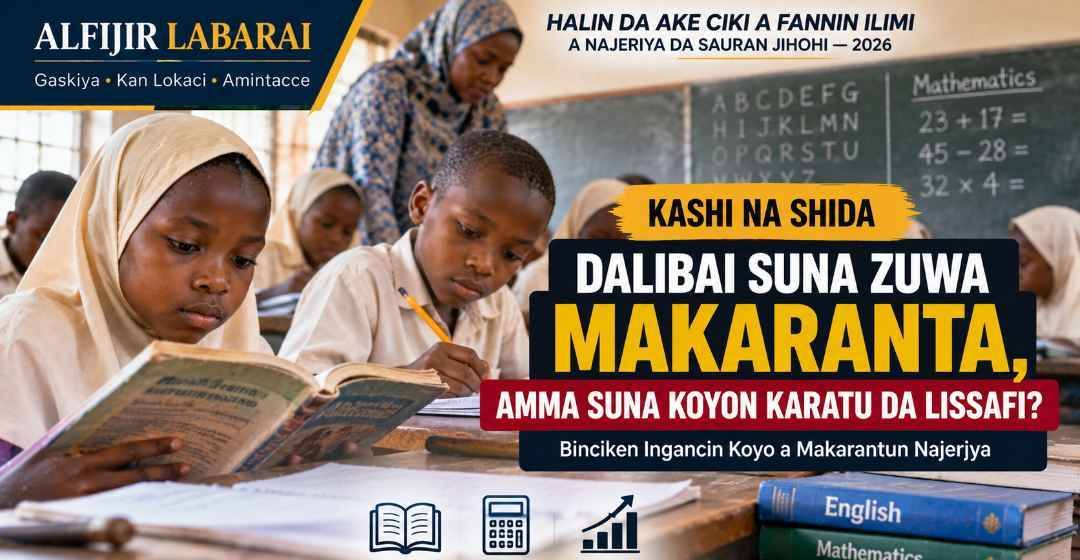
THE STATE OF EDUCATION IN NIGERIA AND THE STATES — 2026
INTRODUCTION
Enrolling a child in school does not automatically mean that the child is receiving the education they need. The fundamental purpose of schooling is to equip learners with the ability to read, understand what they read, write, and apply mathematical skills to everyday problems.
This raises an important question: As efforts continue to expand school enrolment, recruit teachers and provide classrooms, are Nigerian children acquiring the knowledge and skills expected at their respective levels of education?
A nationwide assessment conducted by the Universal Basic Education Commission (UBEC) in collaboration with UNICEF found significant gaps in pupils’ proficiency in mathematics and English.
The assessment, known as the National Assessment of Learning Achievement in Basic Education (NALABE 2022), was conducted in October 2022, while its report was published in December 2025. Therefore, the figures presented in this report reflect learning outcomes measured in 2022, not a new assessment conducted in 2026.
HOW THE ASSESSMENT WAS CONDUCTED
The NALABE assessment covered learners at three levels of basic education:
– Primary 3: 75,067 pupils from 2,529 schools.
– Primary 5: 71,041 pupils from 2,373 schools.
– Junior Secondary 2 (JS2): 23,564 learners from 788 schools.
The assessment covered Nigeria’s 36 states and the Federal Capital Territory, Abuja. Learners were assessed in mathematics and English. Primary 5 and JS2 learners were also assessed in Basic Science and Technology and Social Studies.
The assessment provides evidence of learners’ performance at different stages of basic education and highlights areas where additional support may be needed.
MATHEMATICS: A MAJOR CHALLENGE FOR LEARNERS
According to the original NALABE 2022 report, the proportions of learners who attained or exceeded the minimum proficiency level in mathematics were:
– Primary 3: 50 per cent.
– Primary 5: 34 per cent.
– JS2: 14 per cent.
The report’s figures indicate that approximately half of the assessed Primary 3 pupils and a much larger proportion of learners at the higher levels did not reach the minimum proficiency standard in mathematics.
The report indicates that 67 per cent of Primary 5 learners and 86 per cent of JS2 learners did not attain the minimum proficiency level. For Primary 3, the corresponding figure was approximately 50 per cent.
These findings point to a serious learning challenge, particularly at the junior secondary school level.
However, falling below the minimum proficiency threshold does not necessarily mean that a learner cannot perform any mathematical task. It means that the learner did not meet the assessment’s defined minimum standard.
ENGLISH: ANOTHER SIGNIFICANT LEARNING GAP
The assessment also identified substantial gaps in English proficiency.
The original NALABE report recorded the following proportions of learners who attained or exceeded the minimum proficiency level:
– Primary 3: 32 per cent.
– Primary 5: 44 per cent.
– JS2: 31 per cent.
Consequently, 68 per cent of Primary 3 pupils, 56 per cent of Primary 5 pupils and 69 per cent of JS2 learners did not meet the minimum proficiency threshold in English.
The English assessment covered areas such as reading comprehension and grammar, while the JS2 assessment also included literary comprehension. The results should therefore be understood in relation to the specific skills tested, rather than as a complete measure of every aspect of speaking, writing or communication.
WHY THESE FINDINGS MATTER
Reading and mathematics are foundational skills that support learning across other subjects. A learner who struggles to understand written material or solve mathematical problems may face additional difficulties as the curriculum becomes more demanding.
If these learning gaps are not identified and addressed early, they may persist as learners advance through school.
The NALABE findings reinforce the need to identify learners who are falling behind and provide targeted support based on their actual learning needs. Education authorities should measure not only how many children enrol in school or complete a school term, but also what they are learning.
WHAT SHOULD EDUCATION AUTHORITIES DO?
The findings point to several areas that deserve priority attention:
1. Regularly assess foundational skills: Schools should assess reading, comprehension and mathematics from the early primary years.
2. Provide targeted remedial support: Learners who fall behind should receive additional instruction designed around their specific learning difficulties.
3. Strengthen teacher training: Teachers should receive practical support in teaching reading comprehension, literacy and mathematics effectively.
4. Provide suitable learning materials: Textbooks and other teaching resources should match learners’ levels and support effective classroom instruction.
5. Publish learning outcomes regularly: Education authorities should make assessment findings accessible so that the public can track progress and identify persistent challenges.
6. Link education spending to measurable results: Government should monitor whether spending on schools, teachers and learning materials translates into improved learning outcomes.
These recommendations do not imply that no education programmes are being implemented. Rather, they emphasise the importance of making learning outcomes a central measure of the success of education policies.
WHAT ABOUT THE STATES, PARTICULARLY KANO?
NALABE covered Nigeria’s 36 states and the Federal Capital Territory, and its report indicates differences in learning outcomes across locations.
However, national figures should not be presented as though they represent the performance of Kano State or any other individual state.
A proper assessment of Kano requires the relevant state-level findings from the NALABE report, alongside more recent education data, to determine whether learning outcomes have improved since the 2022 assessment.
This report does not assign a specific proficiency percentage to Kano because the relevant state-level figures have not been independently confirmed for publication here.
SCHOOL ACCESS IS NOT THE SAME AS LEARNING
Earlier editions of this investigation examined out-of-school children, teacher shortages, classrooms and learning materials. This edition highlights another essential dimension: the difference between gaining access to school and acquiring meaningful knowledge.
Building classrooms and recruiting teachers are important, but they do not, on their own, prove that pupils are learning effectively. Equally, the findings of one assessment should not be used to judge every school, teacher or learner.
A more complete picture requires education authorities to combine enrolment and attendance data with evidence of learning achievement, and to monitor changes over time.
CONCLUSION
The NALABE 2022 findings indicate that mathematics and English proficiency require sustained attention. In mathematics, 86 per cent of assessed JS2 learners did not attain the minimum proficiency level. In English, the corresponding figure was 69 per cent.
These figures are not a verdict on every teacher, school or pupil. They are a warning that education policy must focus more directly on what children learn and the support they need to succeed.
The ultimate goal of education is not simply to ensure that children sit in classrooms. It is to help them acquire the knowledge and skills they need for everyday life, further education and meaningful participation in society.
ALFIJIR LABARAI — ACCURATE • TIMELY • TRUSTED
SOURCES
1. Universal Basic Education Commission (UBEC) and UNICEF, National Assessment of Learning Achievement in Basic Education (NALABE 2022), published December 2025: https://www.unicef.org/nigeria/reports/national-assessment-learning-achievement-basic-education
2. Full NALABE 2022 report: https://www.unicef.org/nigeria/media/14341/file/NALABE%202022%20Report_pdf
3. UNICEF Nigeria, Public Finance for Basic Education in Nigeria, September 2026: https://www.unicef.org/nigeria/reports/public-finance-basic-education-nigeria
EDITOR’S NOTE ON THE FIGURES
UNICEF’s September 2026 summary reports that 49 per cent of Primary 3 learners, 67 per cent of Primary 5 learners and 86 per cent of JS2 learners did not attain the minimum mathematics proficiency level. The original NALABE report gives the proportions attaining or exceeding the minimum level as 50 per cent, 34 per cent and 14 per cent, respectively.
Because the publications show a slight difference in the Primary 3 figure, this report distinguishes the original assessment results from the later UNICEF summary rather than combining figures from different publications without explanation.
The assessment was conducted in 2022 and should not be interpreted as a direct measurement of learning outcomes in 2026.
📢 KU BI ALFIJIR LABARAI
Ku kasance tare da Alfijir Labarai / Alfijir News domin samun sahihan labarai, rahotanni, bincike da muhimman bayanai daga Kano, Najeriya da duniya.
📩 TUNTUƁA DA HAƊIN GWIWA
Kira/WhatsApp: +234 803 207 7835
🌐 KAFAFEFENMU
X: https://twitter.com/Musabestseller?s=09
Facebook: https://www.facebook.com/profile.php?id=100089640289165
Threads: https://www.threads.net/@alfijirlabarai
YouTube: https://www.youtube.com/@BestsellerChannel12
Instagram: https://www.instagram.com/musa_bestseller?utm_source=qr&r=nametag
📲 WhatsApp Group:
https://chat.whatsapp.com/Ilj1iz8v3sa3nBfrCz9U6f
ALFIJIR LABARAI MEDIA SERVICES
Gaskiya • Kan Lokaci • Amintacce
© 2026 Alfijir Labarai Media Services