
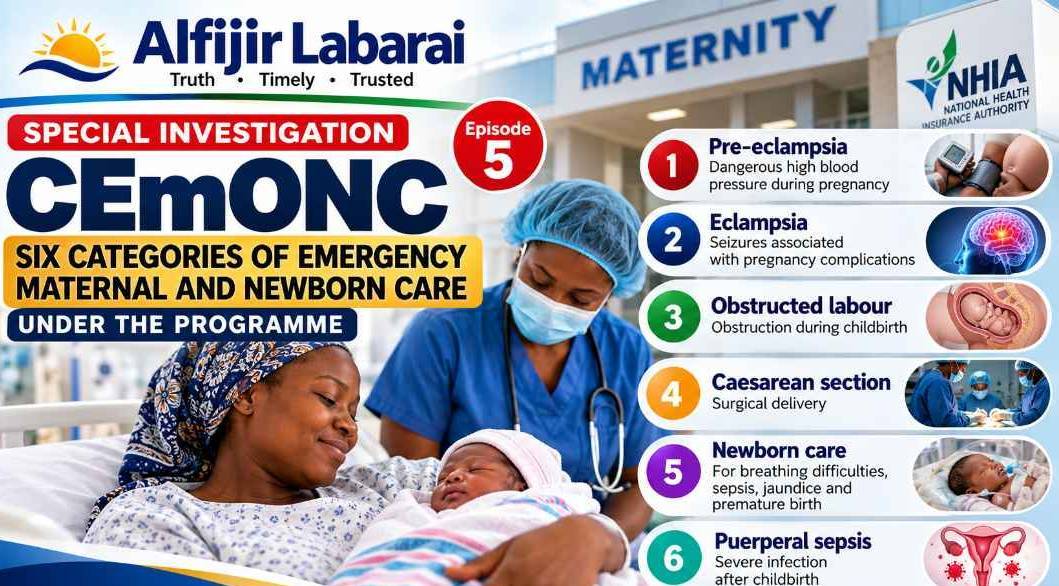
CEmONC
SPECIAL INVESTIGATION: CEmONC IN NIGERIA
Episode 5
Health complications during pregnancy, childbirth and the postnatal period can threaten the lives of mothers and newborns when timely and appropriate medical care is unavailable.
To help address these emergencies, the Federal Government has established the Comprehensive Emergency Obstetric and Newborn Care (CEmONC) programme, with the National Health Insurance Authority (NHIA) playing a key role in its implementation.
The 2025 HOPE-PHC Program Operations Manual, particularly Chapter 12, outlines requirements for assessing health facilities seeking to participate in the programme and explains the framework for reimbursing eligible services.
In this edition, Alfijir Labarai examines six major categories of emergency maternal and newborn care associated with the programme, explaining what they mean and why they matter to patients and their families.
1. Pre-eclampsia: Dangerous high blood pressure during pregnancy
Pre-eclampsia is a pregnancy complication associated with high blood pressure that can affect organs such as the kidneys and liver.
If it is not detected and managed promptly, it can cause serious complications for both the mother and her baby. Warning signs may include severe headaches, visual disturbances and pain in the upper abdomen. However, some women may have the condition without obvious symptoms.
Regular antenatal care can help identify the condition early. Once diagnosed, healthcare professionals assess its severity and determine the appropriate treatment.
2. Eclampsia: Seizures associated with pregnancy complications
Eclampsia occurs when a pregnant woman or a woman who has recently given birth develops seizures associated with pre-eclampsia.
It is a medical emergency that can endanger the lives of both mother and baby. Immediate professional medical care is essential.
If a pregnant woman or a woman who has recently given birth experiences a seizure, emergency medical assistance should be sought immediately.
3. Obstructed labour: Obstruction during childbirth
Obstructed labour occurs when childbirth cannot progress because the baby is unable to pass through the birth canal despite contractions.
If not managed promptly, it can cause severe injury to the mother and baby. Early detection and appropriate medical intervention are therefore essential. In some cases, a Caesarean section may be necessary.
4. Caesarean section: Surgical delivery
A Caesarean section is an operation in which a baby is delivered through an incision in the mother’s abdomen and uterus rather than through vaginal birth.
It may be necessary when labour is obstructed, the baby’s condition becomes critical, or continuing vaginal delivery would put the mother or baby at risk.
Access to skilled medical personnel, appropriate surgical equipment and post-operative care is important for reducing complications.
5. Newborn care for breathing difficulties, sepsis, jaundice and premature birth
Newborns can experience medical conditions that require specialised and sometimes immediate treatment. These include:
– Breathing difficulties: Some newborns may be unable to breathe adequately after birth or may experience serious respiratory problems requiring urgent assistance.
– Sepsis: A severe infection that can spread throughout a newborn’s body and become life-threatening.
– Jaundice: Yellowing of the skin and eyes caused by a build-up of bilirubin. Some cases can become dangerous without appropriate treatment.
– Premature birth: Babies born before 37 completed weeks of pregnancy may require specialised support, including assistance with breathing, temperature regulation and feeding.
Not every newborn with these conditions requires the same treatment. Healthcare professionals must assess each baby and determine the appropriate care.
6. Puerperal sepsis: Severe infection after childbirth
Puerperal sepsis is a serious infection that occurs after childbirth. If it is not identified and treated promptly, the infection can spread and become life-threatening.
Warning signs may include fever, chills, abdominal pain and foul-smelling vaginal discharge. These symptoms do not, by themselves, confirm the diagnosis.
Women who experience symptoms suggesting an infection after childbirth should seek medical attention urgently.
What do these six categories mean for patients?
These categories concern medical emergencies that may require prompt and specialised care. Their inclusion in the CEmONC framework highlights the importance of ensuring that women and newborns can access appropriate treatment when they need it.
However, there is an important distinction between a medical condition being included in the programme’s framework and every medicine, laboratory test, medical supply or hospital stay associated with that condition being covered in every circumstance.
A patient’s eligibility, the participating status of the health facility and the programme’s operational rules may affect how treatment costs are handled. The NHIA therefore needs to provide clear information on covered services, the limits of the benefit package and the circumstances under which a facility may request payment from a patient.
What Alfijir Labarai wants the NHIA to clarify
To provide accurate information to the public, Alfijir Labarai is seeking clarification from the NHIA on the following issues:
1. What is the complete list of treatments and medicines covered under each of the six categories?
2. Which women and newborns qualify for the programme, and what documents or eligibility procedures are required?
3. Does the programme cover laboratory tests, medicines, surgical supplies, blood transfusions, hospital admission and newborn care? Are there limits or exclusions?
4. Under what circumstances, if any, may a participating hospital request payment from a patient?
5. What official procedure can patients follow if they believe they have been charged for a service covered by the programme?
6. Which hospitals in Kano State are currently approved and actively participating in the CEmONC programme?
Understanding these six categories can help the public recognise the types of medical emergencies addressed by the CEmONC framework. However, patients also need clear and accessible information about eligibility, covered services and the rules governing payments.
Alfijir Labarai will continue investigating how the programme is implemented in Nigeria and Kano State, seeking official information from the relevant authorities and giving concerned institutions an opportunity to respond.
Our objective is to provide accurate, evidence-based reporting that helps the public understand healthcare support programmes without treating allegations as established facts.
Alfijir Labarai
Truth • Timely • Trusted
Research reference: HOPE-PHC Program Operations Manual, 2025, Chapter 12. The complete CEmONC benefit package and reimbursement rules should be confirmed with the NHIA before making claims that every related treatment or service is free in all circumstances.
📢 FOLLOW ALFIJIR LABARAI
Stay connected with Alfijir Labarai / Alfijir News for credible news, reports, investigative journalism, and important updates from Kano, Nigeria, and around the world.
📩 CONTACT US & PARTNERSHIP ENQUIRIES
Call/WhatsApp: +234 803 207 7835
🌐 OUR SOCIAL MEDIA PLATFORMS
X: https://twitter.com/Musabestseller?s=09
Facebook: https://www.facebook.com/profile.php?id=100089640289165
Threads: https://www.threads.net/@alfijirlabarai
YouTube: https://www.youtube.com/@BestsellerChannel12
Instagram: https://www.instagram.com/musa_bestseller?utm_source=qr&r=nametag
📲 JOIN OUR WHATSAPP GROUP
https://chat.whatsapp.com/Ilj1iz8v3sa3nBfrCz9U6f
ALFIJIR LABARAI MEDIA SERVICES
Truth • Timeliness • Trust
© 2026 Alfijir Labarai Media Services