SPECIAL INVESTIGATION
By Alfijir Labarai
KANO, 26 SEPTEMBER 2026
Drug abuse and illicit trafficking remain among the major challenges affecting young people, families and public safety in Kano State.
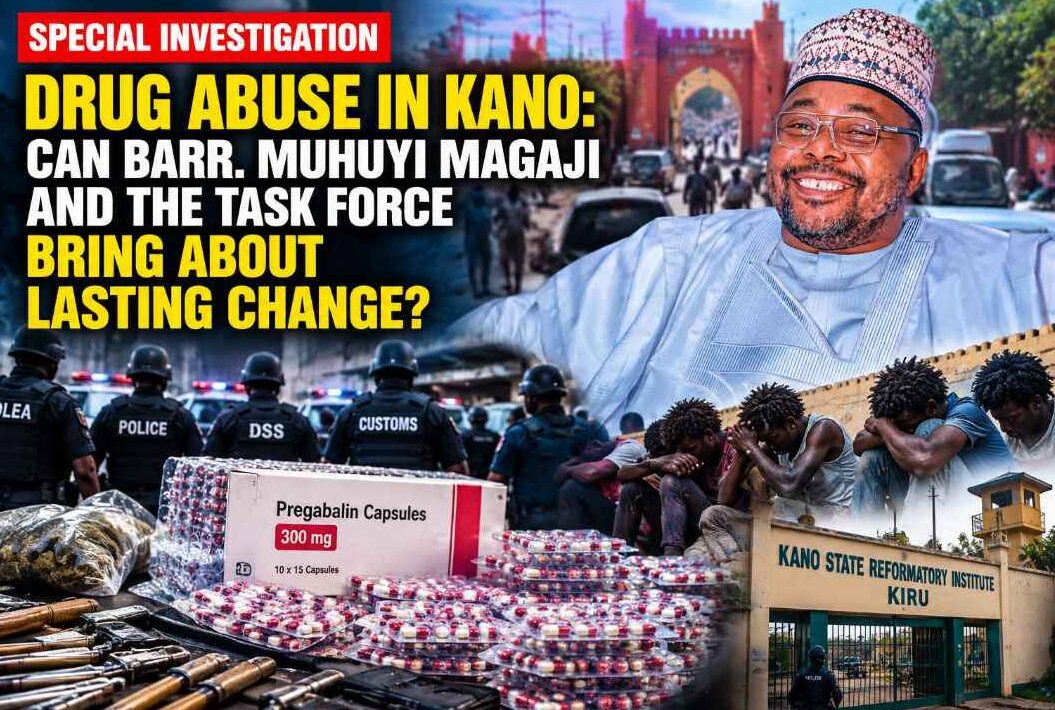
On 22 July 2026, the Kano State Government inaugurated the Multi-Agency Task Force on Drug Abuse and Illicit Trafficking under the leadership of Barr. Muhuyi Magaji Rimin Gado, with the aim of bringing security agencies and other stakeholders together to tackle drug abuse, illicit trafficking and related crimes.
During its first two months, the Task Force said its activities included arrests, drug seizures, enforcement operations, intelligence gathering, prosecution, public sensitisation, child protection and referrals for rehabilitation.
But this is where the Alfijir Labarai investigation begins:
Can these measures reduce the drug problem in Kano in the long term, or will the success of the initiative depend largely on what happens after arrests, seizures and enforcement operations?
For this reason, this investigation does not focus only on the number of suspects arrested or the quantity of drugs seized. It also examines what happens afterwards: prosecution, rehabilitation, treatment, skills acquisition, family support and the reintegration of rehabilitated people into society.
WHAT HAS BEEN RECORDED SO FAR
In a briefing on 22 September, the Task Force said it had arrested more than 380 suspects and secured more than 230 convictions within two months of its inauguration.
The Task Force also said joint operations were conducted in areas identified as drug and criminal hotspots, including Race Course, Filin Idi, Filin Mahaha, Tashar Rami, Kawo and Tashar Rimi.
According to the Task Force, the operations resulted in the recovery of various illicit and controlled substances, including Cannabis Sativa, Exol-5, Diazepam, Pentazocine, Tramadol and Pregabalin capsules. Locally made weapons, including knives, cutlasses, daggers and clubs, were also recovered.
PREGABALIN: THE CHALLENGE OF DIVERTING MEDICINES INTO THE ILLICIT MARKET
One of the issues that attracted particular attention was the reported seizure of about 870,000 Pregabalin capsules from a pharmaceutical company in Kano.
According to the Task Force, the seizure raised concerns over the alleged diversion of controlled medicines from legitimate pharmaceutical supply chains for illicit use.
The development broadens the scope of Kano’s drug problem. It suggests that the fight is not limited to locations where illicit drugs are sold or consumed; it also requires attention to how medicines intended for legitimate use move through the pharmaceutical supply chain and how they may be diverted into illegal markets.
43 CHILDREN: RESCUE IS NOT THE END OF THE JOURNEY
The Task Force also reported that 43 underage children had been rescued after allegedly being exposed to intoxicating substances.
According to the chairman, two rubber-solution dealers were convicted over allegations that they supplied intoxicating substances to children involved in street scavenging. The children were reportedly medically examined and placed under counselling and treatment, while efforts continued to trace and reunite them with their families. Some had already been reunited with their families.
But rescuing a child from a dangerous environment is only the first step.
The question that requires continued monitoring is what happens to these children after they return to their families and communities.
This includes family support, education, healthcare and protection from returning to the circumstances that exposed them to the problem in the first place.
FROM ARRESTS TO REHABILITATION
The Task Force said about 125 people had been referred to the Kano State Reformatory Institute in Kiru for rehabilitation.
The chairman said growing demand for rehabilitation had pushed the Kiru facility to capacity, prompting the state government to provide an additional facility in Tofa Local Government Area.
This is where the initiative will face one of its major tests.
Rehabilitation does not necessarily end when a person leaves a rehabilitation centre. What follows is equally important: vocational training, opportunities for self-reliance, family support and continued follow-up.
The Task Force has also set a target of taking 10,000 youths off the streets, rehabilitating them, providing skills training and supporting their reintegration into society.
If implemented as planned, the programme will raise an important question: can rehabilitated young people be supported to return to productive and self-reliant lives and regain the confidence of their families and communities?
FROM THE FIGHT AGAINST DRUGS TO THE FIGHT AGAINST DABA
The Task Force has also linked some areas affected by drug abuse to activities involving Daba, phone snatching and other forms of criminality.
This means the challenge extends beyond disrupting drug dealers and traffickers. It also requires attention to the factors that may push some young people into drug abuse, street gangs and other forms of criminal activity.
INTER-AGENCY COLLABORATION
The Task Force was established as a multi-agency framework involving security and law-enforcement agencies as well as other stakeholders.
The chairman acknowledged the contributions of agencies including the NDLEA, Police, DSS, NSCDC, Customs, Nigerian Correctional Service, KOSSAP, Vigilante, Hisbah and KAROTA.
Such collaboration can help bring together intelligence, investigations, enforcement, prevention and rehabilitation efforts.
However, its long-term effectiveness will depend on how well these agencies coordinate their work, share information, pursue cases and support rehabilitation and reintegration alongside enforcement.
WHAT SHOULD BE MONITORED GOING FORWARD?
This is where Alfijir Labarai will continue to monitor the initiative.
Key questions include:
How many people who undergo rehabilitation successfully return to normal community life?
How many of those rehabilitated receive vocational training or opportunities for self-reliance?
Is there a system for monitoring people after they complete rehabilitation and return to their communities?
How is the diversion of medicines intended for legitimate use into the illicit market being prevented?
How will the proposed 10,000-youth rehabilitation target be measured if implementation expands?
And are enforcement operations contributing to a reduction in Daba, phone snatching and other crimes in the areas where they are conducted?
CONCLUSION
The developments reported by the Task Force during its first two months indicate that the initiative has combined arrests, prosecution, drug seizures, child protection, public sensitisation and rehabilitation referrals.
However, the main test of the initiative will not be limited to the number of arrests made or the quantity of drugs seized.
The longer-term test will be whether the initiative can contribute to reducing drug abuse and illicit trafficking, protect children and young people, prevent the diversion of controlled medicines into illicit markets, and create sustainable pathways for rehabilitated people to return to society with dignity and opportunities for self-reliance.
In short, tackling drug abuse in Kano requires more than raids and arrests. It requires prevention, investigation, treatment, rehabilitation, skills development, family support and reintegration into society.
That is what Alfijir Labarai will continue to watch as the Kano drug-fighting initiative moves beyond its first two months.
CONNECT WITH ALFIJIR LABARAI
Stay connected with Alfijir Labarai / Alfijir News for the latest news, reports, investigations, programmes and important updates from Kano, Nigeria and around the world.
📞 CONTACT US
For enquiries, news tips, partnership, advertising, sponsorship and more information:
+234 803 207 7835
📰 Have a story, development or important information to share?
Send your news tips, press releases, announcements and community stories to Alfijir Labarai.
🤝 PARTNER WITH US
We welcome individuals, organisations, institutions and businesses interested in:
• Media Partnership
• Advertising
• Programme Sponsorship
• Corporate Partnerships
• Special Reports & Features
• Event & Programme Promotion
📞 Contact us:
+234 803 207 7835
🌐 FOLLOW ALFIJIR LABARAI
🐦 X (Twitter):
“Follow us on X” https://twitter.com/Musabestseller?s=09
📘 Facebook:
“Follow us on Facebook” https://www.facebook.com/profile.php?id=100089640289165
🧵 Threads:
“Follow us on Threads”https://www.threads.net/@alfijirlabarai
▶️ YouTube:
“Subscribe on YouTube” https://www.youtube.com/@BestsellerChannel12
📸 Instagram:
“Follow us on Instagram” https://www.instagram.com/musa_bestseller?utm_source=qr&r=nametag
📲 JOIN OUR WHATSAPP GROUP
Get our latest news updates, programmes, reports and important announcements directly on WhatsApp.
👇👇 Join the Alfijir Labarai / Alfijir News WhatsApp Group:
“Join our WhatsApp Group” https://chat.whatsapp.com/Ilj1iz8v3sa3nBfrCz9U6f?s=cl&p=a&mlu=4&ilr=4
ALFIJIR LABARAI MEDIA SERVICES
Accurate • Timely • Trusted
📰 News • Reports • Investigations • Programmes • Public Awareness
© 2026 Alfijir Labarai Media Services