
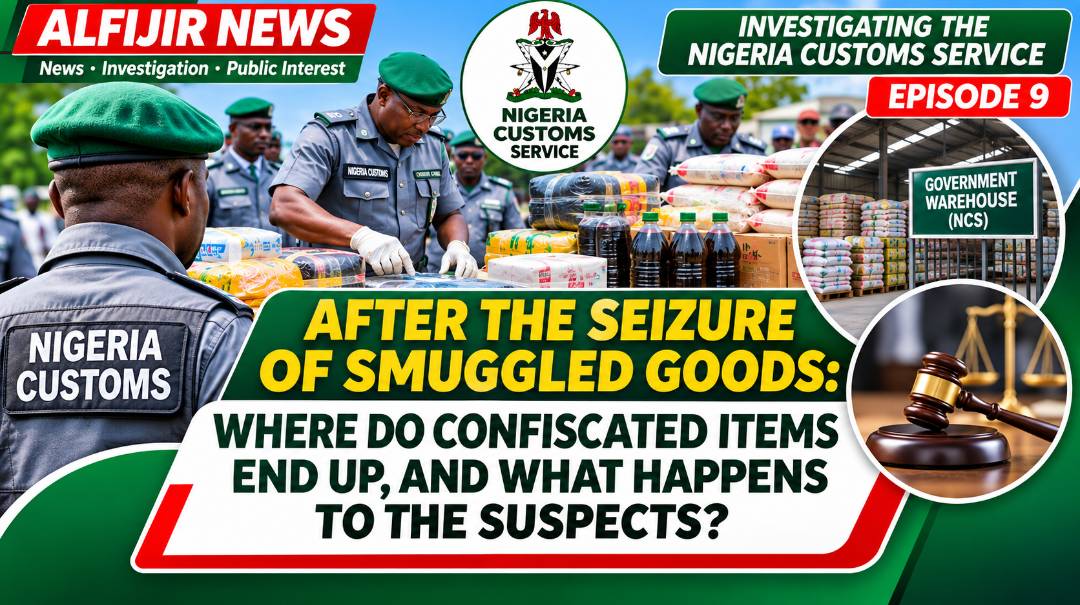
INVESTIGATING THE NIGERIA CUSTOMS SERVICE
EPISODE 9
The seizure of goods suspected to have been imported into Nigeria through illegal channels is one of the major activities of the Nigeria Customs Service (NCS) in its efforts to combat smuggling and protect the country’s economy.
Whenever the Service conducts an enforcement operation, announcements are often made about the seizure of foreign rice, food products, illicit drugs, weapons, vehicles and other goods suspected of violating import regulations.
However, beyond the announcements of such seizures, several important questions remain:
Where are the goods kept after they are seized? What legal procedures must be followed before they are declared forfeited to the government? What happens to the individuals suspected of involvement? And how can members of the public track the final disposition of seized goods?
These are the issues examined in this edition of our investigative series.
CUSTOMS REPORTS 195 SMUGGLING ATTEMPTS, WITH SEIZED GOODS VALUED AT ₦6.19 BILLION
On 4 November 2026, Vanguard published a report based on a briefing by the Acting Comptroller of the Federal Operations Unit (FOU), Zone A, Oladapo Afeni, in Lagos.
According to the report, the unit intercepted 195 smuggling attempts during four weeks of enforcement operations.
The Service stated that the Duty Paid Value (DPV) of the seized goods amounted to ₦6,194,695,947, approximately ₦6.19 billion.
The reported seizures included:
– Foreign rice.
– Imported poultry products.
– Cartons of spaghetti.
– Used clothing.
– Tyres and used vehicles.
– Petroleum products.
– Pharmaceutical products, including codeine syrup.
– Cannabis weighing 3,407.83 kilogrammes.
– 400 grammes of cocaine.
– 100 grammes of methamphetamine.
– 1,250 rounds of ammunition.
– Eight pangolins.
– 23,220 new machetes.
The Service also reported additional revenue of approximately ₦683.66 million, which it attributed to documentary checks, the detection of undervalued imports and the issuance of demand notices for additional duties.
It is important to clarify that the ₦6.19 billion represents the estimated Duty Paid Value disclosed by the Service. It does not mean that the goods were sold for that amount or that the money was paid into government accounts.
Similarly, the interception of 195 smuggling attempts does not mean that 195 court cases have been concluded or that 195 individuals have been convicted.
WHAT HAPPENS TO GOODS AFTER THEY ARE SEIZED?
The Nigeria Customs Service Act, 2023, provides specific procedures for the seizure, detention, forfeiture and disposal of goods.
Section 245(1) empowers a Customs officer, or an authorised person, to seize or detain an item where there are reasonable grounds to believe that it may be liable to forfeiture under the law.
Section 245(2) provides that, following seizure, the item must be delivered into the custody of the Service without delay. It is then to remain under the appropriate custody and control pending the determination of its forfeiture or disposal in accordance with the Act.
This means that the seizure of goods is not necessarily the final stage of the process. There are legal procedures that must be followed to determine their status and eventual destination.
DOES EVERY SEIZED ITEM AUTOMATICALLY BECOME GOVERNMENT PROPERTY?
No. This is one of the most important distinctions the public needs to understand.
The Schedule to the Nigeria Customs Service Act, 2023, provides for notification of seizure and the opportunity for an interested person to make a claim.
In circumstances where notification is required, the Service is expected to notify the person it knows to be the owner of the goods, stating the seizure and the reasons for it, within 30 days.
However, the law provides exceptions to this notification requirement, including certain circumstances where the seizure takes place in the presence of the person whose conduct gave rise to the seizure, the owner, the owner’s agent, or a person in charge of the ship, aircraft or vehicle carrying the goods.
A person claiming that the seized goods should not be forfeited also has the opportunity to submit a written claim within one month, subject to the applicable provisions of the law. The Service may extend the period at its discretion.
Where the applicable period expires without a valid claim, or where the claim does not satisfy the legal requirements, the goods may be treated as forfeited in accordance with the Act.
Where a valid claim is submitted, the matter proceeds through the condemnation procedure provided under the law.
It is therefore important to distinguish between:
– Goods that have been seized.
– Goods still undergoing investigation.
– Goods declared forfeited.
– Goods that have already been disposed of through a legally authorised process.
WHERE ARE SEIZED GOODS STORED?
Section 121(4) of the Nigeria Customs Service Act, 2023, defines a Government Warehouse as a place provided by the government and appointed by Customs for the storage of seized goods, goods declared forfeited and other items connected with the enforcement of customs laws.
The Act also provides that where such a facility is unavailable, terminal operators may provide premises that can be appointed as a Government Warehouse.
This provision raises several important questions:
– How many Government Warehouses are currently being used by the Nigeria Customs Service?
– How are records of seized goods maintained?
– What procedures are used to reconcile the quantity of goods received with those eventually released or removed?
– What safeguards exist to prevent goods from disappearing, deteriorating or being unlawfully transferred to other parties?
– Are there publicly accessible records showing the categories of seized goods and their legal status?
These details are important for transparency and accountability.
WHAT HAPPENS TO GOODS DECLARED FORFEITED?
Section 119 of the Nigeria Customs Service Act, 2023, provides for the sale, disposal or destruction of goods under specified circumstances.
Section 119(1) provides for the disposal of certain goods through sale or destruction under a court order, in the circumstances specified by the Act.
Section 119(4) further provides that the relevant sales are to be conducted through public auction or tender, with advance notice of the sale published in national newspapers, on television and on the Service’s website in the English language.
In addition, Section 245(2) provides for the disposal of goods that have been determined or declared forfeited in accordance with the procedures established by the Service.
This means that there is not necessarily one disposal procedure for every category of goods. The nature of the goods, their legal status and the applicable provisions of the Act all matter.
WHAT HAPPENS TO PEOPLE SUSPECTED OF SMUGGLING?
The arrest or detention of a person does not automatically establish their guilt.
In its report of 4 November 2026, Vanguard quoted the Acting Comptroller of FOU Zone A as saying that the Service works with the NDLEA, Police, DSS, Immigration, the military and other relevant agencies.
He also explained that seized narcotics and suspects allegedly involved in their trafficking would be handed over to the NDLEA for further investigation and possible prosecution, while other categories of goods would be referred to the relevant authorities in line with their statutory responsibilities.
This demonstrates that the work of Customs does not necessarily end with the seizure of goods or the arrest of a suspect. Other agencies may become involved in investigations and prosecutions.
However, important questions remain:
– How many suspects are referred to the NDLEA or other relevant agencies?
– How many are subsequently charged in court?
– How many are convicted after trial?
– How many of the cases remain pending before the courts?
– How does the Service monitor and report the outcomes of these cases?
The effectiveness of anti-smuggling operations cannot be measured solely by the quantity or value of seized goods. Investigation outcomes, completed prosecutions and court judgments are also important indicators.
WHAT HAS CUSTOMS SAID ABOUT THE DISPOSAL OF SEIZED GOODS?
On 13 May 2026, Vanguard published comments from Hussein Abdullahi, the spokesperson for FOU Zone A, concerning the handling of seized food products.
According to the report, he explained that the Nigeria Customs Service Act, 2023, and the Service’s internal Standard Operating Procedures (SOPs) guide the handling of seized goods, particularly perishable items.
He also indicated that legal procedures must be followed before seized goods are disposed of.
This explanation is relevant. However, the public still needs further information about how these procedures operate in practice and what records the Service publishes concerning the final destination of seized goods.
QUESTIONS ALFIJIR NEWS SEEKS ANSWERS TO
As part of this investigation, Alfijir News is seeking detailed clarification from the Nigeria Customs Service on the following issues:
1. What was the total quantity and value of goods seized by the Service across Nigeria in 2025 and from January to October 2026?
2. How many of the goods seized during these periods have been formally declared forfeited?
3. How many seized items remain in the custody of the Service pending the conclusion of investigations or legal proceedings?
4. Where are seized goods stored, and does the Service maintain a comprehensive register showing the description, quantity, storage location and legal status of each item?
5. What procedures are followed when goods declared forfeited are sold, destroyed or otherwise disposed of?
6. Does the Service publish records of public auctions and the proceeds from the sale of forfeited goods to enable public scrutiny?
7. How many people arrested on suspicion of smuggling have been prosecuted, and how many have been convicted?
8. What safeguards does the Service have to prevent seized goods from disappearing or unlawfully returning to the market?
9. Can the Service make available its Standard Operating Procedures governing the handling of perishable and other seized goods?
10. What official procedure can members of the public follow to obtain information about the status and final disposition of goods seized by Customs?
CONCLUSION
The fight against smuggling does not end with the seizure of goods or their presentation at a press briefing.
An equally important part of the process is ensuring that the law is followed in the custody of seized goods, that people with legitimate claims are given the opportunity to challenge the seizure, that the required legal procedures are completed and that the final disposition of forfeited goods is properly documented.
Similarly, the success of anti-smuggling operations should not be measured solely by the number or value of goods seized. Investigation outcomes, completed prosecutions, court judgments and the transparent management of forfeited goods are also important.
Alfijir News calls on the Nigeria Customs Service and other relevant agencies to provide more accessible information that enables the public to understand the fate of seized goods and the outcomes of cases involving alleged smuggling activities.
Alfijir News has previously submitted a request for information to the Nigeria Customs Service and will continue to seek official clarification on this and other aspects of the investigation.
Should the Service provide additional explanations or documents, they will be presented in a subsequent edition.
WE INVESTIGATE. WE ASK QUESTIONS. WE EXPLAIN WHAT THE LAW SAYS.
📢 FOLLOW ALFIJIR LABARAI
Stay connected with Alfijir Labarai / Alfijir News for credible news, reports, investigative journalism, and important updates from Kano, Nigeria, and around the world.
📩 CONTACT US & PARTNERSHIP ENQUIRIES
Call/WhatsApp: +234 701 1 11 3809
+234 803 207 7835
🌐 OUR SOCIAL MEDIA PLATFORMS
X: https://twitter.com/Musabestseller?s=09
Facebook: https://www.facebook.com/profile.php?id=100089640289165
Threads: https://www.threads.net/@alfijirlabarai
YouTube: https://www.youtube.com/@BestsellerChannel12
Instagram: https://www.instagram.com/musa_bestseller?utm_source=qr&r=nametag
📲 JOIN OUR WHATSAPP GROUP
https://chat.whatsapp.com/Ilj1iz8v3sa3nBfrCz9U6f
ALFIJIR LABARAI MEDIA SERVICES
Truth • Timeliness • Trust
© 2026 Alfijir Labarai Media Services