EUROPE THROUGH OUR LENS
Exploring Europe. Understanding Perspectives. Telling the Stories That Matter.
EDITION 003 | 12 NOVEMBER 2026
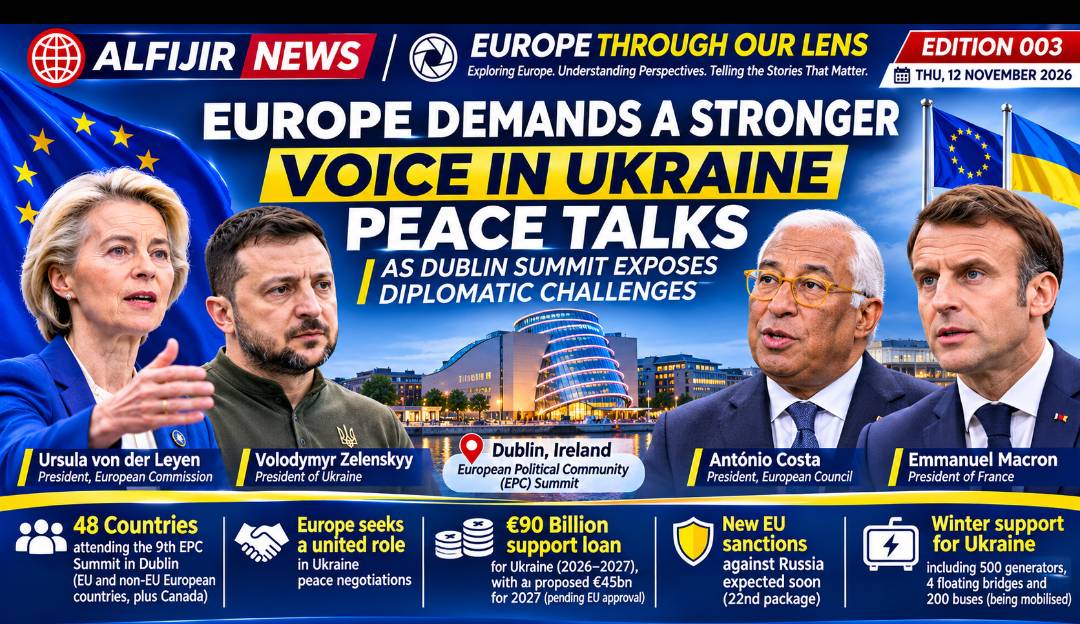
As European leaders gather in Ireland, growing pressure for a coordinated continental position highlights Europe’s struggle to influence negotiations over Ukraine’s future and the security of the continent.
DUBLIN, IRELAND — 12 NOVEMBER 2026
Europe’s ability to shape its own security future is facing a significant diplomatic test as leaders from across the continent gather in Dublin amid renewed efforts to negotiate an end to Russia’s war against Ukraine.
The ninth summit of the European Political Community (EPC), hosted by Ireland on Thursday, brings together leaders from across Europe to discuss security, economic competitiveness, democratic resilience and the continent’s future.
However, one issue has emerged as particularly significant: how Europe can secure a meaningful voice in negotiations that could determine Ukraine’s future and the wider European security order.
The debate reflects growing concern that decisions affecting Europe’s stability should not be reached without the participation of European countries.
A CONTINENT-WIDE SUMMIT, NOT AN EU MEETING
The European Political Community is a forum for political dialogue and cooperation established in 2022 following Russia’s full-scale invasion of Ukraine.
The Dublin gathering is its ninth summit. According to the European Council, leaders from 48 invited countries are participating, representing the 27 European Union member states and other European countries. Canada was also invited as a guest.
The summit is co-chaired by European Council President António Costa and Ireland’s Taoiseach, Micheál Martin. Its theme is “Europe – Strong, Secure and Connected.”
Importantly, the European Political Community is not an institution of the European Union. It provides a wider platform for European countries, including those outside the EU, to discuss shared political, economic and security challenges.
This distinction is particularly important when discussing Ukraine, NATO, Russia and the future of European security.
EUROPE SEEKS A COORDINATED VOICE
The question of who should represent Europe in any future peace negotiations has become increasingly prominent.
Irish Taoiseach Micheál Martin has highlighted the need for clear and coherent European leadership in discussions concerning Ukraine. The issue is expected to feature prominently in the Dublin discussions and the subsequent informal meeting of EU leaders.
French President Emmanuel Macron has also stressed that Europe must take responsibility for defining its own future security.
The debate reflects differences over how European countries should organise their diplomatic representation. Some leaders favour the existing EU institutional leadership, while others emphasise the need for a common position agreed by all 27 member states.
EU foreign policy chief Kaja Kallas has indicated that she and European Council President António Costa could represent the EU under their existing responsibilities. However, a special negotiating mandate had not been announced at the time of publication.
The challenge is therefore not simply choosing a representative. It is ensuring that whoever speaks for Europe has a clear mandate supported by the countries concerned.
A PROPOSED DECLARATION ON EUROPEAN SECURITY
A further indication of Europe’s diplomatic concerns emerged through a proposed declaration discussed during the Dublin summit.
Reuters reported that around 40 countries were expected to endorse a statement arguing that decisions affecting European security must be made with Europeans and that Ukraine’s path to peace must be decided with Ukraine.
The proposed declaration also emphasises respect for national sovereignty, internationally recognised borders, the right of states to choose their alliances and the principles of the United Nations Charter.
However, the final number of countries that endorsed the declaration had not been confirmed in the reporting available at the time of publication.
The proposal should therefore be understood as an effort to build a shared political position, rather than a final agreement already adopted by all the countries concerned.
Its significance lies in the message that European governments want a direct role in decisions affecting their security and the future of the continent.
UKRAINE PEACE DIPLOMACY: PROGRESS, BUT NO SETTLEMENT
The Dublin summit follows renewed diplomatic activity involving Russia, Ukraine and the United States.
US-mediated discussions in Abu Dhabi on 10 and 11 November produced progress towards a prisoner exchange, but did not resolve fundamental disagreements over territory, security guarantees and the terms of a possible ceasefire.
The discussions were followed by a visit to Moscow by US envoys Steve Witkoff and Jared Kushner for talks with Russian President Vladimir Putin.
Ukrainian President Volodymyr Zelenskyy was expected to receive an update from the American envoys in Dublin.
The diplomatic activity has raised expectations of further negotiations, but there is no confirmed comprehensive peace agreement.
The humanitarian progress on prisoner exchanges should not be confused with a breakthrough on the central political and territorial questions underlying the war.
Ukraine continues to insist that any settlement must respect its sovereignty and territorial integrity. Russia’s position on territory and future security arrangements remains a major obstacle.
THE EU REAFFIRMS ITS SUPPORT FOR UKRAINE
Following a meeting with President Zelenskyy in Dublin on 12 November, European Council President António Costa and European Commission President Ursula von der Leyen issued a joint statement reaffirming the European Union’s support for Ukraine.
They welcomed renewed momentum in the peace process and stated that the EU had been present in the peace process and would continue to be involved.
The two leaders stressed that any just and lasting peace must safeguard Ukraine’s sovereignty, territorial integrity and the security of the wider European continent.
They also reaffirmed the EU’s commitment to financial and military assistance, post-war reconstruction and Ukraine’s path towards membership of the European Union.
Their statement demonstrates that, despite disagreements about representation and negotiating arrangements, the EU intends to remain an important participant in efforts to shape Ukraine’s future.
UNDERSTANDING THE €90 BILLION UKRAINE SUPPORT LOAN
Financial support remains a central part of Europe’s strategy.
On 30 October, the European Commission took a further step towards implementing the €90 billion Ukraine Support Loan covering 2026 and 2027.
The Commission proposed that the remaining €45 billion of the loan be made available for 2027, subject to approval by the Council of the European Union.
The proposed allocation includes:
- Up to €31.7 billion for strengthening Ukraine’s defence industrial capacity.
- Up to €13.3 billion for budgetary support.
This is not a separate additional €45 billion loan. It is the proposed 2027 portion of the existing €90 billion support arrangement.
The distinction matters because the Commission’s proposal still requires the relevant approval process. It should not be reported as money already transferred to Ukraine.
At their next meeting on 26–27 November, EU leaders are expected to discuss Ukraine’s urgent financing needs for 2027 on the basis of the Commission’s proposal.
WINTER SUPPORT AS UKRAINE FACES ANOTHER DIFFICULT SEASON
As winter approaches, the European Commission has announced additional practical assistance to help Ukraine maintain essential services.
According to the joint statement by Costa and von der Leyen, the EU is mobilising 500 generators from its rescEU reserves, helping establish emergency support centres and providing essential equipment.
The EU is also supporting the delivery of four floating bridges from Norway and 200 buses.
The assistance is intended to help communities and public services cope with the consequences of continued attacks and infrastructure disruption.
However, the announcement concerns assistance being mobilised and supported. It does not establish that every generator, bridge and bus has already reached its intended destination.
NEW SANCTIONS AGAINST RUSSIA EXPECTED
The European Commission has also indicated that it will present its 22nd sanctions package against Russia ahead of the next European Council meeting.
The announcement was made by Costa and von der Leyen in their Dublin statement.
The package had not yet been formally presented or adopted at the time of publication. Its final contents and the measures it will introduce should therefore be treated as pending.
The proposed sanctions would form part of the EU’s wider response to Russia’s continuing war against Ukraine.
THE NEXT TEST: EUROPEAN UNITY IN PRACTICE
The Dublin summit has highlighted a central question facing European governments: can they turn their shared concerns into a coordinated diplomatic position?
Europe is not a single political institution. It includes EU member states, countries outside the EU, NATO members and countries with different foreign policy priorities.
The European Political Community offers a platform for dialogue across these boundaries, while decisions within the European Union remain subject to the EU’s own institutions and procedures.
For Ukraine, the outcome of these discussions could influence the credibility of future security guarantees and the support available for reconstruction.
For European governments, the stakes are equally significant. A settlement reached without adequate consideration of Europe’s security concerns could have long-term consequences for the continent.
The Dublin discussions may not produce an immediate diplomatic breakthrough. Their importance will depend on whether European leaders can agree on a coherent position and translate it into meaningful participation in future negotiations.
Europe is seeking more than a seat at the negotiating table. It is seeking a credible role in shaping the security arrangements that will determine its future.
SOURCES AND FURTHER READING
- European Council — Meeting of the European Political Community, 12 November 2026.
- European Council — Joint statement by António Costa and Ursula von der Leyen following their meeting with Volodymyr Zelenskyy in Dublin, 12 November 2026.
- Reuters — European security should be decided with Europeans, around 40 countries expected to say, 12 November 2026.
- RTÉ News — Coverage of the Dublin summit and European leaders’ discussions, 12 November 2026.
- European Commission — Commission takes a key step forward on 2027 financial support for Ukraine, 30 October 2026.
- Euronews — Reporting on the Abu Dhabi peace talks, Moscow discussions and the debate over Europe’s diplomatic role, November 2026.
ALFIJIR NEWS | EUROPE THROUGH OUR LENS
Exploring Europe. Understanding Perspectives. Telling the Stories That Matter.