
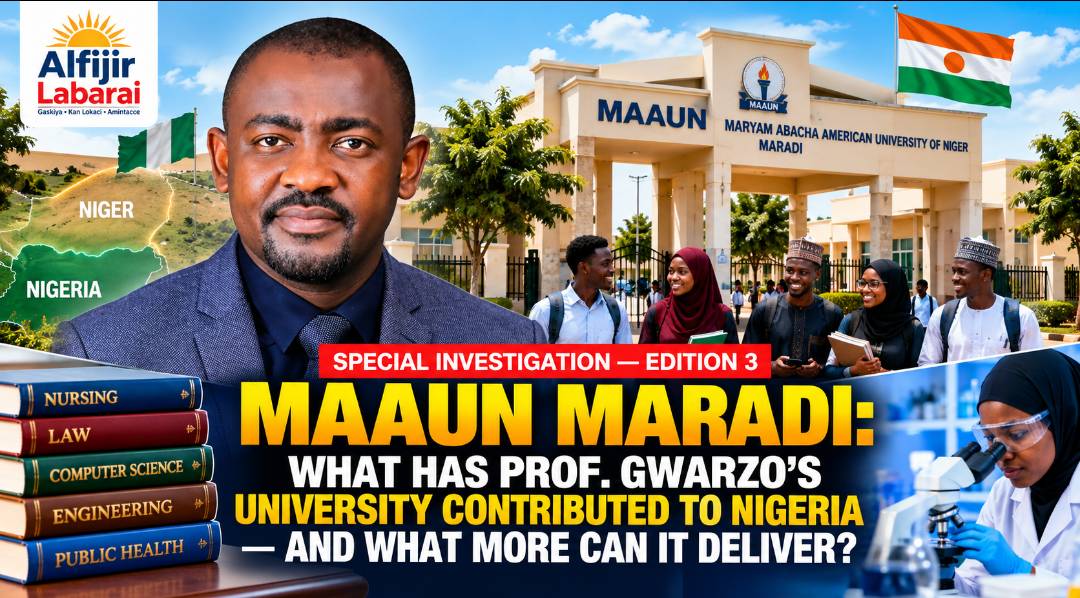
SPECIAL INVESTIGATION — EDITION 3
By Alfijir Labarai
As our investigation examines the potential contribution of universities established under the leadership of Prof. Adamu Abubakar Gwarzo to Nigeria’s education sector, this third edition focuses on Maryam Abacha American University of Niger (MAAUN), Maradi.
Although the university is located in Niger Republic, its activities have developed important connections with Nigeria, particularly in professional training, postgraduate education and the movement of graduates into Nigeria’s regulated professions.
This raises a broader question:
What has MAAUN Maradi actually contributed to Nigeria, and what more can reasonably be expected from the institution in the years ahead?
That is the question this investigation seeks to examine.
1. A University in Niger With a Nigerian Connection
MAAUN Maradi was established in 2013.
The university says it was founded to provide undergraduate and postgraduate education while promoting research and innovation. It currently offers programmes across areas including health sciences, computing, engineering, law, business and the social sciences.
Its location in Maradi, close to Nigeria’s northern border, gives the institution an interesting regional dimension.
But geographical proximity alone does not make a university important to Nigeria.
The real issue is whether the education, research and graduates produced by the institution are generating measurable benefits beyond its campus.
2. 430 New Students: Access Is Only the Beginning
For the 2025/2026 academic session, MAAUN Maradi announced that it had matriculated 430 students into various undergraduate programmes.
The figure represents expanded access to higher education.
But student enrolment is only the beginning of the story.
The more important questions are:
How many will graduate?
How many will secure employment?
How many will create businesses or jobs?
How many will enter research, healthcare, technology or public service?
For a university to demonstrate long-term national impact, these outcomes matter more than enrolment figures alone.
3. Nursing: The Strongest Documented Link to Nigeria
Perhaps the clearest evidence of MAAUN Maradi’s connection with Nigeria can be found in nursing education.
In December 2023, the Nursing and Midwifery Council of Nigeria (NMCN) inducted 340 foreign-trained nurses after their adaptation programmes in 12 Nigerian universities.
According to MAAUN, 212 of the 340 were graduates of Nursing Sciences from MAAUN Niger.
This is significant.
It means graduates trained at MAAUN Maradi entered a professional process that led to recognition by Nigeria’s nursing regulatory system.
Prof. Gwarzo subsequently announced scholarships for all 212 MAAUN nursing graduates to pursue Master’s degrees at the university.
For our investigation, this is more meaningful than simply listing Nursing as one of the university’s programmes.
There are identifiable graduates, a Nigerian regulatory process and a postgraduate opportunity.
4. But What Happened After Induction?
This is where the investigation needs to go further.
The existence of 212 inducted graduates is evidence of educational progression, but it does not by itself tell us their long-term impact.
The next questions are:
How many are currently working in Nigeria?
Where are they working?
How many have advanced to postgraduate qualifications?
How many have moved into teaching, leadership or specialist healthcare roles?
What measurable contribution have they made to Nigeria’s health sector?
These are questions that future alumni tracking should answer.
Without such information, it is difficult to measure the full national impact of the training.
5. Scholarships: Investing in High-Performing Graduates
MAAUN Maradi has also used scholarships as part of its approach to postgraduate education.
In August 2023, Prof. Gwarzo announced scholarships for 50 of the best graduating Law students to pursue Master’s degrees at the university.
Such initiatives can help retain high-performing students within the academic system and potentially develop future lawyers, researchers and legal professionals.
But again, the real test comes later.
What did those scholarship recipients become?
Their career progression, research output and professional contribution would provide a stronger measure of the value of such scholarships than the award itself.
6. Research: Is the University Producing Knowledge, Not Just Graduates?
One of the central responsibilities of a university is to produce knowledge that can help solve real problems.
MAAUN has an academic publication, the MAAUN Journal of Computing, Engineering and Health Sciences, which covers research in computing, engineering, science, environment and technology. The journal describes itself as peer-reviewed and currently lists 2026 publications.
This is an important institutional platform.
But the existence of a journal is not, by itself, proof of research impact.
The more important questions are:
What problems are the studies addressing?
Are the findings being used by governments, industries or professional institutions?
Are researchers developing solutions that can be applied in Nigeria and Niger?
How much of the research is translating into innovation?
These are the indicators that will ultimately determine the significance of MAAUN’s research activities.
7. Developing Lecturers and Embracing Educational Technology
MAAUN, through the Institute of Africa Higher Education Research and Innovation (IAHERI), has also organised faculty development activities involving MAAUN Niger.
A 2023 workshop focused on improving student–lecturer relationships and embracing educational technology. The programme included discussions on virtual classrooms, Google Workspace and online research tools.
Prof. Gwarzo also emphasised regular training and retraining of academic staff, while the organisers highlighted research and innovation.
This is important because the quality of higher education depends not only on buildings and equipment, but also on the quality of teaching, research and academic leadership.
The challenge, however, is to determine whether such training produces measurable improvements in teaching and student outcomes.
8. A New Leadership Chapter
Another development that could shape the future of MAAUN Maradi is the change in its leadership.
On August 8, 2026, Prof. Gwarzo appointed Prof. Ibrahim A. Lawal as the new President of MAAUN Niger-Maradi.
According to the university, Gwarzo had served as President since the institution was established 13 years earlier.
The transition therefore marks a new phase.
Prof. Gwarzo remains the Founder of the group, while Prof. Lawal takes over the presidency of MAAUN Maradi.
The question now is whether the new leadership will bring measurable changes in areas such as:
research,
academic partnerships,
technology,
graduate employability,
and institutional development.
That is something Alfijir Labarai will continue to watch.
9. The N10 Billion Campus Project
MAAUN says its permanent campus at Gwarzo Town, Djiratawa, Maradi, is under construction, with N10 billion committed to the project.
This represents a substantial planned investment.
But once again, the amount alone is not the main issue.
The important question is what the investment will produce.
Will it provide:
– better laboratories?
– stronger research facilities?
– expanded capacity?
– improved technology infrastructure?
– more opportunities for postgraduate education?
– or a larger regional centre for professional training?
The impact of the investment will ultimately be judged by what it delivers to students, researchers and the wider community.
10. Can MAAUN Become a Regional Education Hub?
MAAUN Maradi operates in a unique geographical and educational environment.
It is based in Niger Republic but has demonstrated institutional and professional links with Nigeria.
Its programmes cover areas that are central to the future of West Africa: healthcare, technology, computing, engineering, law and business.
This gives the university the potential to play a wider regional role.
But potential should not be confused with achievement.
For MAAUN to establish itself as a significant regional education hub, it would need to demonstrate sustained results in graduate employment, research, innovation, professional development and partnerships.
11. What the Evidence Shows So Far
Our review of available evidence points to several measurable developments:
430 students were matriculated for the 2025/2026 academic session.
212 MAAUN Niger Nursing graduates were among the 340 foreign-trained nurses inducted by the NMCN in 2023.
Scholarships were announced for the 212 nursing graduates to pursue Master’s degrees.
50 top Law graduates were awarded scholarships for Master’s studies.
The university has an academic journal covering computing, engineering and health sciences, with research publications appearing in 2026.
Faculty development and educational technology training have also been documented.
A new President, Prof. Ibrahim A. Lawal, was appointed in August 2026, marking a new phase in the university’s leadership.
MAAUN says a permanent campus project valued at N10 billion is under construction.
Conclusion
The evidence available so far suggests that MAAUN Maradi has developed a meaningful connection with Nigeria, particularly through the training and professional progression of its nursing graduates.
However, a serious investigation should not stop at the number of students enrolled, scholarships awarded, programmes offered or money committed to infrastructure.
The real test is impact.
How many graduates are working?
How many are creating jobs?
How much research is solving real problems?
How many professionals trained by the institution are strengthening Nigeria’s health, legal, technological and economic sectors?
And, perhaps most importantly:
What will MAAUN Maradi look like five or ten years from now — and what measurable difference will it have made to Nigeria and the wider West African region?
Those are the questions that will ultimately determine whether MAAUN Maradi becomes simply another university producing graduates, or a significant institution contributing to the development of human capital and knowledge in the region.
NEXT EDITION
FRANCO-BRITISH INTERNATIONAL UNIVERSITY (FBIU), KADUNA
A New Model of Higher Education in Nigeria — What Can FBIU Add to the Country?
📢 FOLLOW ALFIJIR LABARAI
Stay connected with Alfijir Labarai / Alfijir News for credible news, reports, investigative journalism, and important updates from Kano, Nigeria, and around the world.
📩 CONTACT US & PARTNERSHIP ENQUIRIES
Call/WhatsApp: +234 803 207 7835
🌐 OUR SOCIAL MEDIA PLATFORMS
X: https://twitter.com/Musabestseller?s=09
Facebook: https://www.facebook.com/profile.php?id=100089640289165
Threads: https://www.threads.net/@alfijirlabarai
YouTube: https://www.youtube.com/@BestsellerChannel12
Instagram: https://www.instagram.com/musa_bestseller?utm_source=qr&r=nametag
📲 JOIN OUR WHATSAPP GROUP
https://chat.whatsapp.com/Ilj1iz8v3sa3nBfrCz9U6f
ALFIJIR LABARAI MEDIA SERVICES
Truth • Timeliness • Trust
© 2026 Alfijir Labarai Media Services