
MU LEKA HUKUMAR ZAƁE
We Investigate. We Ask Questions. We Explain What the Electoral Law Says.
ISSUE 3 — MONDAY, 28 SEPTEMBER 2026
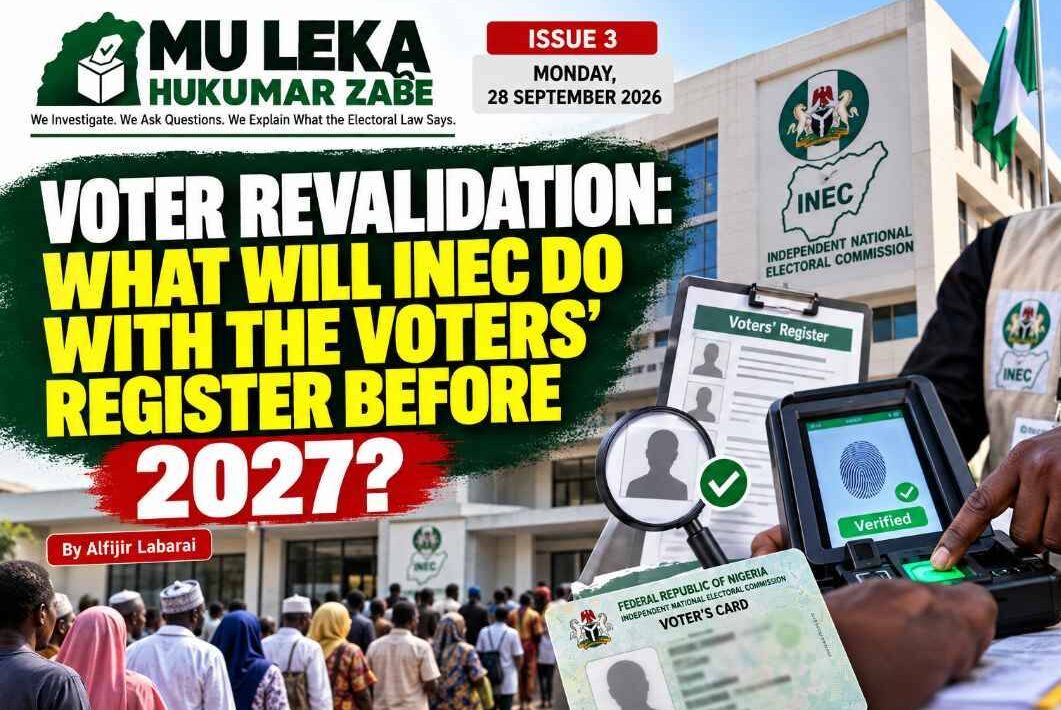
VOTER REVALIDATION: WHY DID INEC POSTPONE THE NATIONWIDE EXERCISE UNTIL AFTER 2027?
By Alfijir Labarai
INTRODUCTION
In Issue 2, we examined an important question: Does Nigeria have an accurate voters’ register that can serve as a reliable foundation for the 2027 General Election?
In this Issue 3, we follow the next major development concerning the voters’ register:
The planned nationwide Voter Revalidation Exercise.
In February 2026, the Independent National Electoral Commission (INEC) announced plans for a nationwide voter revalidation exercise to clean up and strengthen the integrity of the voters’ register ahead of the 2027 General Election.
INEC said the exercise was intended to address issues including duplicate registrations, registration by non-citizens, deceased voters, underage registrations, and incomplete or inaccurate records.
But the situation later changed.
On 10 April 2026, INEC announced that it had decided to postpone the nationwide Voter Revalidation Exercise until after the 2027 General Election.
The Commission said the exercise remained an important part of its mandate to maintain a credible and up-to-date National Register of Voters. It said the exercise was designed to verify and review existing voter records, ensure the accuracy of personal data, eliminate duplicate and ineligible entries, and strengthen the integrity of the register.
This therefore raises a new question:
WHY WAS THE REVALIDATION EXERCISE POSTPONED, AND WHAT DOES THIS MEAN FOR THE VOTERS’ REGISTER AHEAD OF 2027?
THE PLAN THAT CHANGED
When INEC announced the revalidation exercise in February, the Commission presented it as part of its preparations for the 2027 General Election.
The exercise was expected to help review existing voter records and identify entries that might no longer be eligible.
However, in April, INEC postponed the exercise until after the 2027 General Election.
This means that the nationwide revalidation exercise originally planned before the 2027 election will not now serve as a nationwide pre-election revalidation exercise.
That change deserves public attention.
The question is no longer simply:
“What will INEC do during Voter Revalidation?”
The more relevant questions are now:
Why was the exercise postponed?
What other processes will INEC use to maintain the voters’ register before 2027?
And how will voters confirm that their information is correct?
WHAT INEC SAID ABOUT THE PURPOSE OF REVALIDATION
INEC described voter revalidation as a process for verifying and reviewing existing voter records.
The Commission said it was designed to:
Verify existing voter information.
Ensure the accuracy of personal data.
Identify duplicate registrations.
Remove ineligible entries.
Strengthen the integrity of the National Register of Voters.
Give registered voters an opportunity to confirm and correct their details.
The Commission has therefore made clear that the exercise was not intended to be a fresh voter registration exercise.
But since the nationwide exercise has now been postponed until after 2027, another question becomes important:
HOW WILL THESE OBJECTIVES BE ADDRESSED BEFORE THE 2027 ELECTION?
THE VOTERS’ REGISTER AND THE ELECTORAL ACT 2026
The Electoral Act 2026 places responsibility for compiling, maintaining and continuously updating the National Register of Voters on INEC.
Section 9 provides for a National Register of Voters and requires INEC to maintain it on a continuous basis.
The law also provides that voter registration, updating and revision of the register must stop no later than 90 days before an election covered by the Act.
This means that maintaining an accurate register is not dependent on one single revalidation exercise.
The law establishes a wider framework for registration, updating, revision, public scrutiny, claims and objections.
PUBLIC DISPLAY OF THE VOTERS’ REGISTER
Section 19 of the Electoral Act 2026 provides that, not later than 90 days before a general election, INEC shall appoint a period of seven days during which copies of the voters’ register are to be displayed or published for public scrutiny.
The register is to be made available at registration areas and on the Commission’s official website or another website established by the Commission for that purpose.
This gives citizens an opportunity to check the register.
But the law goes further.
INEC is required to accept and consider objections and complaints concerning names omitted from or included in the register, as well as necessary corrections, within 14 days after the voters’ register is displayed.
WHAT IF A VOTER’S NAME IS MISSING?
Under Section 19 of the Electoral Act 2026, a person may make a claim where the name of a registered voter has been omitted from the displayed register.
A person may also object to the inclusion of a person who is not qualified to be registered, including the inclusion of the name of a deceased person.
Claims and objections are addressed to the Resident Electoral Commissioner through the Electoral Officer responsible for the relevant Local Government or Area Council.
This is an important protection within the electoral system.
It means that voters are not expected simply to accept whatever appears on the register without an opportunity to raise concerns.
WHAT IF A VOTER DISAGREES WITH THE DECISION?
Section 20 of the Electoral Act 2026 provides for the appointment of a Revision Officer to hear and determine claims and objections concerning entries or omissions in the voters’ register.
Where a person is dissatisfied with the determination of the Revision Officer, the law provides an opportunity to appeal to the Resident Electoral Commissioner within seven days.
The decision of the Resident Electoral Commissioner is final under that provision.
This is why voter education matters.
A person who discovers a problem with the voters’ register needs to know not only that there is a problem, but also what procedure the law provides for addressing it.
DUPLICATE REGISTRATION REMAINS AN ISSUE
Although the nationwide revalidation exercise has been postponed, duplicate registration remains an issue that INEC has repeatedly warned about.
In February 2026, the Commission said its technology was capable of detecting double registration and that persons involved in double registration would be removed from the register.
The important question for Mu Leka Hukumar Zaɓe is therefore not merely whether duplicate registrations can be detected.
We will ask:
How are suspected duplicates verified?
What safeguards exist against mistaken identification?
What happens to a voter whose registration is wrongly affected?
And what procedure is available to challenge an incorrect decision?
THE 2023 REGISTER
As of the 2023 General Election, Nigeria’s voters’ register stood at 93,469,008 voters, according to INEC.
INEC said in February 2026 that persistent challenges affecting the register included duplicate registrations, registration by non-citizens, deceased voters and incomplete or inaccurate records.
Those concerns were among the reasons the Commission initially proposed the nationwide revalidation exercise.
However, because the nationwide revalidation has now been postponed until after 2027, the focus should shift to the mechanisms that will be used to maintain and verify the register before the election.
WHAT CAN A VOTER DO NOW?
Voters should pay attention to official INEC announcements concerning:
Their voter registration status.
The accuracy of their personal information.
Their voter information and polling unit.
PVC-related issues.
The publication or display of the voters’ register.
Claims and objections.
And any official instructions issued by INEC before the 2027 election.
INEC’s voter portal also provides services relating to voter information updates, transfers, PVC replacement and voter information review.
MU LEKA KANO
As a media platform based in Kano, Alfijir Labarai will examine how these processes affect voters in Kano.
We will ask INEC Kano:
How is the voters’ register being maintained ahead of 2027?
How will voters be informed when the register is displayed?
How can voters submit claims or objections?
Where should voters go when they discover problems with their registration?
And what procedures are available to voters who believe their registration has been wrongly affected?
We will seek answers from the appropriate electoral authorities and compare official information with the experiences of voters.
WE WILL NOT ASSUME
Mu Leka Hukumar Zaɓe will not present an allegation as fact without evidence.
We will not say that a voter has been removed from the register without verification.
We will not claim that the postponement of revalidation automatically means the register is inaccurate.
Instead, we will ask:
What has INEC said?
What does the Electoral Act 2026 provide?
What do official records show?
What can a voter do when a problem is discovered?
And what mechanisms exist to protect the accuracy of the voters’ register?
Where information is not yet verified, we will say so.
Where official information changes, we will report the change.
Because our responsibility is:
We Investigate.
We Ask Questions.
We Explain What the Electoral Law Says.
THE BIG QUESTION OF ISSUE 3
VOTER REVALIDATION:
WHY DID INEC POSTPONE THE NATIONWIDE EXERCISE UNTIL AFTER 2027?
And more importantly:
WHAT WILL HAPPEN TO THE VOTERS’ REGISTER BEFORE THE 2027 GENERAL ELECTION?
These are the questions Mu Leka Hukumar Zaɓe will continue to follow.
CONCLUSION
The voters’ register is more than a list of names.
It is a fundamental part of the electoral process because it identifies the people who are registered to participate in elections.
INEC initially announced a nationwide voter revalidation exercise as part of efforts to clean up and strengthen the register ahead of 2027.
But on 10 April 2026, the Commission announced that the exercise had been postponed until after the 2027 General Election.
That development creates a new set of questions for voters and the public:
How will the register be maintained before 2027?
How will voters confirm their information?
When will the voters’ register be displayed for public scrutiny?
How will claims and objections be handled?
And what does the Electoral Act 2026 provide for voters whose information is missing or incorrect?
These are the questions we will continue to investigate.
Monday after Monday.
MU LEKA HUKUMAR ZAƁE
We Investigate. We Ask Questions. We Explain What the Electoral Law Says.
By Alfijir Labarai
CONNECT WITH ALFIJIR LABARAI
Stay connected with Alfijir Labarai / Alfijir News for the latest news, reports, investigations, programmes and important updates from Kano, Nigeria and around the world.
📞 CONTACT US
For enquiries, news tips, partnership, advertising, sponsorship and more information:
+234 803 207 7835
📰 Have a story, development or important information to share?
Send your news tips, press releases, announcements and community stories to Alfijir Labarai.
🤝 PARTNER WITH US
We welcome individuals, organisations, institutions and businesses interested in:
• Media Partnership
• Advertising
• Programme Sponsorship
• Corporate Partnerships
• Special Reports & Features
• Event & Programme Promotion
📞 Contact us:
+234 803 207 7835
🌐 FOLLOW ALFIJIR LABARAI
🐦 X (Twitter):
“Follow us on X” https://twitter.com/Musabestseller?s=09
📘 Facebook:
“Follow us on Facebook” https://www.facebook.com/profile.php?id=100089640289165
🧵 Threads:
“Follow us on Threads”https://www.threads.net/@alfijirlabarai
▶️ YouTube:
“Subscribe on YouTube” https://www.youtube.com/@BestsellerChannel12
📸 Instagram:
“Follow us on Instagram” https://www.instagram.com/musa_bestseller?utm_source=qr&r=nametag
📲 JOIN OUR WHATSAPP GROUP
Get our latest news updates, programmes, reports and important announcements directly on WhatsApp.
👇👇 Join the Alfijir Labarai / Alfijir News WhatsApp Group:
“Join our WhatsApp Group” https://chat.whatsapp.com/Ilj1iz8v3sa3nBfrCz9U6f?s=cl&p=a&mlu=4&ilr=4
ALFIJIR LABARAI MEDIA SERVICES
Accurate • Timely • Trusted
📰 News • Reports • Investigations • Programmes • Public Awareness
© 2026 Alfijir Labarai Media Services