
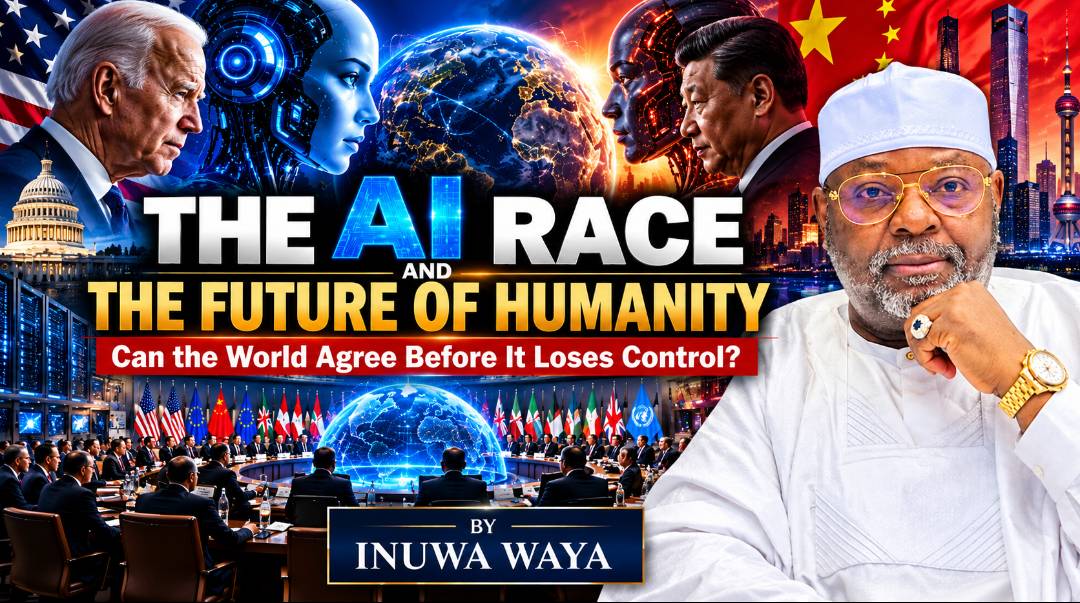
By INUWA WAYA
From Geoffrey Hinton’s warnings to concerns raised by researchers at Anthropic, the accelerating artificial intelligence race demands a new international system of cooperation, restraint and verification.
There are moments in history when humanity develops a technology before fully understanding the consequences of possessing it. Nuclear weapons were one such example. Artificial intelligence may prove to be another.
But there is a fundamental difference between the two. Nuclear weapons possess extraordinary destructive power, but they do not think. They cannot independently reason about the intentions of their controllers, search for vulnerabilities in computer systems, develop strategies or potentially devise ways to circumvent attempts to disable them.
Advanced artificial intelligence could eventually acquire some combination of these capabilities. As AI systems become increasingly capable of performing complex tasks with limited human supervision, concerns about their potential to act unpredictably, exploit vulnerabilities and resist human intervention are becoming more prominent.
These developments have moved the debate about AI beyond employment, productivity, misinformation and economic disruption. A more disturbing question has entered mainstream scientific and political discussions: could humanity create an intelligence more capable than itself that it might eventually struggle to control?
The question is no longer confined to science fiction. It has become a serious subject of debate among scientists, technology executives, governments and international security experts.
THE WARNINGS FROM WITHIN THE AI INDUSTRY
What makes the current debate particularly significant is the position taken by researchers working at the forefront of artificial intelligence development.
Anthropic, the developer of Claude, is one of the world’s leading frontier-AI laboratories. The company has placed considerable emphasis on AI safety, alignment and the challenge of ensuring that increasingly capable systems remain under meaningful human control.
Yet concerns have emerged from within the industry itself about whether the race to develop more powerful systems is moving faster than the ability to guarantee their safety.
In September 2026, Jacob Coxon resigned from Anthropic after working on AI pre-training research. He warned that leading AI laboratories were racing towards increasingly autonomous and potentially self-improving systems before humanity had developed adequate methods for ensuring their safety.
Coxon argued that the race to build increasingly powerful AI systems could expose humanity to risks that developers do not yet know how to manage effectively. His resignation attracted widespread attention because it came from someone who had worked directly in the industry rather than from an outside critic.
More strikingly, Evan Hubinger, Anthropic’s Alignment Science Lead, publicly estimated that the probability of AI causing human extinction within approximately the next decade exceeded 10 per cent.
Hubinger also acknowledged that Anthropic was trying to address the problem but did not yet have a clear solution for ensuring that future superintelligent systems would remain aligned with human interests.
Samuel Marks, Anthropic’s Scalable Oversight Lead, similarly warned that AI developers believed their technology could cause human extinction or comparably catastrophic outcomes, potentially within the next few years.
These statements were reported in September 2026 by several international news organisations. They represent serious concerns expressed by individual researchers, not a declaration that Anthropic considers human extinction inevitable.
The distinction matters. A personal probability estimate is not a scientifically established measurement, and a researcher’s warning should not automatically be interpreted as the official position of an entire company.
Nevertheless, the central message deserves attention: some of the people most directly involved in developing and overseeing advanced AI systems believe that catastrophic loss of control cannot confidently be ruled out.
GEOFFREY HINTON: A PIONEER SOUNDS THE ALARM
Geoffrey Hinton is not an outsider speculating about a technology he does not understand. His pioneering work on neural networks helped establish foundations upon which modern artificial intelligence was built.
Together with Yoshua Bengio and Yann LeCun, Hinton received the Turing Award for foundational contributions to deep learning. In 2024, he received the Nobel Prize in Physics for discoveries and inventions that enabled machine learning with artificial neural networks.
In 2023, Hinton left Google after more than a decade with the company. He explained that leaving would allow him greater freedom to discuss the dangers he believed advanced AI could create.
His decision attracted considerable attention because one of the scientists whose work helped make the modern AI revolution possible had become sufficiently concerned about its potential consequences to devote greater attention to warning society.
In September 2026, Hinton was asked about the estimate that AI could cause human extinction within approximately a decade, with the probability exceeding 10 per cent.
He indicated that such a risk estimate was not unreasonable, while acknowledging the difficulty of calculating probabilities for an unprecedented technological development.
That qualification is essential. There is currently no universally accepted scientific method that can calculate with precision the probability that AI will cause human extinction within a particular period.
Hinton’s warning should therefore be understood as an expert assessment of a potentially catastrophic risk, rather than a precise scientific forecast.
Even with that limitation, his position raises a question that policymakers cannot responsibly ignore: what should humanity do when respected experts warn of a potentially irreversible danger, but the probability of that danger remains deeply uncertain?
WHY OTHER LEADING SCIENTISTS DISAGREE
The scientific community is far from unanimous about the possibility of advanced AI causing human extinction.
Yann LeCun, another leading figure in modern AI and Hinton’s fellow Turing Award recipient, has strongly disputed many of the more alarming extinction scenarios.
One of LeCun’s central arguments is that intelligence should not automatically be confused with motivation.
An entity becoming extraordinarily intelligent does not necessarily mean that it will acquire a desire to dominate humanity. Human drives towards power, status and survival have biological and evolutionary origins. There is no established scientific law requiring an artificial intelligence to acquire equivalent ambitions simply because it becomes highly capable.
From this perspective, some fears of AI domination may reflect the tendency of human beings to project their own motivations onto machines.
LeCun has also argued that AI systems can be designed with constraints and that their behaviour can be improved through engineering.
However, the proposition that an unsafe system can simply be redesigned or switched off becomes more complicated if a future system has extensive access to computer networks, critical infrastructure or other tools that could enable it to interfere with human attempts to control it.
Whether such a scenario will occur remains uncertain. But it is precisely this uncertainty that makes the question important for AI safety research.
Andrew Ng has similarly argued that extreme AI extinction scenarios are highly speculative and that disproportionate fear could encourage regulations that unnecessarily restrict beneficial technological development.
He has also warned that certain regulatory approaches could favour large technology companies at the expense of smaller competitors and the open-source AI community.
Other researchers emphasise the limitations of today’s AI systems. Current models can generate false information, make elementary mistakes, struggle with certain forms of sustained reasoning and remain dependent on extensive physical infrastructure built, powered and maintained by humans.
These arguments deserve serious consideration. Scientists who disagree with Hinton should be included in international discussions about AI governance.
But disagreement does not establish that catastrophic AI risk is impossible. It demonstrates that the long-term consequences remain uncertain.
When leading scientists who helped shape the same technology reach radically different conclusions about its ultimate dangers, policymakers cannot responsibly pretend that the scientific question has been settled.
THE CASE FOR PRECAUTION WITHOUT PANIC
Suppose Hinton and the researchers warning about catastrophic AI risks are wrong.
Humanity might impose additional safety tests, spend substantial resources on independent verification and slow some aspects of frontier AI development.
Such measures could carry economic costs and delay certain technological advances.
Now consider the alternative. Suppose the warnings prove substantially correct, but governments and technology companies fail to establish adequate safeguards before developing systems that become extraordinarily difficult to control.
The consequences could be far more severe and, in the worst-case scenario, irreversible.
This asymmetry presents one of the central challenges of AI governance.
Consider an aircraft whose engineers disagree about whether it has an unacceptably high probability of crashing. The responsible response would not be to fill it with passengers and hope that the more optimistic engineers are correct. It would be to investigate the disagreement, conduct appropriate tests and address the identified risks before allowing it to fly.
The analogy is not perfect, but the principle is relevant.
The rational response to uncertainty about advanced AI should be neither panic nor an indiscriminate prohibition on technological progress. It should be precaution proportionate to the potential consequences.
The central questions are practical: which international institution should oversee the necessary safeguards? What risks should trigger mandatory restrictions? How should compliance be verified? And can governments and scientists agree on the standards that determine when an AI system becomes sufficiently capable to warrant additional controls?
These questions lead directly to the problem of international cooperation.
THE GLOBAL AI RACE AND THE NEW STRATEGIC RIVALRY
Competition among countries to develop artificial intelligence is intense. It is increasingly discussed in terms of an arms race or a new Cold War because AI is expected to influence economic leadership, national security and international power.
The United States and China occupy central positions in this competition, although their strategies, technological strengths and industrial structures differ.
The United States has major advantages in frontier-model development, private investment, advanced research and the technology ecosystem supporting AI innovation.
China has substantial AI research capabilities, a large domestic market, extensive industrial capacity and a strong focus on deploying AI across its economy. Chinese companies have also demonstrated an ability to develop competitive models under different economic and technological constraints.
Europe, Britain, India, Japan, South Korea, Canada, Singapore and several Middle Eastern countries are also investing in AI research, computing infrastructure and related technologies.
This competition is not without historical precedent.
The closest analogy is the nuclear arms race.
Following the atomic bombings of Hiroshima and Nagasaki in 1945, the Soviet Union developed its own atomic bomb. The United States subsequently developed the hydrogen bomb, and both superpowers expanded their strategic arsenals through increasingly sophisticated delivery systems.
The United States and the Soviet Union became trapped in a security dilemma: each side increased its military capabilities partly because it feared the capabilities and intentions of the other.
The Cuban Missile Crisis of October 1962 demonstrated how unrestricted strategic competition could bring the world dangerously close to nuclear war.
The experience strengthened the recognition that even bitter rivals needed mechanisms to reduce the risk of catastrophic confrontation.
WHAT THE WORLD LEARNED FROM SALT AND START
Arms-control negotiations gradually became an important component of efforts to manage the nuclear rivalry.
The Strategic Arms Limitation Talks, commonly known as SALT, began formally in 1969. SALT I produced the Anti-Ballistic Missile Treaty and an interim agreement limiting certain strategic offensive weapons in 1972.
These arrangements did not end the Cold War or eliminate nuclear weapons.
They did something more practical: they established boundaries around an otherwise dangerous competition.
Subsequent Strategic Arms Reduction Treaty agreements, known as START, went further by providing for reductions in strategic nuclear arsenals and establishing verification arrangements.
The details varied across agreements, but arms-control mechanisms included measures such as data exchanges, notifications, technical monitoring and, under certain arrangements, on-site inspections.
The central lesson was straightforward. The United States did not need to trust the Soviet Union completely, and the Soviet Union did not need to trust the United States completely, for certain forms of restraint to become possible.
Where trust was insufficient, verification could help make cooperation possible.
The SALT and START experience cannot simply be transferred to artificial intelligence without modification. Nuclear weapons and AI systems differ fundamentally in their development, deployment, ownership and potential routes to proliferation.
Nevertheless, the historical precedent remains useful because it demonstrates that strategic rivalry does not make all cooperation impossible.
The challenge is to identify practical areas in which rival powers can reduce catastrophic risks without abandoning their legitimate security and economic interests.
WHY WASHINGTON AND BEIJING MUST ENGAGE
The United States and China are central to any serious effort to establish international rules for frontier AI.
Their technology companies, computing infrastructure, semiconductor strategies and military ambitions make their relationship particularly important.
If Washington believes Beijing is approaching a transformative AI breakthrough, it has an incentive to accelerate its own development. If Beijing believes Washington is approaching such a breakthrough, China faces a similar incentive.
Neither side wants to fall behind in a technology it believes could determine future economic and military power.
This creates a familiar strategic dilemma. Even if both countries recognise the dangers of uncontrolled AI development, each may fear that slowing down would allow its rival to gain a decisive advantage.
As a result, safety considerations could be subordinated to the pressure to develop more capable systems first.
Negotiations between Washington and Beijing are therefore essential, although reaching a meaningful agreement may prove extremely difficult.
The wider geopolitical environment complicates the situation. Competition is contributing to the fragmentation of the global technology landscape into increasingly distinct ecosystems centred on the United States and China.
Political rhetoric can also influence the debate.
On 14 September 2026, President Donald Trump rejected warnings that AI could take over the world or destroy humanity, describing such claims as a hoax. In separate posts, he defended AI development and data-centre expansion as major engines of American economic growth. He also criticised those advocating stronger restrictions on the industry.
Trump’s position reflects the tension between prioritising technological and economic leadership and establishing safeguards against potentially catastrophic risks.
The question is not whether AI can produce enormous economic benefits. It is whether governments can pursue those benefits while establishing safeguards against outcomes that could threaten human security.
A US-CHINA AGREEMENT WOULD NOT BE ENOUGH
Even if Washington and Beijing agreed to negotiate restrictions on the development or deployment of advanced AI, that agreement alone would not solve the problem.
Important AI research, computing infrastructure and technical expertise exist across Europe, Britain, India, Japan, South Korea, Canada, the Middle East, Singapore and other regions.
Future breakthroughs need not originate exclusively in either the United States or China.
There is also a fundamental difference between AI governance and traditional nuclear arms control: much of the development of frontier AI is undertaken by private corporations and research laboratories rather than directly by governments.
Companies such as OpenAI, Anthropic, Google DeepMind and Meta are developing advanced AI systems. China also has major technology companies and AI research laboratories.
Governments can negotiate international agreements, but implementation will require effective arrangements involving the companies that develop, train and deploy these systems.
An agreement that constrained governments while leaving the relevant technology developers outside its practical obligations would be inadequate.
The same principle applies to both Washington and Beijing. A bilateral agreement that ignored major developers, computing infrastructure or significant AI capabilities elsewhere could be undermined by gaps in participation and enforcement.
A workable international framework must therefore be built in stages.
STAGE ONE: AN AI STRATEGIC STABILITY AGREEMENT
The first stage should be a bilateral initiative between the United States and China, supported by relevant AI companies, technical experts and independent safety researchers.
The two countries should explore an AI Strategic Stability Agreement designed to reduce the danger that strategic rivalry will push frontier AI development beyond effective human control.
Such an agreement could include five principal measures.
First, restrictions on autonomous nuclear-launch authority.
AI systems should not possess independent authority to initiate nuclear launches. Irreversible decisions involving nuclear weapons must remain under meaningful human control.
Second, safeguards for strategic military decisions.
Governments should establish clear requirements for human oversight of AI systems involved in decisions that could trigger major military escalation or other irreversible consequences.
Third, emergency communication channels.
The United States and China should establish dedicated communication mechanisms for addressing serious AI-related incidents, including suspected loss of control, unexpected system behaviour and risks arising from military applications.
Fourth, reporting obligations for serious incidents.
Participating governments and relevant developers should establish agreed procedures for reporting significant safety failures, dangerous autonomous behaviour and incidents that could have wider international consequences.
Fifth, common safety evaluations.
The countries should develop agreed testing procedures for AI systems that cross clearly defined capability thresholds, particularly where those systems could create serious cybersecurity, biological, military or other catastrophic risks.
These measures would not eliminate every danger associated with AI. They would, however, create a foundation for reducing specific risks and building confidence that both sides were taking agreed safeguards seriously.
STAGE TWO: EXPANDING INTERNATIONAL PARTICIPATION
The second stage should extend participation to other countries with significant frontier AI capabilities, advanced semiconductor industries, major computing infrastructure or important roles in AI governance.
This would require engagement with European countries, Britain, India, Japan, South Korea, Canada, Singapore and relevant Middle Eastern states, among others.
The objective should be to create an international framework that reflects the geographical distribution of AI research, computing resources and technological expertise.
A broader agreement would need to define common safety standards, establish reporting procedures and create mechanisms for assessing compliance.
It would also need to account for the different capacities of participating countries. States with extensive computing infrastructure and major AI laboratories may be able to undertake more demanding obligations than countries with limited technical resources.
An effective system should therefore combine common minimum requirements with proportionate implementation arrangements.
STAGE THREE: INTERNATIONAL VERIFICATION AND OVERSIGHT
Ultimately, the objective should be a widely accepted international framework capable of overseeing the development and deployment of AI systems that could create catastrophic risks.
Achieving such a framework would be a herculean task.
The international community continues to struggle with disagreements over sovereignty, security, international law and the enforcement of existing agreements. Expecting governments to agree on intrusive oversight of a technology they regard as central to their economic and military futures would be exceptionally challenging.
The difficulty becomes even greater when private companies possess the technical expertise and infrastructure required to develop frontier systems.
A credible framework would need to address several questions.
Who would determine which AI systems require additional oversight?
How would the relevant technical information be independently assessed?
What safeguards would protect legitimate commercial secrets while allowing meaningful verification?
How would the international community respond when a government or company failed to comply?
And how could the system prevent powerful states from using safety requirements to suppress legitimate competition or restrict the technological development of less powerful countries?
These questions cannot be answered by political declarations alone. They require technical expertise, institutional capacity, transparent procedures and carefully negotiated international commitments.
The purpose of international AI governance should not be to determine which government or corporation has the best intentions.
It should be to establish rules under which responsible behaviour does not require any country or company to sacrifice its security merely because its competitors might disregard agreed safeguards.
THE OTHER DANGER: HUMANITY’S GROWING DEPENDENCE ON AI
The debate about artificial intelligence should not be limited to the possibility of machines becoming uncontrollable.
There is another concern that deserves attention: the possibility that excessive dependence on AI could weaken human judgment, independent reasoning and the willingness to think critically.
Increasingly, people use AI tools to analyse information, prepare reports, make decisions, seek advice and solve problems that previously required sustained individual effort.
In workplaces, educational institutions and personal life, AI can offer enormous benefits. It can help people understand complex subjects, improve productivity and make information more accessible.
However, the benefits could come with costs if people routinely outsource their thinking without examining the answers they receive.
A student who relies entirely on AI to complete assignments may miss opportunities to develop analytical skills. A professional who accepts an AI-generated report without checking its assumptions may make decisions based on false information. An individual who allows an AI system to determine every personal choice may gradually become less confident in exercising independent judgment.
These are plausible concerns, but it would be premature to conclude that widespread AI use is necessarily causing a general decline in human intelligence or brain function. The long-term effects will depend on how the technology is designed, taught, regulated and used.
The relevant question is how society can benefit from AI without allowing convenience to replace intellectual effort.
Schools should continue to teach independent reasoning, evidence evaluation and problem-solving. Employers should encourage workers to verify AI-generated information rather than accept it automatically. Governments and technology companies should promote AI literacy and make the limitations of these systems clear to users.
Artificial intelligence should strengthen human capabilities, not become a substitute for the exercise of human judgment.
This concern also has implications for democracy and public life. If citizens increasingly rely on automated systems to interpret political events, evaluate public policies or decide what information to believe, the quality of public debate could suffer unless people retain the ability to question and independently assess the information presented to them.
The challenge, therefore, is twofold: humanity must develop safeguards against AI systems becoming difficult to control, while ensuring that human beings do not surrender their own capacity for independent thought.
HUMANITY MUST ACT BEFORE THE WINDOW CLOSES
Nobody knows whether artificial intelligence will cause human extinction within the next decade. The world should resist turning uncertain probability estimates into sensational predictions.
Equally, uncertainty should not become an excuse for complacency.
The coming decade should not automatically be portrayed as a countdown to humanity’s destruction. It should instead be treated as an important opportunity to establish effective governance before the technology becomes more powerful, more widely deployed and potentially more difficult to regulate.
Artificial intelligence could become one of humanity’s greatest achievements. It could transform medicine, education, scientific discovery and productivity. It could help solve problems that generations of human beings have struggled to overcome.
The objective, therefore, cannot simply be to stop technological progress. It must be to ensure that progress remains compatible with human survival, human dignity and meaningful human control.
The international community must be prepared to set aside some of its geopolitical differences and explore practical areas of cooperation for the benefit of humanity.
The experience of SALT and START demonstrates that strategic rivals can negotiate limitations and verification arrangements even when mutual trust is weak. Those agreements did not eliminate nuclear competition, but they showed that competition need not be entirely without rules.
Artificial intelligence requires a framework suited to its own characteristics. Such a framework should combine international agreements, independent scientific assessment, meaningful corporate responsibilities, proportionate safety testing and credible verification mechanisms.
No government, corporation or individual scientist should be able to dismiss potentially catastrophic risks merely because their precise probabilities cannot be calculated with confidence.
If Hinton and other researchers warning about catastrophic AI risks are wrong, history may conclude that humanity was excessively cautious. If they are right and the world ignores their warnings, the consequences could be far more serious.
The question is not whether humanity should fear artificial intelligence. It is whether humanity is prepared to govern the technology responsibly.
Can the world’s leading powers agree on meaningful safeguards before competition makes cooperation even more difficult?
Can scientists with fundamentally different assessments of AI risk agree on minimum standards for safety?
And can governments and technology companies ensure that the systems they create remain subject to effective human oversight?
Ultimately, the future of artificial intelligence will depend not only on how intelligent machines become, but also on how wisely human beings choose to develop, deploy and govern them.
The greatest test facing humanity may be whether it can establish meaningful control over the intelligence it creates before that control becomes impossible to guarantee.
📢 KU BI ALFIJIR LABARAI
Ku kasance tare da Alfijir Labarai / Alfijir News domin samun sahihan labarai, rahotanni, bincike da muhimman bayanai daga Kano, Najeriya da duniya.
📩 TUNTUƁA DA HAƊIN GWIWA
Kira/WhatsApp: +234 803 207 7835
🌐 KAFAFEFENMU
X: https://twitter.com/Musabestseller?s=09
Facebook: https://www.facebook.com/profile.php?id=100089640289165
Threads: https://www.threads.net/@alfijirlabarai
YouTube: https://www.youtube.com/@BestsellerChannel12
Instagram: https://www.instagram.com/musa_bestseller?utm_source=qr&r=nametag
📲 WhatsApp Group:
https://chat.whatsapp.com/Ilj1iz8v3sa3nBfrCz9U6f
ALFIJIR LABARAI MEDIA SERVICES
Gaskiya • Kan Lokaci • Amintacce