
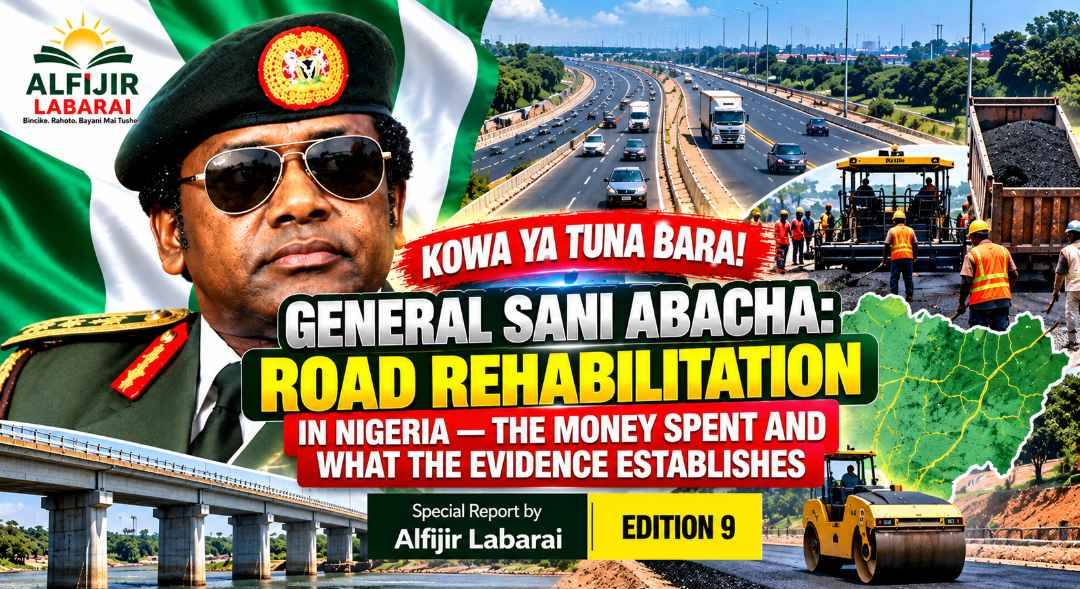
KOWA YA TUNA BARA!
Special Report by Alfijir Labarai
EDITION 9
Introduction
Roads are essential infrastructure that connects communities, facilitates transportation, supports trade and enables farmers to move their produce to markets.
During the administration of General Sani Abacha, from 1993 to 1998, road rehabilitation was presented as one of the areas receiving funding for national development.
This edition examines what official records establish about road-related expenditure during that period. How much funding was publicly announced? What do available financial records show? And what can reasonably be attributed to the Abacha administration based on the available evidence?
WHAT ABACHA ANNOUNCED IN 1997
In his Independence Day address marking Nigeria’s 37th anniversary of independence on 1 October 1997, General Sani Abacha discussed activities undertaken through the Petroleum Trust Fund (PTF).
In the address, he stated that more than ₦30 billion had been committed to road rehabilitation across the country.
The statement is an important record of what the administration publicly announced. However, an announcement of funding or commitment does not, by itself, establish that every planned project was completed. Assessing actual delivery requires project records, completion reports and evidence of expenditure.
Source: Archivi.ng
https://archivi.ng/the-archivist/stories/issue-4/independence-day-speeches-nigeria/1997-independence-day-speech
WHAT DO IMF RECORDS SHOW?
A report published by the International Monetary Fund (IMF) contains financial data for the Petroleum Special Trust Fund (PSTF), including expenditure on development projects.
Under the category “Roads, road transport and waterways”, the report records the following expenditure:
• 1996: ₦11.863 billion.
• 1997: ₦12.412 billion.
These figures relate to the entire category, which includes roads, road transport and waterways. They should therefore not be described as expenditure on road rehabilitation alone.
The PTF and PSTF were distinct but related funding arrangements. According to the IMF, the PSTF received transfers from the PTF, including revenue linked to domestic petroleum product sales. The financial figures cited in this section are specifically recorded under the PSTF and should not be confused with the separate commitment announced for the PTF in Abacha’s 1997 address.
Source: International Monetary Fund
https://www.elibrary.imf.org/view/journals/002/1998/078/article-A004-en.xml
PTF CONTRIBUTED TO A ROAD PROJECT INVOLVING KANO
A World Bank report on a road project involving several states, including Kano, documents a funding arrangement that included World Bank financing and contributions from participating authorities.
The report records a PTF contribution of ₦224 million and a state counterpart contribution of ₦299 million. It also records approximately US$36.07 million disbursed from the World Bank credit.
This provides evidence that PTF contributed to a road project involving Kano. However, it does not mean that PTF financed the entire project. Nor does the project’s inclusion of Kano establish that all roads in the state were completed during Abacha’s administration.
Source: World Bank
https://documents1.worldbank.org/curated/en/275611468291014954/pdf/multi-page.pdf
WHAT THE EVIDENCE ESTABLISHES — AND WHAT STILL NEEDS VERIFICATION
The available records support three key findings.
First, the Abacha administration’s 1997 address announced that more than ₦30 billion had been committed to road rehabilitation nationwide.
Second, IMF financial data records expenditure under the broader category of roads, road transport and waterways in 1996 and 1997.
Third, the World Bank’s report confirms that PTF contributed to a road project involving Kano, alongside other sources of funding.
However, further official documentation is needed to establish a complete list of roads rehabilitated during the period, the total kilometres completed, the number of contracts completed before the end of Abacha’s rule, and the amounts actually paid for each project.
For that reason, this report does not present unverified claims about the total kilometres of roads covered or the percentage of projects completed as established facts.
CONCLUSION
The available evidence indicates that road rehabilitation was among the areas for which funding was announced and recorded during General Sani Abacha’s administration.
The administration’s public statement, IMF financial data and the World Bank’s report on a state road project provide useful evidence for understanding the funding arrangements and road-related expenditure of the period.
Nevertheless, a complete assessment of the programme requires more detailed documentation identifying the individual roads, their completion status, payments made to contractors and projects that continued after Abacha left office.
Alfijir Labarai’s responsibility is to examine historical development programmes through verifiable evidence, rather than relying solely on government announcements or attributing projects to an administration without establishing when they began and when they were completed.
KOWA YA TUNA BARA! — Remembering history requires evidence.
Alfijir Labarai
Investigation, Reporting and Evidence-Based Information.
📢 FOLLOW ALFIJIR LABARAI
Stay connected with Alfijir Labarai / Alfijir News for credible news, reports, investigative journalism, and important updates from Kano, Nigeria, and around the world.
📩 CONTACT US & PARTNERSHIP ENQUIRIES
Call/WhatsApp: +234 803 207 7835
🌐 OUR SOCIAL MEDIA PLATFORMS
X: https://twitter.com/Musabestseller?s=09
Facebook: https://www.facebook.com/profile.php?id=100089640289165
Threads: https://www.threads.net/@alfijirlabarai
YouTube: https://www.youtube.com/@BestsellerChannel12
Instagram: https://www.instagram.com/musa_bestseller?utm_source=qr&r=nametag
📲 JOIN OUR WHATSAPP GROUP
https://chat.whatsapp.com/Ilj1iz8v3sa3nBfrCz9U6f
ALFIJIR LABARAI MEDIA SERVICES
Truth • Timeliness • Trust
© 2026 Alfijir Labarai Media Services