
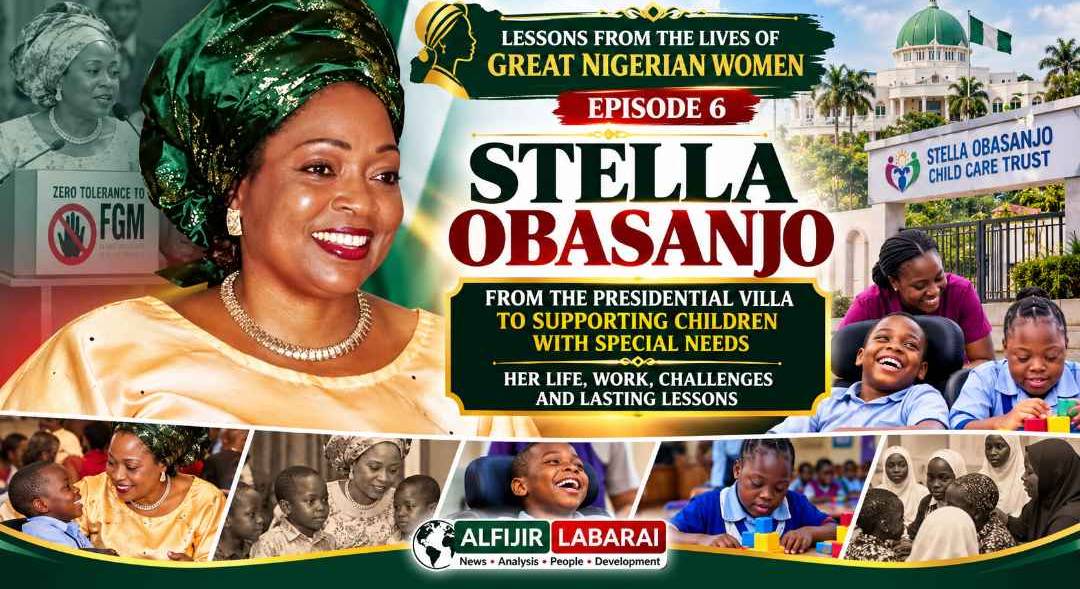
LESSONS FROM THE LIVES OF GREAT NIGERIAN WOMEN
EPISODE 6
STELLA OBASANJO
Introduction
Nigeria’s First Ladies have occupied a prominent place in the country’s public life. Beyond ceremonial responsibilities, some have used their positions to draw attention to social challenges, support vulnerable groups and promote public awareness campaigns.
One of them was Stella Obasanjo, wife of former President Olusegun Obasanjo and First Lady of Nigeria from 29 May 1999 until her death on 23 October 2005.
Born on 14 November 1945, Stella Obasanjo became associated with initiatives focusing on children with special needs and efforts to end female genital mutilation (FGM).
Her life provides an opportunity to examine how public influence can be used for social causes, why charitable initiatives require sustainable support, and why the legacies of public figures should be assessed through both documented achievements and evidence-based scrutiny.
1. Child Welfare: Supporting Children with Special Needs
One of the major initiatives associated with Stella Obasanjo was the Stella Obasanjo Child Care Trust, established to support children with special needs.
The Trust’s work brought attention to a group that can face significant barriers to education, healthcare, social inclusion and personal development.
Children with disabilities and other special needs deserve more than sympathy. They need access to appropriate education, healthcare, professional support and opportunities to participate meaningfully in society.
A report published by The Nation in November 2025 revisited the Trust as it marked the twentieth anniversary of Stella Obasanjo’s death. The report described activities planned around the remembrance, including an essay competition, an awareness walk and presentations by special schools. It also reported plans to support the Trust’s health, education and economic development activities.
These developments demonstrate that the initiative remained a subject of public activity and support years after its founder’s death.
The lesson: Public figures can use their influence to bring attention to vulnerable children, but the lasting value of such initiatives depends on the services delivered and the difference they make to beneficiaries.
2. Inclusion Is More Important Than Sympathy
The experience of children with special needs raises an important question for Nigerian society: are vulnerable children receiving the opportunities they need to develop their abilities?
Inclusive education, accessible facilities, appropriate healthcare and protection against discrimination are essential to helping children participate in society.
Government institutions, schools, families, healthcare providers, charitable organisations and private-sector partners all have responsibilities in this area.
Charitable support can help meet urgent needs, but it should complement rather than replace sustainable public services and long-term inclusion policies.
The lesson: A society’s commitment to vulnerable children should be measured not only by donations and public ceremonies, but also by the opportunities it makes available to them.
3. Women’s Rights: Her Role in the Campaign Against FGM
Stella Obasanjo also played a documented role in international advocacy against female genital mutilation, a harmful practice that can have serious physical and psychological consequences.
On 6 February 2003, at an international conference in Addis Ababa, Ethiopia, she made the declaration of “Zero Tolerance to FGM” in Africa on behalf of African First Ladies.
The date subsequently became internationally recognised as the International Day of Zero Tolerance for Female Genital Mutilation.
Her involvement demonstrated how a prominent public figure could use her position to draw attention to an issue affecting the health, dignity and rights of women and girls.
However, public declarations alone cannot eliminate harmful practices. Lasting progress requires community engagement, education, access to healthcare, legal protection and sustained efforts to address the social pressures that allow such practices to continue.
The lesson: Advocacy can help place neglected issues on the public agenda, but meaningful progress depends on sustained action and measurable results.
4. Sustainability: Can a Charitable Initiative Outlive Its Founder?
A major test of any charitable organisation is whether it can continue to serve its intended beneficiaries after its founder is no longer alive.
The Stella Obasanjo Child Care Trust offers an opportunity to consider this question. Reporting in 2025 documented activities associated with its twentieth-anniversary remembrance and efforts to support its work.
Such continuity is important, but the existence of an organisation or the announcement of activities does not, by itself, establish the full extent of its impact.
Long-term success requires dependable funding, accountable management, qualified personnel, clear objectives and transparent reporting.
Organisations also need systems that allow them to maintain their work through changes in leadership, funding and public attention.
The lesson: A lasting legacy is not simply an institution bearing someone’s name. It is an institution that continues to deliver meaningful services and can demonstrate its results.
5. Public Accountability and Press Freedom
A balanced examination of a public figure’s legacy must also consider controversies documented during their time in public life, while distinguishing allegations from established facts.
In May 2005, the Committee to Protect Journalists (CPJ) reported the arrest of Omo-Ojo Orobosa, publisher of the weekly Midwest Herald, following a publication that accused Stella Obasanjo of corruption in connection with the alleged sale of government-owned houses to relatives at below-market prices.
According to CPJ, Orobosa’s lawyer, Festus Keyamo, said that police had indicated they were acting on the First Lady’s orders. The report attributed the allegations about the property transaction to the newspaper’s publication and the lawyer’s account.
CPJ subsequently reported that Orobosa was released on 20 May 2005. The available reports cited here do not establish that the allegations against Stella Obasanjo were proven in court.
The episode nevertheless raises broader questions about press freedom, the treatment of journalists and the importance of allowing public-interest reporting to take place without intimidation.
Journalists also have a responsibility to verify allegations, seek responses from those concerned and avoid presenting unproven claims as established facts.
The lesson: Public service requires openness to legitimate scrutiny. Accountability and responsible journalism are both essential to a healthy democracy.
6. Measuring Social Impact: What Evidence Is Available?
Assessing a charitable initiative requires a distinction between its activities and its outcomes.
Establishing a trust, organising an awareness campaign or announcing support for children demonstrates that activities have taken place. It does not automatically establish how many people benefited, the extent of the improvements they experienced or whether those improvements were sustained.
The publicly available sources cited in this profile document the Trust’s purpose and some of its activities. However, they do not provide a comprehensive, independently verified long-term evaluation of its outcomes.
That limitation should not be interpreted as proof that the Trust had no impact. It means that stronger public evidence would be needed to assess the full scale and durability of its achievements.
Useful evidence would include beneficiary numbers, services delivered, educational or health outcomes, financial accountability reports and independent assessments of the organisation’s work.
The lesson: Public recognition is not a substitute for evidence. Social programmes should make their results as transparent as their announcements.
Lessons We Can Learn from Stella Obasanjo
Stella Obasanjo’s public life offers several lessons for Nigeria’s present and future leaders:
1. Use influence for social good. Public visibility can help bring neglected social issues to the attention of decision-makers and communities.
2. Protect vulnerable children. Children with special needs deserve dignity, care, education and opportunities for development.
3. Support women and girls. Advocacy against harmful practices must be sustained through education, healthcare, community engagement and protection.
4. Build institutions that endure. Charitable initiatives need reliable funding, transparent management and plans for continuity.
5. Respect accountability and press freedom. Public figures should be open to legitimate scrutiny, while journalists must verify allegations and report fairly.
6. Measure results honestly. The success of a programme should be assessed through evidence of benefits to the people it was established to serve.
Conclusion
Stella Obasanjo’s legacy includes her association with child welfare through the Stella Obasanjo Child Care Trust and her documented role in the 2003 declaration against female genital mutilation in Africa.
The continued activities associated with the Trust demonstrate that her child-welfare initiative remained part of Nigeria’s charitable landscape years after her death. At the same time, a full assessment of its long-term impact would benefit from more comprehensive public outcome data.
Her public life also reminds us that leadership must be examined critically and fairly, with due regard for accountability, press freedom and the distinction between allegations and proven facts.
Ultimately, the strongest legacy a public figure can leave is not merely a title, a campaign or an institution bearing their name. It is a lasting improvement in people’s lives, supported by evidence, transparency and a commitment to continue serving future generations.
ALFIJIR LABARAI — Truth. Timeliness. Trust.
Sources and Further Reading
1. The Nation, 9 November 2025 — Stella Obasanjo Childcare Trust: Pet Project at Twenty
https://thenationonlineng.net/stella-obasanjo-childcare-trust-pet-project-at-twenty/
2. Population Reference Bureau — Commemorating International Day of Zero Tolerance to Female Genital Mutilation
Commemorating International Day of Zero Tolerance to Female Genital Mutilation
3. United Nations — International Day of Zero Tolerance for Female Genital Mutilation
https://www.un.org/en/events/femalegenitalmutilationday/
4. Committee to Protect Journalists, 5 May 2005 — Publisher Arrested After Questioning First Lady’s House Sales
Publisher arrested after questioning first lady’s house sales
5. The New Humanitarian, 9 May 2005 — Publisher Under Arrest After “Greedy Stella” Obasanjo Story
https://www.thenewhumanitarian.org/news/2005/05/09/publisher-under-arrest-after-%E2%80%9Cgreedy-stella%E2%80%9D-obasanjo-story
6. National Library of Nigeria — Photo and Biographical Information: Stella Obasanjo
https://nigeriareposit.nln.gov.ng/items/43eec51c-fea6-499d-afd8-20a09c7635f4/full
Editorial note: This profile distinguishes documented activities from claims that have not been independently established. The sources reviewed do not provide a comprehensive independent evaluation of the Trust’s long-term outcomes.
📢 FOLLOW ALFIJIR LABARAI
Stay connected with Alfijir Labarai / Alfijir News for credible news, reports, investigative journalism, and important updates from Kano, Nigeria, and around the world.
📩 CONTACT US & PARTNERSHIP ENQUIRIES
Call/WhatsApp: +234 803 207 7835
🌐 OUR SOCIAL MEDIA PLATFORMS
X: https://twitter.com/Musabestseller?s=09
Facebook: https://www.facebook.com/profile.php?id=100089640289165
Threads: https://www.threads.net/@alfijirlabarai
YouTube: https://www.youtube.com/@BestsellerChannel12
Instagram: https://www.instagram.com/musa_bestseller?utm_source=qr&r=nametag
📲 JOIN OUR WHATSAPP GROUP
https://chat.whatsapp.com/Ilj1iz8v3sa3nBfrCz9U6f
ALFIJIR LABARAI MEDIA SERVICES
Truth • Timeliness • Trust
© 2026 Alfijir Labarai Media Services