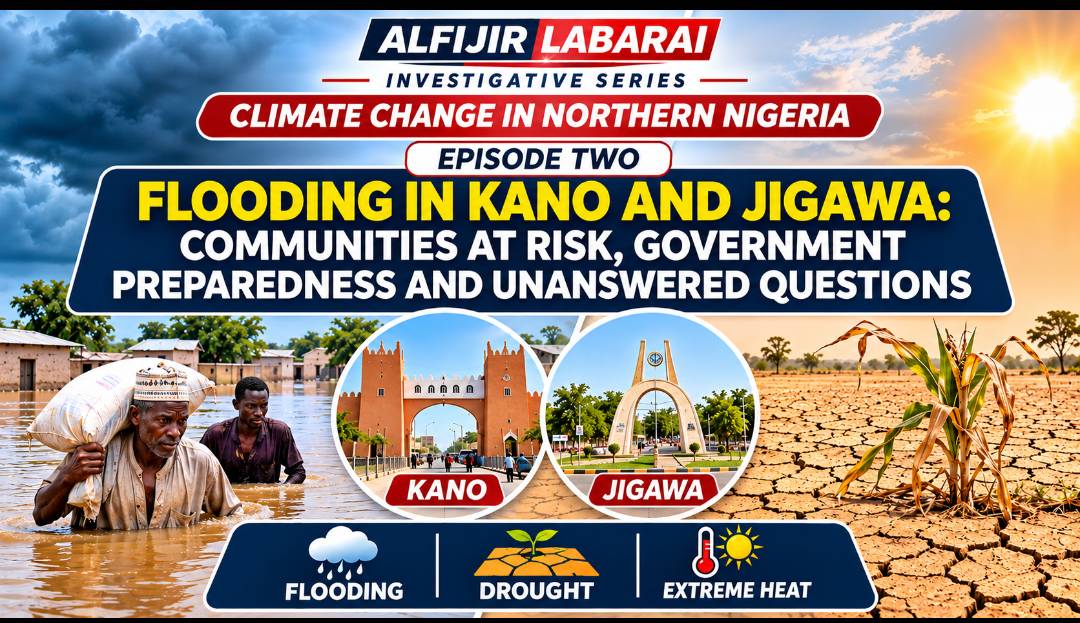
CLIMATE CHANGE IN NORTHERN NIGERIA
DROUGHT, FLOODING AND EXTREME HEAT — IMPACTS ON COMMUNITY LIVELIHOODS
EPISODE TWO
Flooding remains one of the major hazards threatening communities, particularly farmers, pastoralists, women, children and small business owners. Its effects go beyond damage to homes and farmlands. Flooding can disrupt transportation, destroy livelihoods, worsen food insecurity and increase the risk of disease outbreaks.
In Nigeria, relevant agencies have continued to issue weather forecasts and identify areas that may be exposed to flooding. However, an important question remains: are these warnings translating into effective preventive measures that reach the communities most at risk?
In this edition, Alfijir Labarai focuses on Kano and Jigawa States, examining information from weather and emergency management agencies, as well as statements made by officials and reported by the media.
1. NiMet Forecast: Rainfall Patterns Vary Across Northern Nigeria
The Nigerian Meteorological Agency (NiMet) issued its 2026 seasonal climate prediction, highlighting possible variations in rainfall distribution and the length of the rainy season across different parts of the country.
The agency warned that some parts of northern Nigeria could experience extended dry spells, while other areas might record rainfall above their long-term averages.
In its August–October 2026 forecast update, NiMet included Kano, Katsina, Jigawa, Bauchi, Yobe, Borno, Sokoto, Kebbi and Zamfara among the states expected to experience moderate to above-average rainfall.
The agency also emphasised the importance of maintaining drainage systems and taking preventive measures to reduce flood risks.
These forecasts demonstrate why the climate situation across Northern Nigeria should not be treated as uniform. Local geography, rainfall patterns and updated meteorological information must all be considered when planning for potential hazards.
2. NIHSA Identifies Areas at Risk of Flooding
The Nigeria Hydrological Services Agency (NIHSA) released an urban flood risk map covering October to November 2026.
Among the locations identified were:
Kano State: Fagge, Dala, Ungogo, Tofa and Takai.
Jigawa State: Hadejia, Malam Madori, Taura, Kafin Hausa and Ringim.
Borno State: Maiduguri, Jere, Bama, Konduga and Dikwa.
Bauchi State: Zaki, Alkaleri, Ningi and Gamawa.
The map also provided model-based estimates of potential floodwater depths in selected locations. For example, it indicated an estimated depth of 0.51 metres for Fagge, Dala and Ungogo in Kano, while some locations in Jigawa had estimates ranging from 0.41 to 0.50 metres.
It is important to clarify that these figures are estimates generated by a flood-risk modelling system. They do not establish that floodwater actually reached those depths in the named locations or that flooding had already occurred in every listed community.
The responsibility of state authorities is to use such risk information to plan preventive action before disasters occur.
3. NEMA: Flooding Affected 673,350 People Across Nigeria
The National Emergency Management Agency (NEMA) reported that, according to its dashboard data as of 20 October 2026, flooding had affected 673,350 people across 134 local government areas in 28 states.
The figures released by the agency included:
– 673,350 people affected.
– 214,997 people displaced from their homes.
– 245 fatalities.
– 134 local government areas affected across 28 states.
These are nationwide figures, not figures for Northern Nigeria alone.
The statement available to us did not provide a complete breakdown by individual state. Therefore, Alfijir Labarai will not attribute the national figures to Kano, Jigawa or other northern states without supporting state-level data.
This highlights the importance of NEMA publishing detailed information on affected people by state and local government area, enabling the public and researchers to understand where the impact is greatest.
4. Kano: Rainstorms Killed Nine People and Displaced 4,524
On 4 September 2026, the newspaper PUNCH reported figures provided by the Chairman of the Kano State Emergency Management Agency (KSEMA), Isyaku Kubarachi, concerning the impact of rainstorms between January and August 2026.
According to the figures attributed to the agency’s chairman:
– Nine people lost their lives.
– Forty-nine people sustained injuries.
– 4,524 people were displaced from their homes.
The affected areas were reported to include eight local government areas: Gaya, Ajingi, Rimin Gado, Minjibir, Kabo, Bichi, Shanono and Kibiya.
Bichi reportedly recorded 775 affected people, followed by Minjibir with 712 and Kibiya with 630.
The KSEMA chairman reportedly stated that the agency had completed an assessment of the affected areas and submitted its report to the state government for consideration of assistance to affected residents. At the time of the interview, he said the agency was awaiting relief materials.
However, the information available from that statement does not establish how many of the affected people subsequently received assistance, when any distribution took place or what support was provided to each group.
This leaves an important question:
After assessing the 4,524 people reported to have been displaced, what concrete assistance did the affected households receive?
5. Kano: 178 Communities Identified as Facing Moderate Flood Risk
At a public awareness event on 2026 flood preparedness held in Kano, it was reported that 178 communities across 28 local government areas of the state were considered to be at moderate risk of flooding.
During the event, a NEMA representative highlighted the importance of community preparedness, effective warning systems, simulation exercises and the availability of emergency response equipment.
Statements attributed to the Kano State Government also outlined proposed measures, including:
– Clearing drainage channels.
– Providing equipment to community groups.
– Removing structures obstructing waterways.
– A plan to plant 10 million trees.
These statements indicate measures announced as part of the government’s preparedness efforts. However, they do not independently establish that all the projects have been completed.
There is therefore a need for an implementation report showing how many drainage channels have been cleared, which locations have benefited, how many obstructive structures have been removed and how the tree-planting programme has progressed.
6. Jigawa: 148 Communities Identified as Facing Moderate Flood Risk
On 4 June 2026, NEMA reported that 148 communities across 17 local government areas in Jigawa State had been identified as facing moderate flood risk.
The Chairman of the Jigawa State Emergency Management Agency (SEMA), Hannafi Yakubu, reportedly stated that the state government had procured 20 evacuation and emergency response boats to support the movement of residents away from areas that could be affected by flooding.
Earlier, on 26 April 2026, Guardian Nigeria reported that Jigawa State Governor Umar Namadi had approved the allocation of ₦353 million for emergency response equipment. The reported package included 20 boats, relief materials and the rehabilitation of camps for displaced people.
It is important to distinguish between approval of funds and confirmation that the funds have been fully spent. Similarly, an announcement that equipment has been procured does not, on its own, establish that it has been deployed to all locations where it is needed or that it is fully operational.
Our investigation therefore requires further clarification on where the boats are stationed, how they are being used and which communities have benefited from them.
7. Jigawa Distributes Relief to Victims of the 2025 Floods
On 31 October 2026, PUNCH reported that the Jigawa State Government, in collaboration with the Federal Government, distributed relief materials to 610 people identified as victims of the 2025 floods.
The distribution was described as the second phase of the assistance programme.
The reported relief items included rice, pasta, cooking oil, mattresses, blankets and livelihood-related equipment such as water pumps, milling machines, sewing machines and cargo tricycles.
This assistance is relevant to people affected by the 2025 floods. However, it must not be confused with assistance for victims of the 2026 floods, as these are separate incidents and beneficiary groups.
There is also a need for further information on how beneficiaries were selected, whether any affected households were left out and whether the assistance has helped families restore their livelihoods.
8. Issues That Still Require Clarification
Based on the information reviewed so far, several important questions remain unanswered:
1. How many of the 4,524 people reportedly displaced by rainstorms in Kano received assistance?
2. What proportion of the drainage clearance programme in Kano has been completed?
3. Has a detailed warning and preparedness plan been established for the 178 communities identified as facing moderate flood risk?
4. Where are the 20 emergency response boats in Jigawa stationed, and which communities are expected to benefit from them?
5. Has the approved ₦353 million emergency response allocation in Jigawa been fully spent, or only partly utilised?
6. How are the authorities ensuring that assistance reaches households that have lost homes, farmlands and sources of income?
These questions are not allegations of wrongdoing. They are accountability questions that deserve clear answers so the public can understand how public resources are being used and what protection is being provided to communities at risk.
9. What Climate Change Means for Northern Communities
Drought, flooding and extreme heat can affect agriculture, livestock production, food supplies, public health and household economies.
However, not every flood or rainstorm should automatically be attributed to climate change without scientific evidence establishing that connection.
What can be stated is that climate change can alter rainfall patterns and temperature conditions, potentially increasing certain risks for communities that lack adequate preparedness. The influence of climate change on a specific event requires scientific assessment based on evidence from the relevant location and period.
For this reason, our investigation will continue to examine scientific information, the impact of weather-related hazards on communities and the effectiveness of government preparedness measures.
10. Questions Alfijir Labarai Seeks to Address to the Authorities
To KSEMA and the Kano State Government:
– Following the assessment of the 4,524 people reported to have been displaced, how many have received assistance?
– What type of assistance was provided, and when was it distributed?
– What measures have been taken to protect the 178 communities identified as facing moderate flood risk?
– How much has been spent on drainage clearance, and which locations have benefited?
– What is the current status of the proposed 10-million-tree planting programme?
To Jigawa SEMA and the Jigawa State Government:
– Where are the 20 emergency response boats stationed?
– Has the procurement and deployment of equipment covered by the approved ₦353 million allocation been completed?
– Which communities have benefited from flood-prevention and preparedness measures?
– What arrangements are in place to support victims of the 2025 floods and communities that may be affected by flooding in 2026?
To NEMA, NIHSA and NiMet:
– Will the agencies publish detailed figures on people affected by flooding, broken down by state and local government area?
– How are the agencies ensuring that weather warnings reach farmers, pastoralists and residents of rural communities?
– What updated forecasts are available to help state governments and communities prepare for potential hazards?
Conclusion
The information reviewed by Alfijir Labarai shows that flooding has affected communities across Nigeria, while Kano and Jigawa are among the states where authorities have identified communities facing flood risks.
In Kano, figures attributed to KSEMA indicate deaths, injuries and displacement following rainstorms. In Jigawa, authorities have announced emergency response preparations, including the procurement of boats, while relief materials have been distributed to some people affected by the 2025 floods.
The key issue that remains is whether these announcements and preparedness plans have translated into effective action on the ground, and whether protection and assistance are reaching those who need them most.
Weather warnings are not enough if they do not lead to preventive action.
Alfijir Labarai will continue to follow this issue, seek further information from the relevant authorities and listen to farmers, pastoralists and other communities affected by weather-related hazards.
📢 FOLLOW ALFIJIR LABARAI
Stay connected with Alfijir Labarai / Alfijir News for credible news, reports, investigative journalism, and important updates from Kano, Nigeria, and around the world.
📩 CONTACT US & PARTNERSHIP ENQUIRIES
Call/WhatsApp: +234 701 1 11 3809
+234 803 207 7835
🌐 OUR SOCIAL MEDIA PLATFORMS
X: https://twitter.com/Musabestseller?s=09
Facebook: https://www.facebook.com/profile.php?id=100089640289165
Threads: https://www.threads.net/@alfijirlabarai
YouTube: https://www.youtube.com/@BestsellerChannel12
Instagram: https://www.instagram.com/musa_bestseller?utm_source=qr&r=nametag
📲 JOIN OUR WHATSAPP GROUP
https://chat.whatsapp.com/Ilj1iz8v3sa3nBfrCz9U6f
ALFIJIR LABARAI MEDIA SERVICES
Truth • Timeliness • Trust
© 2026 Alfijir Labarai Media Services