
EUROPE THROUGH OUR LENS
EDITION 007 | 26 NOVEMBER 2026
ALFIJIR NEWS
European Union leaders are facing difficult decisions over the bloc’s long-term spending priorities and the financial support Ukraine may need in 2027, as a special European Council meeting takes place in Brussels on 26–27 November.
At the centre of the discussions are the proposed 2028–2034 Multiannual Financial Framework (MFF), additional financing for Ukraine, and the wider question of how Europe should balance defence, economic competitiveness, agriculture, regional development and other priorities.
The discussions come at a time when the EU is under pressure to strengthen its security and industrial capacity while maintaining support for existing programmes and responding to the continuing war in Ukraine.
A €1.58 TRILLION BUDGET PROPOSAL
The European Council is considering the next EU long-term budget, which would cover the period from 2028 to 2034.
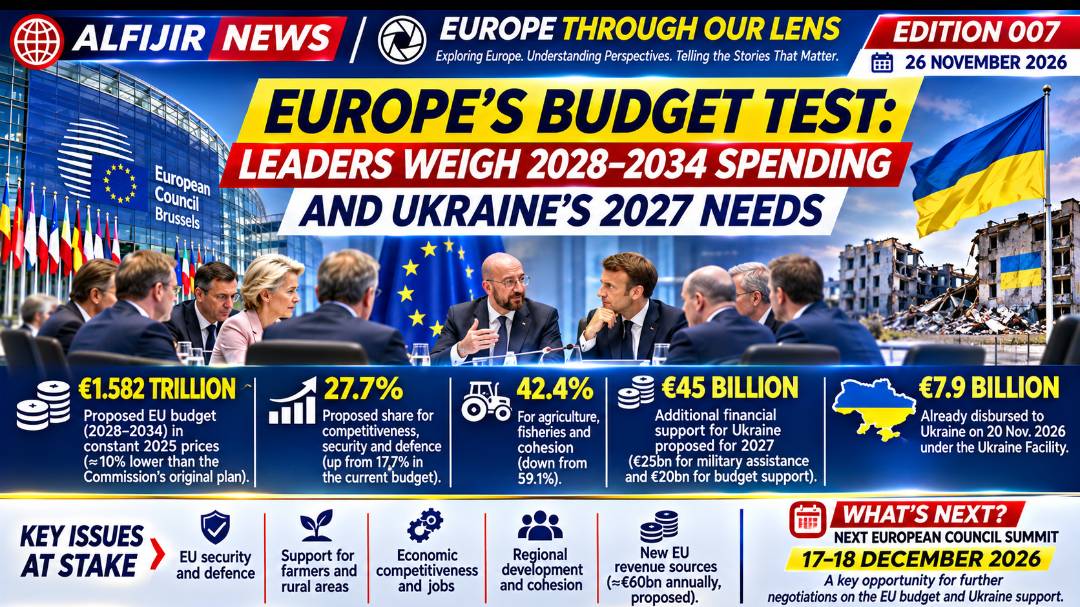
The proposal presented by European Council President António Costa puts the overall financial framework at approximately €1.582 trillion in constant 2025 prices.
The proposed allocation would represent a significant shift in spending priorities.
Under the proposal, around 27.7% of the budget would go towards competitiveness, security and defence, compared with approximately 17.7% under the current framework.
Meanwhile, agriculture, fisheries and cohesion policies would account for around 42.4%, compared with approximately 59.1% in the current framework.
These figures describe a proposal, not an adopted budget. They indicate the direction of the negotiations but do not mean that the final allocations have been agreed.
The debate is likely to expose differences between governments that want more funding for defence and industrial competitiveness and those concerned about maintaining support for farmers, regional development and existing EU programmes.
THE EU’S SEARCH FOR NEW SOURCES OF REVENUE
Another important part of the proposed budget is how the EU would raise the money needed to finance its priorities.
The European Commission has put forward five potential new sources of revenue, commonly described as new own resources. They include contributions linked to:
– Digital services;
– Non-recycled electronic waste;
– Tobacco-related products;
– The Carbon Border Adjustment Mechanism (CBAM);
– The EU Emissions Trading System (ETS).
The Commission estimates that these proposals could generate approximately €60 billion annually.
However, the proposals remain subject to negotiations. They should not be presented as approved taxes or confirmed revenue.
Agreement on the EU’s long-term budget will require difficult negotiations among member states, with the final MFF regulation requiring unanimity in the Council and the consent of the European Parliament.
UKRAINE’S ADDITIONAL €45 BILLION FINANCING PROPOSAL
Ukraine’s financial needs are another major issue facing EU leaders.
On 18 November 2026, the European Commission proposed up to €45 billion in additional financial support for Ukraine in 2027.
The proposed package is divided into two main components:
– Up to €25 billion for military assistance;
– Up to €20 billion for budget support.
The proposal is intended to help Ukraine meet urgent defence and public-finance needs as the war with Russia continues.
It is important to distinguish this proposed additional €45 billion from the separate €90 billion Ukraine Support Loan for 2026–2027, which is structured around €60 billion for defence and €30 billion for budget support.
The two figures refer to different financial arrangements. The additional €45 billion proposal should not be described as money already approved, transferred or received by Ukraine.
DIFFERENCES AMONG EU MEMBER STATES
The proposed financing has also exposed differences among EU governments over the military dimension of support for Ukraine.
On 26 November, Bulgarian Prime Minister Rumen Radev said Bulgaria was prepared to support the civilian component of the proposed assistance but not its military component.
His statement should be understood as the position he publicly expressed, rather than automatically treated as a final position agreed by every Bulgarian institution.
There have also been disagreements involving other member states over the proposed military assistance. However, opposition to particular elements should not be confused with a confirmed decision by a country to withdraw completely from the wider financing proposal.
These differences illustrate the political challenges facing the EU as it seeks to maintain a common approach to Ukraine.
A SEPARATE €7.9 BILLION PAYMENT TO UKRAINE
While leaders discuss additional financial assistance, the European Commission announced on 20 November that it had disbursed €7.9 billion under the Ukraine Facility.
This payment is part of an existing EU support mechanism and should not be confused with the newly proposed additional €45 billion package.
The distinction matters because announcements of proposed funding, approval of financial instruments and actual disbursements represent different stages of public financing.
WHY THE BUDGET NEGOTIATIONS MATTER
The 2028–2034 budget will influence the EU’s ability to finance its policies for seven years.
Decisions on defence, industrial competitiveness, agriculture, regional development and climate-related priorities will affect governments, businesses, workers, farmers and communities across the Union.
The negotiations also raise a wider question about the EU’s future role: how can it strengthen its strategic independence and security while preserving the economic and social priorities that have shaped European integration?
The final outcome will depend on whether member states and the European Parliament can find common ground on the size of the budget, its distribution and the sources of revenue.
WHAT TO WATCH NEXT: THE DECEMBER EUROPEAN COUNCIL SUMMIT
The next regular European Council meeting is scheduled for 17–18 December 2026.
The meeting will provide another important opportunity for EU leaders to address outstanding European priorities, including the long-term budget negotiations and other matters requiring political agreement.
The December summit should therefore be watched as a possible next stage in the discussions. However, its scheduled date does not guarantee that leaders will reach a final agreement on the 2028–2034 budget or Ukraine’s proposed additional financing.
For now, the central question remains whether the EU can reconcile competing national priorities with its wider ambitions for security, economic competitiveness and support for Ukraine.
EUROPE THROUGH OUR LENS
Exploring Europe. Understanding Perspectives. Telling the Stories That Matter.
Sources and further reading
1. European Council – Special European Council, 26–27 November 2026:
https://www.consilium.europa.eu/en/meetings/european-council/2026/11/26-27/
2. European Council President António Costa – Proposal for the next EU long-term budget:
https://www.consilium.europa.eu/en/european-council/president/a-realistic-proposal-for-the-next-eu-long-term-budget/
3. European Commission – Proposal for €45 billion in additional financial support for Ukraine in 2027, 18 November 2026:
https://enlargement.ec.europa.eu/news/commission-proposes-eur45-billion-additional-financial-support-ukraine-2027-2026-11-18_en
4. European Commission – €7.9 billion disbursement under the Ukraine Facility, 20 November 2026:
https://enlargement.ec.europa.eu/news/commission-disburses-eur79-billion-strengthen-ukraines-financial-stability-and-advance-reform-2026-11-20_en
5. Reuters – Bulgaria’s position on the proposed Ukraine financing:
https://www.reuters.com/markets/asia/bulgaria-ready-back-eu-loan-ukraine-civilian-aid-radev-says-2026-11-26/
6. Associated Press – European discussions on Ukraine financing:
https://apnews.com/article/europe-ukraine-loan-russia-summit-8c1baf00b55973a3534096aae2cc73a6
7. Council of the European Union – Official meeting calendar, including the 17–18 December 2026 European Council:
https://www.consilium.europa.eu/en/meetings/calendar/
📢 FOLLOW ALFIJIR LABARAI
Stay connected with Alfijir Labarai / Alfijir News for credible news, reports, investigative journalism, and important updates from Kano, Nigeria, and around the world.
📩 CONTACT US & PARTNERSHIP ENQUIRIES
Call/WhatsApp: +234 701 1 11 3809
+234 803 207 7835
🌐 OUR SOCIAL MEDIA PLATFORMS
X: https://twitter.com/Musabestseller?s=09
Facebook: https://www.facebook.com/profile.php?id=100089640289165
Threads: https://www.threads.net/@alfijirlabarai
YouTube: https://www.youtube.com/@BestsellerChannel12
Instagram: https://www.instagram.com/musa_bestseller?utm_source=qr&r=nametag
📲 JOIN OUR WHATSAPP GROUP
https://chat.whatsapp.com/Ilj1iz8v3sa3nBfrCz9U6f
ALFIJIR LABARAI MEDIA SERVICES
Truth • Timeliness • Trust
© 2026 Alfijir Labarai Media Services