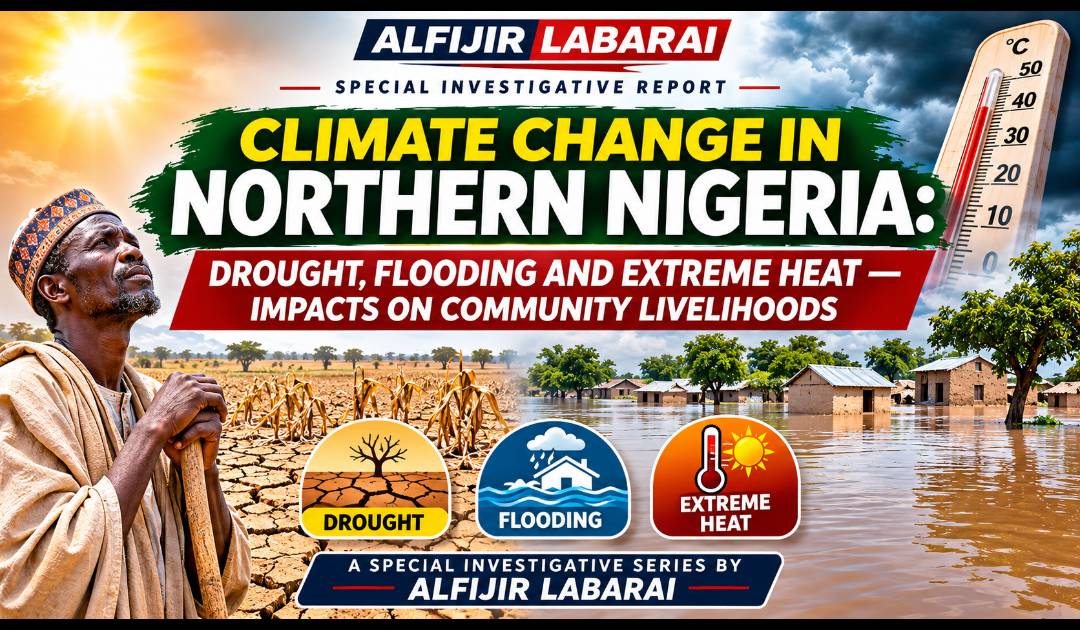
SPECIAL INVESTIGATIVE REPORT
Climate change is one of the major environmental challenges requiring sustained attention in Nigeria. Across Northern Nigeria, where many communities depend on agriculture, livestock production and other climate-sensitive economic activities, changing rainfall patterns, drought, flooding and extreme heat raise important questions about livelihoods, food security, public health and economic resilience.
How are these environmental challenges affecting communities across the region? Are residents receiving adequate information, protection and support? And how can the effectiveness of government programmes designed to address climate-related risks be assessed?
These are among the key questions that the new special investigative series by Alfijir Labarai seeks to examine.
The investigation will explore the effects of climate-related hazards on communities across Northern Nigeria, examine government responses and assess the extent to which existing interventions are addressing the needs of affected populations.
WHAT OFFICIAL CLIMATE DATA REVEALS
The Nigerian Meteorological Agency (NiMet) published its State of the Climate in Nigeria 2025 report in February 2026. The report provides information on temperature, rainfall and other weather-related conditions across the country.
According to figures reported from the assessment, Nguru in Yobe State recorded 100 days when temperatures reached or exceeded 40°C, with a maximum recorded temperature of 44.6°C. Maiduguri in Borno State recorded 82 days at or above the same temperature threshold, with a maximum of 44.5°C.
These figures highlight the importance of investigating the effects of extreme heat on public health, livelihoods and agricultural activities.
However, temperature records alone cannot establish the full extent of the effects on communities. Understanding those effects requires additional evidence from residents, health professionals, agricultural experts and relevant government agencies.
Alfijir Labarai will therefore combine official climate data with community testimonies and other verifiable evidence to examine the implications of these conditions.
DROUGHT AND RAINFALL VARIABILITY: CHALLENGES FOR FARMERS AND HERDERS
Agriculture and livestock production remain important sources of livelihoods across Northern Nigeria. Changes in the timing, duration and distribution of rainfall can create difficulties for farmers and pastoral communities whose activities depend on seasonal weather conditions.
The investigation will examine how farmers and herders are responding to changing weather patterns, the losses they may have experienced and the measures they are adopting to reduce climate-related risks.
It will also investigate whether farmers receive timely and accessible weather forecasts and whether they have access to agricultural practices and resources that can help them manage weather uncertainty.
Nevertheless, not every agricultural or livestock-related problem can automatically be attributed to climate change. Insecurity, high input costs, limited access to finance, water shortages and other economic and environmental pressures may also contribute to the challenges facing rural communities.
The investigation will seek to distinguish these factors using available evidence and expert assessments.
FLOODING: IMPACTS ON HOMES, FARMLAND AND LIVELIHOODS
Flooding can cause significant damage to homes, farmland, roads, businesses and other infrastructure. It can also disrupt access to essential services and undermine the ability of affected households to recover financially.
Alfijir Labarai will investigate not only the consequences of flooding but also the preparedness measures taken before flood events occur.
Key areas of inquiry will include early-warning systems, public awareness, emergency response, the distribution of relief materials and assistance provided to affected communities during recovery.
The investigation will also examine drainage projects and other flood-prevention measures, including whether completed projects are delivering the intended benefits.
Relevant information will be sought from the Nigeria Hydrological Services Agency (NIHSA), the National Emergency Management Agency (NEMA) and State Emergency Management Agencies (SEMAs) in selected states.
EXTREME HEAT AND PUBLIC HEALTH
Extreme heat can increase the risk of heat-related illnesses, particularly among people who work outdoors for extended periods or lack reliable access to drinking water and adequate shelter from the sun.
Farmers, construction workers, street traders and other outdoor workers are among the groups whose experiences deserve closer examination.
The investigation will seek expert opinions from health professionals on heat-related risks, prevention measures and the availability of public information on staying safe during periods of high temperatures.
It will also examine whether existing public-health interventions adequately address the needs of vulnerable groups.
CLIMATE-RELATED HAZARDS AND HOUSEHOLD ECONOMIC PRESSURES
The consequences of climate-related hazards extend beyond the physical environment. Crop losses, water shortages and damage to property can affect household income, food prices and families’ ability to meet their daily needs.
The investigation will examine how these pressures affect women, young people, farmers, herders and small business owners.
Interviews with affected residents will help establish the nature of the losses they have experienced, the coping strategies they have adopted and the assistance they have received.
Where reliable data are available, the investigation will compare conditions before and after specific events. It will also consider other factors that may have influenced household income, food prices and economic conditions.
WHAT IS THE GOVERNMENT DOING, AND HOW EFFECTIVE ARE THE INTERVENTIONS?
The existence of climate policies or budget allocations does not, by itself, demonstrate that environmental challenges are being adequately addressed. Equally, the absence of publicly available information does not automatically prove that no action has been taken.
Alfijir Labarai will examine government programmes relating to climate change, agriculture, water resources and disaster-risk reduction.
The investigation will seek to establish the amounts budgeted for relevant interventions, the funds released, the projects implemented and the outcomes experienced by communities.
Where appropriate, budget documents and implementation records will be compared with evidence from project locations and interviews with residents.
Government agencies and other relevant institutions will be given opportunities to explain their policies, activities, constraints and future plans.
The objective is not to assign blame before the evidence is established, but to determine what has been done, what remains outstanding and where further action may be needed.
WHY FOCUS ON NORTHERN NIGERIA?
Northern Nigeria contains diverse ecological zones, weather conditions and livelihood systems. The environmental challenges experienced in Kano may differ from those in Yobe, Borno, Katsina, Jigawa, Sokoto or Kebbi.
The investigation will therefore avoid treating the region as a single, uniform environment.
Initial desk research will help identify locations where field reporting could provide the strongest evidence. The final selection of communities will depend on available climate data, documented hazards, the significance of their effects and access to reliable sources.
Interviews will be conducted with farmers, herders, women, young people, experts, government officials and other individuals whose livelihoods may be affected by climate-related hazards.
KEY QUESTIONS THE INVESTIGATION WILL ADDRESS
The investigation will seek answers to the following questions:
1. Which climate-related hazards are most significant in the communities selected for investigation?
2. How are drought, flooding and extreme heat affecting agriculture, livestock production, public health and household incomes?
3. Do communities receive timely and reliable weather forecasts and early warnings?
4. What programmes have government agencies and emergency-management institutions implemented?
5. Are public funds allocated to relevant interventions producing measurable results?
6. What obstacles prevent some communities from accessing adequate protection or assistance?
7. Which practical measures could help reduce risks and strengthen community resilience?
The answers will be based on verifiable information rather than assumptions.
THE NEXT STAGE OF THE INVESTIGATION
Following this introductory report, Alfijir Labarai will continue reviewing climate data, official reports, public budgets and community-level evidence.
Selected locations will be identified for field reporting, with particular attention to the availability of credible sources and the importance of the issues being examined.
Claims relating to public expenditure, losses, official performance or the causes of specific events will be checked before publication. Relevant institutions will be contacted for clarification and a right of reply where their actions or responsibilities are examined.
The investigation will also distinguish between established facts, allegations requiring further verification and questions that remain unanswered.
CONCLUSION
Climate change is not merely a subject for scientific reports or government policy documents. Its consequences may affect farmers, pastoralists, households, traders and others whose livelihoods depend on environmental conditions.
Understanding those consequences requires more than identifying hazards. It also requires examining how communities experience them, what protection is available and whether public interventions are making a measurable difference.
This report marks the beginning of Alfijir Labarai’s special investigation into climate change and its implications for communities across Northern Nigeria.
Further reports will examine drought, flooding, extreme heat, agricultural livelihoods, public spending and government responses as evidence becomes available.
ALFIJIR LABARAI
ACCURATE • TIMELY • TRUSTED
INITIAL SOURCES FOR THE INVESTIGATION
– Nigerian Meteorological Agency (NiMet) — State of the Climate in Nigeria 2025.
– Nigeria Hydrological Services Agency (NIHSA).
– National Emergency Management Agency (NEMA).
– Relevant State Emergency Management Agencies (SEMAs).
NiMet report: https://nimet.gov.ng/downloader?file=admin%2Fuploads%2Fpublications%2F698f49a29a834_State+of+the+Climate+2025.pdf.pdf
NIHSA: https://nihsa.gov.ng/
NEMA: https://nema.gov.ng/
📢 FOLLOW ALFIJIR LABARAI
Stay connected with Alfijir Labarai / Alfijir News for credible news, reports, investigative journalism, and important updates from Kano, Nigeria, and around the world.
📩 CONTACT US & PARTNERSHIP ENQUIRIES
Call/WhatsApp: +234 701 1 11 3809
+234 803 207 7835
🌐 OUR SOCIAL MEDIA PLATFORMS
X: https://twitter.com/Musabestseller?s=09
Facebook: https://www.facebook.com/profile.php?id=100089640289165
Threads: https://www.threads.net/@alfijirlabarai
YouTube: https://www.youtube.com/@BestsellerChannel12
Instagram: https://www.instagram.com/musa_bestseller?utm_source=qr&r=nametag
📲 JOIN OUR WHATSAPP GROUP
https://chat.whatsapp.com/Ilj1iz8v3sa3nBfrCz9U6f
ALFIJIR LABARAI MEDIA SERVICES
Truth • Timeliness • Trust
© 2026 Alfijir Labarai Media Services