
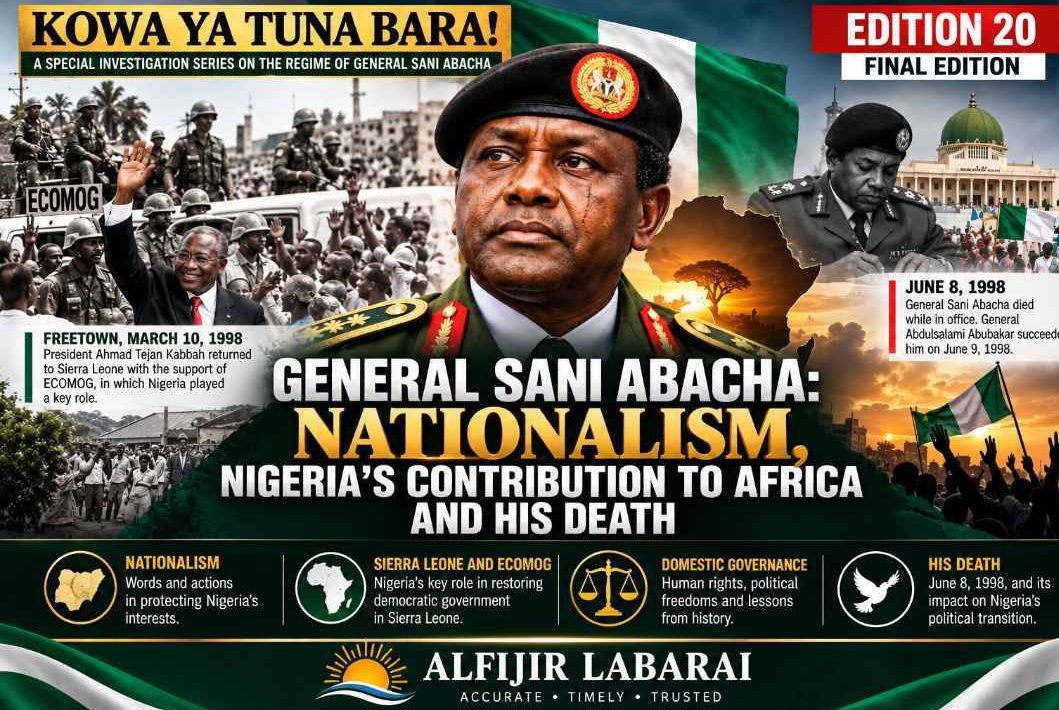
KOWA YA TUNA BARA! — EDITION 20
A Special Investigation by Alfijir Labarai
Introduction
A nation’s history is incomplete when only its achievements are documented while its challenges are ignored. Similarly, historical fairness is not achieved by portraying a leader entirely as a hero or a villain without carefully examining the available evidence.
In this final edition of KOWA YA TUNA BARA!, Alfijir Labarai examines the question of nationalism during the administration of General Sani Abacha, Nigeria’s role in regional security efforts in West Africa, and Abacha’s death on June 8, 1998.
The objective is to distinguish documented facts from opinions and historical interpretations, enabling readers to assess the record for themselves.
Nationalism: Words and Actions
Nationalism involves protecting a country’s interests, security, peace, international standing and the welfare of its citizens. However, assessing a leader’s legacy requires more than examining declared intentions or public statements. It also requires evaluating the actions taken, their outcomes and their effects on society.
During Abacha’s administration, Nigeria continued to play a significant role in the political and security affairs of West Africa. One notable example was the work of the Economic Community of West African States Monitoring Group (ECOMOG) in Sierra Leone.
Nevertheless, a leader’s role in protecting national interests or supporting another country does not automatically establish that all domestic policies were appropriate. Equally, examining a leader’s shortcomings should not mean disregarding contributions that credible records have documented.
This investigation therefore does not treat nationalism as a conclusion to be reached without evidence. It examines documented actions and leaves readers to make their own informed assessments.
Nigeria and the Restoration of Democratic Government in Sierra Leone
One of the significant developments in West Africa in 1998 was the return of President Ahmad Tejan Kabbah to Freetown, the capital of Sierra Leone.
Following the overthrow of his government in a military coup in 1997, ECOMOG, a regional force established by ECOWAS member states, played a major role in removing the military junta and restoring the elected government.
On March 10, 1998, President Kabbah returned to Freetown. General Sani Abacha, then Nigeria’s Head of State and Chairman of ECOWAS, was among the regional leaders associated with the restoration process. United Nations records documented Kabbah’s return as an important step towards restoring constitutional government and democracy in Sierra Leone.
This evidence demonstrates that Nigeria played a significant role in the regional effort. However, ECOMOG was a multinational force, and its operations involved contributions from several countries. It would therefore be inaccurate to attribute the entire outcome to one individual or one country.
This regional contribution also does not remove the need to examine other aspects of Abacha’s administration. A balanced historical account must document both achievements and shortcomings according to the available evidence.
Domestic Governance and Citizens’ Rights
Despite Nigeria’s role in regional operations, an important part of Abacha’s record concerns how his government exercised power at home.
The United States Department of State’s 1998 human rights report on Nigeria documented serious human rights abuses during the first half of that year. It also described restrictions on political freedoms, assembly and association, as well as pressure on journalists and civil society activists.
Following Abacha’s death, General Abdulsalami Abubakar assumed power and introduced a new transition programme towards civilian rule. The same report described measures taken during the subsequent period to address certain abuses and ease restrictions affecting journalists and civil society groups.
These records are important because a country’s international standing alone cannot provide a complete measure of its leadership. Citizens’ rights, freedom of expression and the ability to choose their leaders are also essential considerations.
National interest and good governance require both the protection of a country’s interests and respect for the rights of its people.
The Death of General Sani Abacha
Nigeria’s Defence Headquarters confirms that General Sani Abacha died while in office on June 8, 1998.
General Abdulsalami Abubakar succeeded him as Head of State on June 9, 1998. His administration subsequently introduced a transition programme that culminated in the inauguration of Olusegun Obasanjo as President on May 29, 1999, marking the return to civilian government.
Contemporary reports linked Abacha’s death to a heart-related condition. However, this investigation does not present a specific medical cause as conclusively established because the documentary sources consulted do not include a definitive official medical report confirming it.
What official records establish is the date of his death and the change of leadership that followed.
Abacha’s death marked a major turning point in Nigeria’s political history, as the subsequent transition programme led to the restoration of civilian rule in 1999.
Lessons from Abacha’s Legacy for Nigeria
Abacha’s record demonstrates the importance of assessing leadership from multiple perspectives. Contributions supported by evidence, including regional efforts, can be acknowledged without overlooking questions about human rights and citizens’ democratic freedoms.
Similarly, projects and initiatives carried out during a leader’s administration should not automatically be credited to that leader without examining when they began, their sources of funding, the institutions responsible for implementation and the documentary evidence establishing the administration’s role.
This is a central lesson running through all the editions of KOWA YA TUNA BARA!: historical assessment requires research, evidence, fairness and a clear distinction between established facts and issues that still require further investigation.
Conclusion: History Requires More Than Praise or Condemnation
In this 20th and final edition, Alfijir Labarai concludes its KOWA YA TUNA BARA! investigation by examining nationalism, Nigeria’s role in West Africa and the death of General Sani Abacha.
The central lesson is that a leader’s historical record must be examined fairly. Documented contributions may be acknowledged, while mistakes and human rights abuses must also be reported without concealment.
The purpose of this investigation is not to compel readers to adopt a single opinion. It is to present evidence that encourages reflection, informed discussion and independent judgement.
With this 20th edition, Alfijir Labarai concludes the KOWA YA TUNA BARA! series, reaffirming that history is most useful when it is documented on the basis of evidence rather than personal preference.
ALFIJIR LABARAI — Accurate • Timely • Trusted
📢 FOLLOW ALFIJIR LABARAI
Stay connected with Alfijir Labarai / Alfijir News for credible news, reports, investigative journalism, and important updates from Kano, Nigeria, and around the world.
📩 CONTACT US & PARTNERSHIP ENQUIRIES
Call/WhatsApp: +234 803 207 7835
🌐 OUR SOCIAL MEDIA PLATFORMS
X: https://twitter.com/Musabestseller?s=09
Facebook: https://www.facebook.com/profile.php?id=100089640289165
Threads: https://www.threads.net/@alfijirlabarai
YouTube: https://www.youtube.com/@BestsellerChannel12
Instagram: https://www.instagram.com/musa_bestseller?utm_source=qr&r=nametag
📲 JOIN OUR WHATSAPP GROUP
https://chat.whatsapp.com/Ilj1iz8v3sa3nBfrCz9U6f
ALFIJIR LABARAI MEDIA SERVICES
Truth • Timeliness • Trust
© 2026 Alfijir Labarai Media Services