
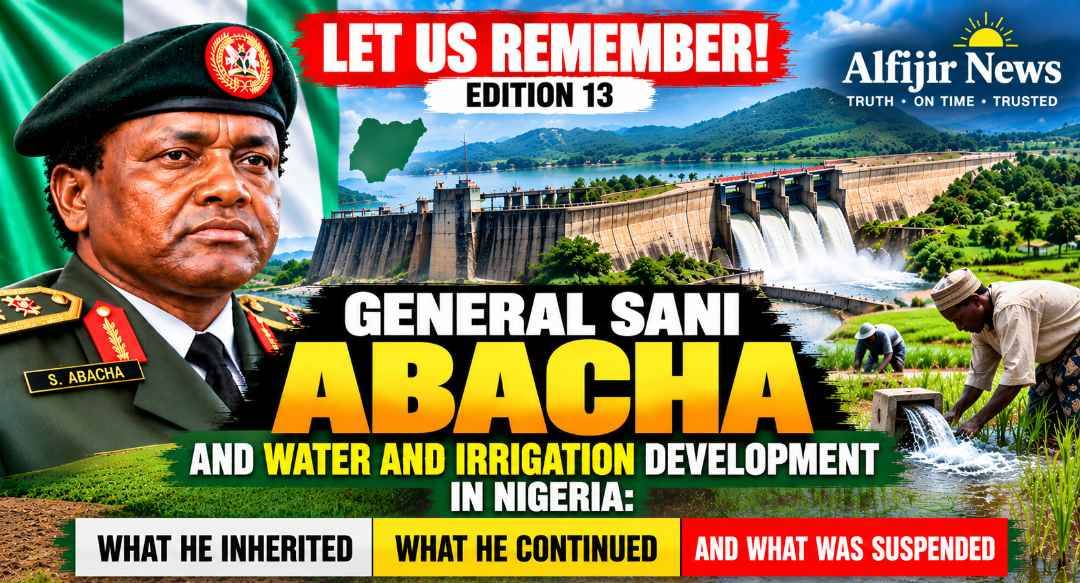
LET US REMEMBER!
EDITION 13
Water and irrigation development is closely connected to agriculture, food production, livestock, fishing and the livelihoods of millions of Nigerians.
But when examining the administration of General Sani Abacha between 1993 and 1998, it is not enough to list dams and irrigation projects and attribute them to his government.
A proper historical assessment must ask three questions:
What was inherited?
What continued during the period?
And what was suspended?
AGRICULTURE AND WATER SERVICES: WHAT DID THE BUDGET SHOW?
Historical IMF data show that planned federal expenditure for Agriculture and Water Services increased substantially during the period under review.
The planned figures were:
1993 — ₦2.908 billion
1994 — ₦3.362 billion
1995 — ₦3.924 billion
1996 — ₦5.713 billion
1997 — ₦7.398 billion
1998 — ₦9.043 billion
The figures indicate a significant increase in planned expenditure.
However, these are budgeted figures, not proof that every naira was released or spent.
There is also an important historical qualification. Abacha assumed power in November 1993, meaning the 1993 figure covers a period before his administration. Likewise, the 1998 figure covers months after his death in June 1998.
The figures therefore should not be attributed entirely to the Abacha administration.
HADEJIA VALLEY: A PROJECT STARTED BEFORE ABACHA
One of the clearest examples is the Hadejia Valley Irrigation Project.
The project began in 1981. Construction was suspended in 1984 because of financial constraints.
A new contract was awarded in 1992, before Abacha assumed power. Under the 1992–1996 contract, important components were completed, including the feeder canal, main canal, headworks and development of approximately 1,979 hectares of irrigated farmland.
But the project was not completed.
Construction was again suspended in 1996 because of financial constraints, with the remaining works still outstanding.
In April 1998, the Petroleum Trust Fund (PTF) took over the remaining work for review and re-award.
After the PTF was scrapped in 1999, the project was transferred back to the Hadejia-Jama’are River Basin Development Authority.
This gives us an important historical distinction:
The project started before Abacha, continued during his administration, achieved measurable progress during the period, but was not completed before his death.
CHALLAWA GORGE DAM: NOT AN ABACHA PROJECT
The same principle applies to Challawa Gorge Dam.
It would be historically inaccurate to describe the dam as a project built or completed by the Abacha administration.
The dam had already been completed before Abacha came to power.
However, it formed part of the broader water and irrigation infrastructure associated with the Hadejia Valley development system during the period under review.
Therefore, its historical relevance to this investigation is not that Abacha built it, but that his administration inherited and operated within a water infrastructure system that already included the dam.
KAFIN ZAKI: WHEN A PROJECT WAS SUSPENDED
The history of Kafin Zaki Dam provides another perspective.
The project originated before the Abacha administration. Available historical accounts indicate that its contract was suspended in 1994 under the Abacha government, while an inquiry into the project was also established.
This is important because it shows that the story of water infrastructure during the period was not simply one of construction and expansion.
Some projects continued.
Others encountered financial or administrative difficulties.
And some were suspended.
WHY IRRIGATION MATTERED
The Hadejia Valley project was not simply about supplying water to farms.
The broader objectives of irrigation development included supporting:
crop production
livestock
fishing
rural communities
food production
employment and local economic activity
The World Bank documentation indicates that the original Phase I plan covered approximately 12,500 hectares, divided between Stage I and Stage II.
This illustrates why irrigation projects were considered important development investments.
If successful, such projects could affect not only individual farmers but also food production, employment and the wider rural economy.
But when projects are delayed or suspended, the expected benefits are also delayed.
THE BIG QUESTION: ALLOCATION OR ACTUAL RESULTS?
This investigation highlights a recurring problem when assessing historical government performance.
If the budget for Agriculture and Water Services increased, that does not automatically mean that water infrastructure improved by the same proportion.
We still need to know:
How much was actually released?
How much was spent?
Which projects were completed?
Which projects remained unfinished?
Who benefited from the completed components?
And most importantly:
What did farmers and communities actually receive from the investment?
These questions are necessary because a budget is an input, while a completed and functioning irrigation system is an outcome.
WHAT CAN THE RECORDS ESTABLISH?
Based on the evidence reviewed, several points can be established.
First: Planned federal expenditure for Agriculture and Water Services increased during the years under review.
Second: The Hadejia Valley Irrigation Project was not initiated by Abacha. It began in 1981 and was restarted in 1992, before he assumed power.
Third: Significant components of the Hadejia project, including approximately 1,979 hectares of irrigated land and key canal and headwork components, were completed under the 1992–1996 contract.
Fourth: The project was suspended again in 1996 because of financial constraints.
Fifth: The PTF took over the remaining works in April 1998, but the project was not completed during the Abacha period.
Sixth: Not every major water project associated with the period can properly be described as an Abacha project. Some had been initiated or completed before he came to power.
CONCLUSION
The history of water and irrigation development during the Abacha years is more complicated than a list of dams and government spending figures.
It is a story of inherited projects, continued construction, partial completion, financial constraints and suspended works.
The Hadejia Valley Irrigation Project provides a particularly useful example. It began long before Abacha, made measurable progress during the period, but was not completed before his death.
This is why historical reporting must distinguish between:
what a government inherited,
what it actually did,
what it completed,
and what remained unfinished.
For Alfijir News, “Let Us Remember!” is not about praising or condemning a past government without evidence.
It is about asking the questions, checking the records and allowing the evidence to speak.
LET US REMEMBER!
History deserves evidence, not assumptions.
SOURCES
1. International Monetary Fund — Nigeria: Selected Issues and Statistical Appendix.
2. World Bank — Hadejia Valley Irrigation Project documentation.
📢 FOLLOW ALFIJIR LABARAI
Stay connected with Alfijir Labarai / Alfijir News for credible news, reports, investigative journalism, and important updates from Kano, Nigeria, and around the world.
📩 CONTACT US & PARTNERSHIP ENQUIRIES
Call/WhatsApp: +234 803 207 7835
🌐 OUR SOCIAL MEDIA PLATFORMS
X: https://twitter.com/Musabestseller?s=09
Facebook: https://www.facebook.com/profile.php?id=100089640289165
Threads: https://www.threads.net/@alfijirlabarai
YouTube: https://www.youtube.com/@BestsellerChannel12
Instagram: https://www.instagram.com/musa_bestseller?utm_source=qr&r=nametag
📲 JOIN OUR WHATSAPP GROUP
https://chat.whatsapp.com/Ilj1iz8v3sa3nBfrCz9U6f
ALFIJIR LABARAI MEDIA SERVICES
Truth • Timeliness • Trust
© 2026 Alfijir Labarai Media Services