
By Alfijir Labarai
In recent years, private-sector investment in education has become an increasingly important part of Nigeria’s higher education system.
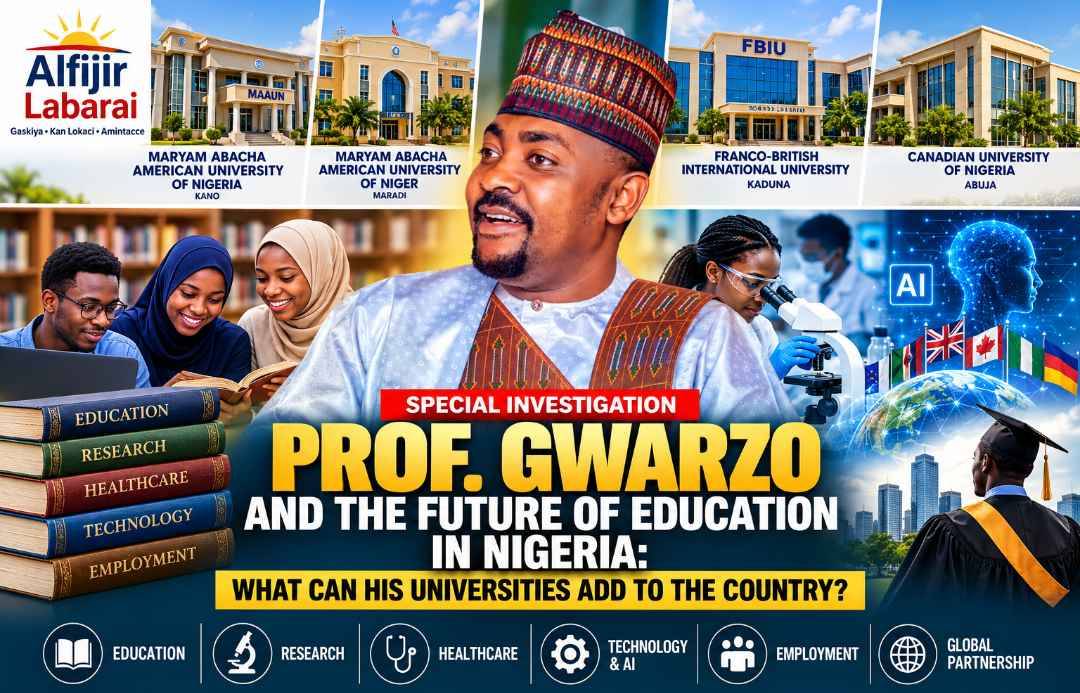
Among those who have made significant investments in the sector is Prof. Adamu Abubakar Gwarzo, founder and leader of the MAAUN Group of Universities.
The university group comprises Maryam Abacha American University of Nigeria (MAAUN), Maryam Abacha American University of Niger, Franco-British International University (FBIU), Kaduna, and Canadian University of Nigeria (CUN), Abuja.
However, this investigation by Alfijir Labarai is not simply about the number of universities Prof. Gwarzo has established.
The bigger question is:
WHAT CAN THIS UNIVERSITY SYSTEM ADD TO NIGERIA?
Nigeria’s education challenges go beyond the availability of university admission spaces.
The country needs universities capable of producing skilled professionals, conducting useful research, developing technology, equipping young people with practical skills, and connecting Nigeria’s academic sector with institutions around the world.
1. EXPANDING ACCESS TO UNIVERSITY EDUCATION
One of the contributions private universities can make is to increase access to higher education.
MAAUN has outlined a number of academic programmes as well as scholarship and support initiatives for students.
But this is where evidence becomes important.
How many students have these universities admitted?
How many have graduated?
How many secured employment after graduation?
Which fields are producing professionals most needed by the labour market?
These are the figures that can help determine the actual impact of a university on society.
2. RESEARCH: FROM THE CLASSROOM TO SOLVING NATIONAL PROBLEMS
Another important area is research.
MAAUN established the Institute of African Higher Education Research and Innovation, focusing on research, innovation and the development of higher education.
In May 2026, MAAUN and Bayero University Kano also signed a collaboration agreement covering joint research, exchange of academics and students, scientific conferences, publications and scholarships.
This could become significant if research is directed towards solving problems facing Nigeria — from healthcare to agriculture, technology, the environment and the economy.
A university’s role should therefore go beyond teaching students.
It should also generate knowledge capable of helping society solve its problems.
3. TECHNOLOGY AND ARTIFICIAL INTELLIGENCE
The world is entering a new era in which Artificial Intelligence is transforming the way people work, learn and conduct business.
In May 2026, MAAUN signed a partnership agreement with Fortress Global AI Resources aimed at advancing AI development, academic research, skills development and technological infrastructure.
This raises an important question:
Can Nigerian universities produce young people who will not only use AI technology, but also develop solutions that apply AI to Nigeria’s own challenges?
If this happens, the contribution of universities could extend beyond the classroom into the country’s digital economy.
4. HEALTHCARE: TRAINING SPECIALISED PROFESSIONALS
Healthcare is another area where universities can make a major contribution.
In February 2026, MAAUN and the Kano Cancer Treatment Centre strengthened their collaboration to expand training for healthcare professionals in oncology. The initiative includes the training of MAAUN Nursing students as well as practising nurses in the region.
Such partnerships could be particularly important in Northern Nigeria, where there is a need for more specialised healthcare professionals.
But the more important issue is measuring the results:
How many professionals have been trained?
How many have entered the healthcare workforce?
What impact has the training had on cancer care?
These are the questions that can help establish the real value of such programmes.
5. CONNECTING NIGERIA TO GLOBAL EDUCATION
Another development that stands out is MAAUN’s effort to establish partnerships with universities and institutions in different countries.
In information published in March 2026, MAAUN said it had 62 Memoranda of Understanding with institutions across 31 countries, covering research, student and faculty exchanges, training, AI, computing and other areas.
In June 2026, MAAUN also signed an agreement with Nile University of Science and Technology in Somalia covering research, innovation, academic exchanges and scholarship opportunities.
Such partnerships can provide Nigerian students and academics with greater access to international knowledge, research networks and academic opportunities.
They could also contribute to positioning Nigeria as a destination for international education, rather than simply a country from which students travel abroad in search of education.
6. EDUCATION AND EMPLOYMENT
Ultimately, one of the most important questions for any university is:
What happens to its students after graduation?
Do they secure employment?
Do they create jobs?
Do they continue their education?
Are the skills they acquired relevant to the labour market?
This is one of the key measures that can help determine the economic impact of Prof. Gwarzo’s universities.
Nigeria does not only need more graduates.
It needs graduates who can participate effectively in the labour market, create businesses, conduct research and develop solutions to problems affecting society.
7. PROF. GWARZO’S VISION: TWO MILLION STUDENTS
On the MAAUN Group website, Prof. Adamu Abubakar Gwarzo states that his life ambition is to help educate two million students, enabling them to build their futures and contribute to the world.
That is an ambitious vision.
But the bigger question is:
If the target of two million students is achieved, what kind of graduates will they become?
How many will become doctors, engineers, scientists, teachers, entrepreneurs, technology experts and researchers?
And how many will return their knowledge and skills to the development of Nigeria?
Ultimately, the value of a university is not determined simply by the number of students it teaches.
Its impact is also reflected in the quality of people it produces and what those people go on to contribute to society.
CONCLUSION
Prof. Gwarzo’s universities are part of an expanding private higher-education system with activities spanning education, research, technology, healthcare and international academic partnerships.
For Nigeria, the most important issue is how the results of these investments can be measured: the number of skilled professionals produced, research that solves real problems, technologies developed, jobs created, and the impact graduates make in their communities.
Therefore, this is not simply an investigation into universities.
It is an investigation into a bigger question:
CAN INVESTMENT IN PRIVATE UNIVERSITIES BECOME ONE OF THE IMPORTANT WAYS NIGERIA CAN DEVELOP THE SKILLED HUMAN CAPITAL IT NEEDS FOR ITS FUTURE?
Alfijir Labarai will continue to follow this subject by examining each university, its programmes, students, research activities, scholarships, partnerships and measurable impact on society.
📢 FOLLOW ALFIJIR LABARAI
Stay connected with Alfijir Labarai / Alfijir News for credible news, reports, investigative journalism, and important updates from Kano, Nigeria, and around the world.
📩 CONTACT US & PARTNERSHIP ENQUIRIES
Call/WhatsApp: +234 803 207 7835
🌐 OUR SOCIAL MEDIA PLATFORMS
X: https://twitter.com/Musabestseller?s=09
Facebook: https://www.facebook.com/profile.php?id=100089640289165
Threads: https://www.threads.net/@alfijirlabarai
YouTube: https://www.youtube.com/@BestsellerChannel12
Instagram: https://www.instagram.com/musa_bestseller?utm_source=qr&r=nametag
📲 JOIN OUR WHATSAPP GROUP
https://chat.whatsapp.com/Ilj1iz8v3sa3nBfrCz9U6f
ALFIJIR LABARAI MEDIA SERVICES
Truth • Timeliness • Trust
© 2026 Alfijir Labarai Media Services