
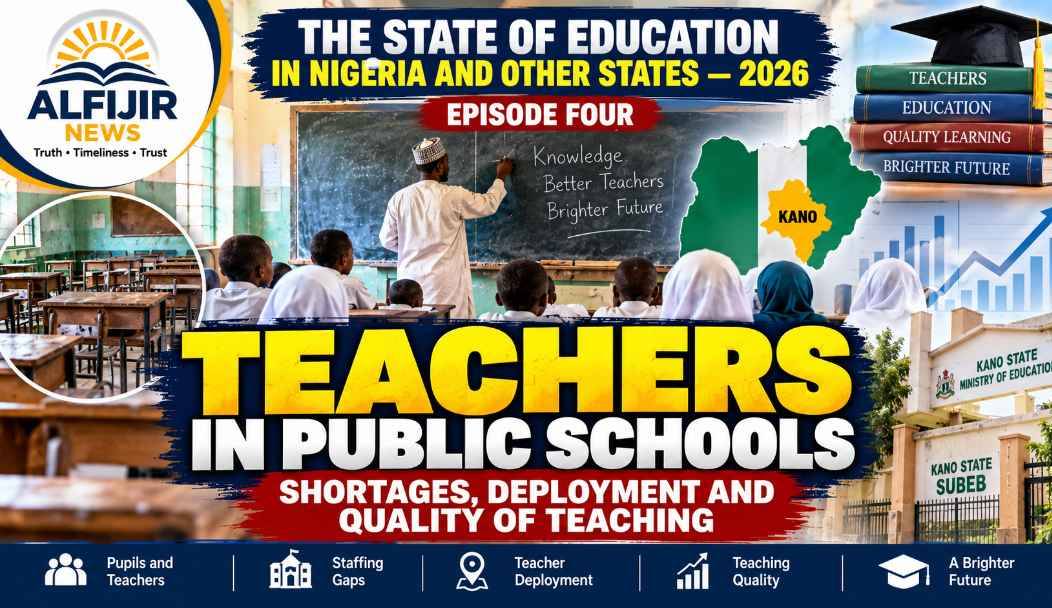
THE STATE OF EDUCATION IN NIGERIA AND OTHER STATES — 2026
EPISODE FOUR:
ALFIJIR NEWS | SPECIAL INVESTIGATION
INTRODUCTION
Education is one of the most important foundations of societal development. However, the quality of education does not depend solely on the number of schools or enrolled pupils. It also depends on the availability of qualified teachers, how they are distributed, and the conditions under which they teach.
Across Nigeria, an important question remains: Does the number of teachers in public schools match the number of pupils they are expected to teach? Are teachers distributed effectively among schools and communities? And what measures are being taken to ensure that recruitment translates into better learning outcomes?
In this fourth episode of Alfijir News’ investigation into the state of education in Nigeria and other states, we examine reported figures on teachers and pupils nationwide, with particular attention to Kano State, where published reports have highlighted concerns about teacher distribution and staffing levels in some schools.
TEACHERS AND PUPILS IN NIGERIA: WHAT DO THE FIGURES SHOW?
A report published by Punch on 18 August 2026, based on data from the Digital Nigeria Education Management Information System (DNEMIS), stated that the public schools covered by the data had 31,827,244 pupils and 592,077 teachers.
This represents an average of approximately 53.8 pupils per teacher.
However, an important qualification must be noted. Of the 108,016 schools referenced in the report, only 84,177 submitted data, representing approximately 77.9 per cent.
This means the figures must be interpreted with caution. They do not necessarily provide a complete picture of every public school in Nigeria because some schools did not submit their data.
Furthermore, an average of 53.8 pupils per teacher does not mean that every classroom contains 53 pupils. It is an overall pupil-to-teacher ratio based on the available data, and staffing conditions may vary considerably from one school to another.
THE SITUATION IN KANO STATE
According to the figures reported by Punch, Kano State had 5,226,239 pupils in public schools, with a reported ratio of 88 pupils per teacher.
This figure raises important questions about staffing levels and the distribution of teachers across the state.
Further information is needed before drawing conclusions about every school in Kano. Is the ratio similar across all local government areas? Are some schools adequately staffed while others face serious shortages? When were the underlying figures last updated?
Answers to these questions would help distinguish between an overall shortage of teachers and a problem of unequal teacher deployment.
WHEN ONE TEACHER IS RESPONSIBLE FOR MULTIPLE CLASSES
A report published by Blueprint on 22 November 2024, drawing on findings from the PLANE survey in selected supported areas of Kano, stated that approximately 25 per cent of the surveyed primary schools had one teacher responsible for all six primary-school grades.
The report also cited an average of 131 pupils per teacher in the local government areas covered by the survey.
These findings illustrate the challenges reported in some schools at that time. However, they relate to the locations covered by the survey in 2024. They should not be presented as evidence that every primary school in Kano faces the same conditions in 2026.
The key question now is whether those challenges have reduced, persisted or changed since the survey was conducted.
TEACHER RECRUITMENT IN KANO: FIGURES THAT NEED CLARIFICATION
On 22 July 2026, Channels Television reported that the Kano State Governor presented appointment letters to 8,588 teachers. The report stated that the figure included 4,900 newly recruited teachers and 3,688 teachers associated with the BESDA programme.
However, a report published on the Kano SUBEB blog on 23 July 2026 cited a different total of 7,688 teachers. It referred to 4,000 teachers appointed on a permanent and pensionable basis, alongside 3,688 BESDA teachers.
The difference between the reported figures of 8,588 and 7,688 requires clarification from the relevant authorities.
Alfijir News does not treat this discrepancy as proof of wrongdoing or dishonesty. The difference may relate to how the categories of teachers were counted, the stages of recruitment, or the way the information was reported.
Nevertheless, the public deserves a clear answer to an important question: What is the accurate number of teachers who were recruited, issued appointment letters and actually deployed to schools to begin work?
It is also important to look beyond the number of appointment letters issued. How many teachers have physically resumed duty? Which schools received them? And what impact has the recruitment had on schools that previously faced severe shortages?
WILL RECRUITING MORE TEACHERS ALONE SOLVE THE PROBLEM?
Recruiting more teachers can help reduce shortages, but its impact depends on how teachers are deployed and the quality of instruction they provide.
If teachers are recruited but not assigned to schools with the greatest staffing needs, some schools may continue to experience shortages.
Other factors also matter, including teachers’ qualifications, professional training, teaching materials, classroom conditions and the systems used to assess pupils’ learning progress.
For this reason, an investigation into teacher shortages should not focus only on how many teachers have been recruited. It should also examine whether they have been deployed where they are most needed, whether they have the resources to teach effectively, and whether pupils are benefiting from improved instruction.
QUESTIONS ALFIJIR NEWS SEEKS TO HAVE ANSWERED
To obtain a clearer picture of the situation, Alfijir News is seeking clarification from the Kano State Ministry of Education and the Kano State Universal Basic Education Board (SUBEB) on the following issues:
1. What is the latest available number of teachers and pupils in Kano State public schools, based on data updated in 2026?
2. Which figure accurately reflects the teacher recruitment exercise reported in July 2026: 8,588 or 7,688? What explains the difference between the published reports?
3. How many teachers have actually resumed work, and how many have been deployed to schools?
4. Do the authorities have an updated list of schools facing teacher shortages, including the staffing needs of individual schools and local government areas?
5. What criteria are used to distribute teachers between urban communities and rural areas?
6. What measures are in place to ensure that teachers possess the required qualifications and professional training?
7. How does the government assess the impact of teacher recruitment on class sizes, teacher attendance and pupils’ learning outcomes?
8. Are there updated figures showing whether the challenges reported in selected Kano communities in 2024 have reduced?
Alfijir News welcomes responses from the relevant authorities, including official documents, updated statistics and other evidence that can help clarify these issues.
CONCLUSION
The published figures indicate that the relationship between the number of pupils and the number of teachers remains an important issue requiring continued investigation in Nigeria, particularly in Kano State.
However, overall statistics alone cannot fully explain the conditions in every school. Updated data, a clearer account of teacher deployment and evidence of the impact of recruitment are needed to determine whether current measures are addressing the problem.
The public needs more than an announcement that teachers have been recruited. It needs to know where they have been deployed, which schools have benefited and whether pupils are receiving better teaching.
These are the questions that will help establish whether the measures being taken are producing meaningful improvements or whether significant gaps remain.
Alfijir News will continue to follow this issue and publish the responses of the relevant authorities when they are received.
EDITOR’S NOTE
Alfijir News has reviewed the available reports and presented the figures with attribution to their respective sources. The difference between the reported teacher recruitment figures of 8,588 and 7,688 remains subject to clarification by the relevant Kano State authorities.
The reports cited on teacher shortages in selected areas of Kano in 2024 are presented within their original context and should not be interpreted as a comprehensive assessment of all schools in the state in 2026.
This report may be updated if official clarification or additional verifiable evidence becomes available.
ALFIJIR NEWS
Truth • Timeliness • Trust
SOURCES
1. Punch — “Teacher Crisis: 32m Nigerian Pupils Share 592,077 Teachers” (18 August 2026)
2. Channels Television — Report on the recruitment of 8,588 teachers in Kano State (22 July 2026)
Gov Yusuf Employs Kano 8,588 Teachers, Commends FG For Suspending NECO Fees
3. Kano SUBEB — Report on the presentation of appointment letters to 7,688 teachers (23 July 2026)
https://labaransubeb.blogspot.com/2026/07/subeb-hands-over-appointment-letters-to.html
4. Blueprint — PLANE survey report on staffing conditions in selected Kano primary schools (22 November 2024)
25% of Kano primary schools have only one teacher to all six grades, PLANE reveals
5. Kano State Government — Basic Education Teachers Mapping and Recruitment Plan (31 March 2025)
https://kanostate.gov.ng/wp-content/uploads/2025/03/Kano-State-Governmnet-Basic-Education-Teachers-Mapping-and-Recruitment-Plan.pdf
📢 FOLLOW ALFIJIR LABARAI
Stay connected with Alfijir Labarai / Alfijir News for credible news, reports, investigative journalism, and important updates from Kano, Nigeria, and around the world.
📩 CONTACT US & PARTNERSHIP ENQUIRIES
Call/WhatsApp: +234 803 207 7835
🌐 OUR SOCIAL MEDIA PLATFORMS
X: https://twitter.com/Musabestseller?s=09
Facebook: https://www.facebook.com/profile.php?id=100089640289165
Threads: https://www.threads.net/@alfijirlabarai
YouTube: https://www.youtube.com/@BestsellerChannel12
Instagram: https://www.instagram.com/musa_bestseller?utm_source=qr&r=nametag
📲 JOIN OUR WHATSAPP GROUP
https://chat.whatsapp.com/Ilj1iz8v3sa3nBfrCz9U6f
ALFIJIR LABARAI MEDIA SERVICES
Truth • Timeliness • Trust
© 2026 Alfijir Labarai Media Services