
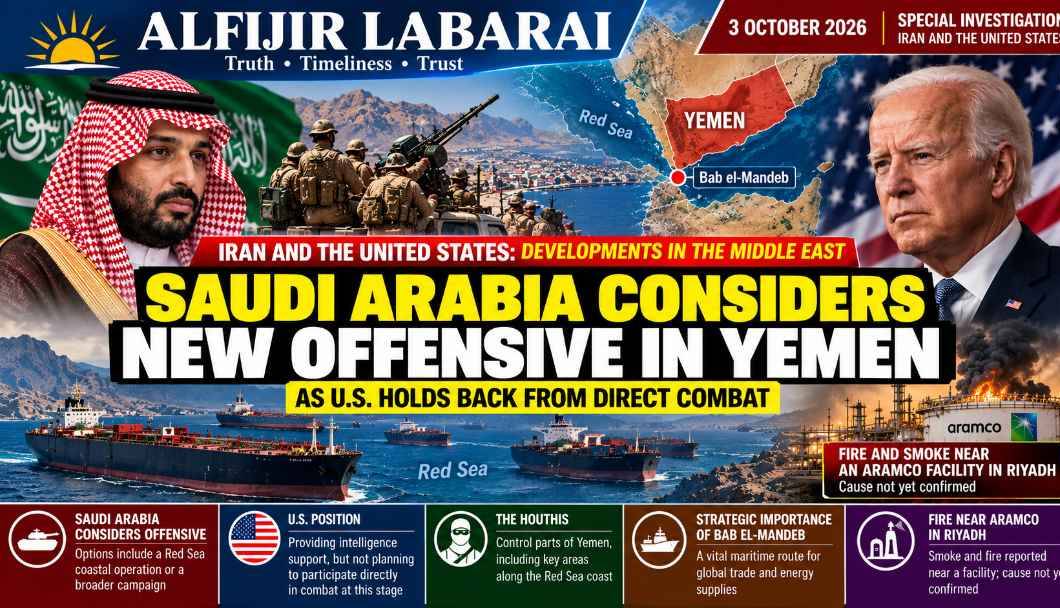
SPECIAL INVESTIGATION
IRAN AND THE UNITED STATES: DEVELOPMENTS IN THE MIDDLE EAST
Saturday, 3 October 2026
SAUDI ARABIA CONSIDERS NEW OFFENSIVE IN YEMEN AS U.S. HOLDS BACK FROM DIRECT COMBAT
INTRODUCTION
Tensions in the Middle East remain a major concern for regional security and international trade, particularly around Yemen, the Red Sea and the strategic Bab el-Mandeb Strait.
A Reuters report published on 2 October 2026 said Saudi Arabia was planning a possible military offensive against Houthi forces in Yemen. Options under consideration reportedly include a coastal operation to regain control of strategically important areas near the Red Sea shipping route or a broader campaign involving multiple fronts. The timing and scale of any operation remain uncertain. citeturn165262news34
Reports from Reuters and Axios also indicate that the United States is providing intelligence support to Saudi Arabia but is not planning to participate directly in the proposed offensive at this stage. citeturn165262news34turn165262search0
Separately, Reuters reported on 3 October that smoke and fire had been seen near an Aramco facility in Riyadh. At the time of publication, the cause had not been confirmed by Saudi authorities. citeturn165262news35
This report examines the proposed Saudi operation, the strategic importance of Bab el-Mandeb, Washington’s reported position and the unanswered questions surrounding the incident near Aramco.
1. SAUDI ARABIA CONSIDERS A NEW OFFENSIVE IN YEMEN
According to Reuters, Saudi Arabia is planning a possible offensive against the Houthis, who control parts of Yemen, including areas of strategic importance along the Red Sea coast.
The reported options include a focused operation around Bab el-Mandeb or a broader offensive involving several fronts in Yemen. Yemeni forces operating under Saudi oversight are expected to lead the ground campaign, with Saudi air support.
Reuters reported that the operation could begin in the coming weeks, although the precise timing and scope remain uncertain. The report describes military preparations and options; it does not establish that the proposed large-scale offensive has already begun. citeturn165262news34
The potential consequences will depend on whether the operation proceeds, the forces involved and the response from the Houthis.
2. WHY THE BAB EL-MANDEB STRAIT MATTERS
Bab el-Mandeb connects the Red Sea to the Gulf of Aden and forms part of an important maritime route linking markets in Asia, the Middle East and Europe.
Disruption around the strait could affect commercial shipping through higher insurance costs, delays and the need for vessels to use alternative routes.
Such disruptions can increase transportation costs and potentially affect the prices of goods and energy products. The actual impact would depend on the scale and duration of any disruption, the security measures adopted and the response of shipping companies.
This is why developments around Yemen’s Red Sea coast matter beyond the immediate conflict. Any sustained threat to maritime traffic could have consequences for international trade and supply chains.
3. THE UNITED STATES: INTELLIGENCE SUPPORT, BUT NO DIRECT COMBAT ROLE FOR NOW
Reuters and Axios reported on 2 October that the United States was not planning to participate directly in the proposed Saudi offensive at that stage, although Washington was providing intelligence and other non-combat support. citeturn165262news34turn165262search0
This distinction is important. Intelligence sharing and other forms of security assistance are not the same as deploying U.S. forces to participate directly in combat operations.
The situation could change if the conflict escalates or regional security interests are threatened. However, any assessment of a change in U.S. policy would require new, confirmed information from officials or reliable reporting.
For now, the available reports describe a proposed Saudi-led operation with U.S. intelligence support, rather than direct U.S. participation in the offensive.
4. FIRE AND SMOKE NEAR AN ARAMCO FACILITY IN RIYADH: WHAT IS CONFIRMED?
On 3 October, Reuters reported that a witness had seen smoke and fire near an Aramco facility in Riyadh. citeturn165262news35
At the time the report was published, Saudi authorities had not confirmed the cause of the incident. Aramco had not immediately responded to Reuters’ request for comment, and no party had publicly claimed responsibility.
The available information does not establish that the Houthis carried out an attack, nor does it confirm that a missile or drone caused the fire.
The incident should therefore be treated as unresolved pending further information from Saudi authorities, Aramco or independently verified reporting.
5. IRAN AND THE HOUTHIS: WHY ATTRIBUTION REQUIRES CARE
The Houthis are commonly described in international reporting as an Iran-aligned movement. Their relationship with Tehran is one of the factors that places Yemen’s conflict within the wider regional security picture.
However, political or military alignment does not, by itself, prove that the Iranian government ordered a specific attack.
Any claim linking Iran or the Houthis to a particular incident should be assessed using verifiable evidence, official statements and independent reporting.
This distinction is especially important during periods of heightened tension, when early accounts may be incomplete or may come from parties involved in the conflict.
6. WHY SHIPPING ROUTES AND ENERGY FACILITIES MATTER TO SAUDI ARABIA
Saudi Arabia has major economic interests connected to energy production, infrastructure and international trade. Protecting energy facilities and maritime routes is therefore an important security concern.
Disruption to shipping routes can raise freight and insurance costs. Damage to energy infrastructure could also interrupt operations and affect economic activity.
However, determining the scale of any threat requires confirmed information about incidents, damage, shipping diversions and changes in insurance or transportation costs.
The reported fire near an Aramco facility deserves continued attention, but the available information does not establish its cause or confirm that the facility itself was directly attacked.
7. WHAT TO WATCH NEXT
Several developments will help clarify the direction of the conflict:
– Whether Saudi Arabia proceeds with the offensive described in the reports.
– Whether any operation is limited to the Red Sea coast or expands to other parts of Yemen.
– Whether the United States maintains its current position of providing intelligence support without direct combat participation.
– Whether Saudi authorities release confirmed information about the fire near the Aramco facility.
– Whether security risks around Bab el-Mandeb affect shipping routes, insurance costs or energy transportation.
– Whether diplomatic efforts produce an alternative to further military escalation.
CONCLUSION
The key development reported on 2 October 2026 is that Saudi Arabia is planning a possible offensive against the Houthis in Yemen, with options focused on strategically important areas along the Red Sea coast.
The United States is reported to be providing intelligence support while holding back from direct participation in the proposed offensive for now.
Meanwhile, the fire and smoke reported near an Aramco facility in Riyadh on 3 October remain unexplained in the available reporting. No conclusion should be drawn about the cause or responsibility without further confirmation.
For observers following developments involving Iran, the United States and the wider Middle East, the central questions are whether the proposed Saudi operation will proceed, how Washington’s role may evolve and whether tensions will further affect maritime security and international trade.
WHAT TO WATCH IN THE COMING WEEK
– Updates on Saudi Arabia’s reported military preparations.
– Any change in the U.S. position on intelligence support or direct combat involvement.
– Official findings concerning the incident near the Aramco facility in Riyadh.
– Further developments involving the Houthis and Yemen’s Red Sea coast.
– Changes affecting maritime traffic and energy transportation.
– New diplomatic initiatives aimed at reducing regional tensions.
SOURCES AND FURTHER READING
1. Reuters — 2 October 2026
“Saudis plan assault on Houthis to break Red Sea chokehold.”
https://www.reuters.com/world/asia-pacific/saudis-plan-assault-houthis-break-red-sea-chokehold-2026-10-02/
2. Axios — 2 October 2026
“Saudis plan major offensive against the Houthis, but U.S. won’t join for now.”
https://www.axios.com/2026/10/02/saudis-yemen-houthis-bab-al-mandeb-strait
3. Reuters — 3 October 2026
“Fire, smoke seen near Aramco facility in Riyadh, witness says.”
https://www.reuters.com/business/energy/fire-smoke-seen-near-aramco-facility-riyadh-witness-says-2026-10-03/
ALFIJIR LABARAI
Truth • Timeliness • Trust
We investigate. We ask questions. We explain what is happening.
📢 FOLLOW ALFIJIR LABARAI
Stay connected with Alfijir Labarai / Alfijir News for credible news, reports, investigative journalism, and important updates from Kano, Nigeria, and around the world.
📩 CONTACT US & PARTNERSHIP ENQUIRIES
Call/WhatsApp: +234 803 207 7835
🌐 OUR SOCIAL MEDIA PLATFORMS
X: https://twitter.com/Musabestseller?s=09
Facebook: https://www.facebook.com/profile.php?id=100089640289165
Threads: https://www.threads.net/@alfijirlabarai
YouTube: https://www.youtube.com/@BestsellerChannel12
Instagram: https://www.instagram.com/musa_bestseller?utm_source=qr&r=nametag
📲 JOIN OUR WHATSAPP GROUP
https://chat.whatsapp.com/Ilj1iz8v3sa3nBfrCz9U6f
ALFIJIR LABARAI MEDIA SERVICES
Truth • Timeliness • Trust
© 2026 Alfijir Labarai Media Services