
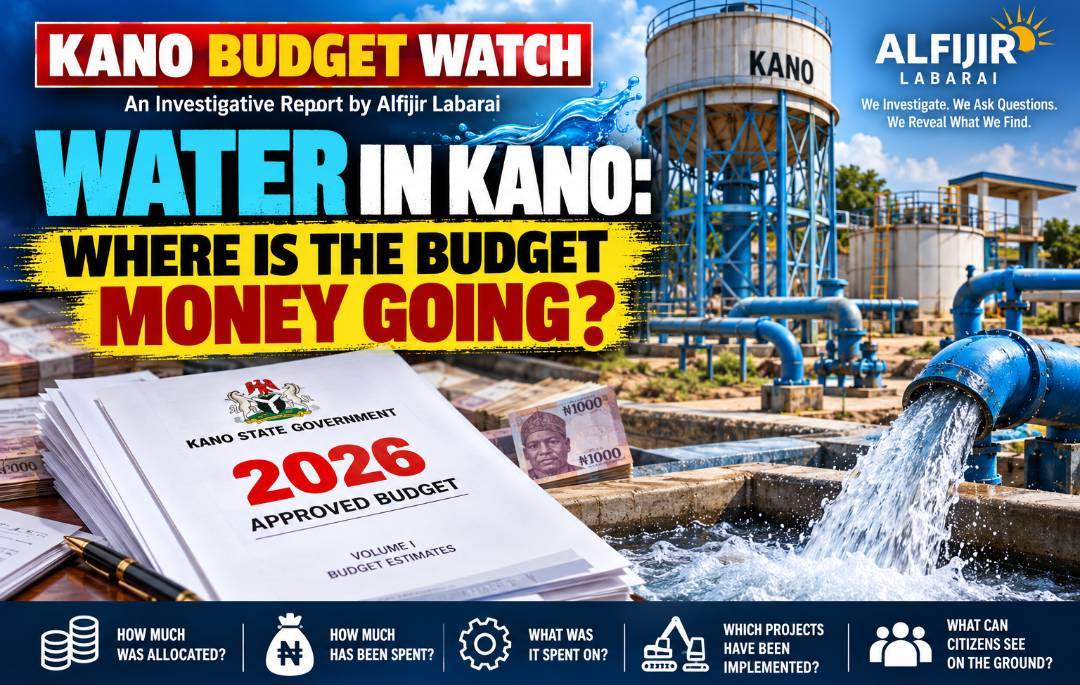
WATER
Access to reliable water supply is an important public concern in Kano State. Government spending on water infrastructure, treatment facilities and water supply services therefore deserves careful public scrutiny.
For the 2026 fiscal year, the Kano State Government allocated ₦36,012,957,510.25 to Water Resources and Rural Development.
But how much of this allocation had been recorded as expenditure by the end of June 2026? What categories accounted for the spending? And what evidence is available to show the projects and services delivered?
These are the questions examined in this edition of KANO BUDGET WATCH.
THE 2026 WATER BUDGET: ₦36.013 BILLION
The Kano State Government’s Q2 2026 Budget Performance Report lists an Original Budget of ₦36.013 billion for Water Resources and Rural Development.
The report covers the second quarter and cumulative expenditure from January to June 2026. It compares expenditure against the Original Approved Budget.
According to the report, cumulative expenditure for the programme stood at ₦6,645,583,101.25, equivalent to 18.5 per cent of the allocation.
The balance against the Original Budget was ₦29,367,374,409.00.
These figures describe reported budget implementation. They do not, by themselves, establish whether individual projects were completed or whether every recorded expenditure resulted in a corresponding payment to a contractor.
WHERE DID THE RECORDED EXPENDITURE GO?
The Q2 report divides the programme’s expenditure into three principal categories: Personnel, Overhead and Capital Expenditure.
1. PERSONNEL EXPENDITURE
Original Budget: ₦1,902,247,000.00
Expenditure recorded from January to June: ₦685,855,818.01
Budget performance: 36.1 per cent.
This category concerns personnel-related expenditure. Further examination of the underlying records would be needed to establish the detailed composition of the expenditure.
2. OVERHEAD EXPENDITURE
Original Budget: ₦2,397,242,250.00
Expenditure recorded from January to June: ₦2,745,250,165.75
Budget performance: 114.5 per cent.
The reported expenditure exceeded the Original Budget by approximately ₦348.008 million.
This is an important area for further examination. The Q2 report states, in its general discussion of budget implementation, that certain expenditure variations would be addressed through budget adjustment and supplementary budget processes in collaboration with the State House of Assembly.
However, the figures alone do not establish whether a specific adjustment was subsequently approved for this programme.
The questions requiring documentary answers are:
– Was a budget adjustment proposed or approved for the excess?
– What amount, if any, was formally adjusted?
– When was the adjustment made?
– What approval records are available?
These questions should be answered using the relevant budget documents and legislative records.
3. CAPITAL EXPENDITURE
Original Budget: ₦31,713,068,260.25
Expenditure recorded from January to June: ₦3,214,477,117.49
Budget performance: 10.1 per cent.
The balance against the Original Capital Budget was ₦28,498,591,142.76.
Capital Expenditure is particularly important to this investigation because it is the budget category associated with capital projects and infrastructure investment.
The figures raise a central question: which specific water-related projects and activities account for the ₦3.214 billion recorded as Capital Expenditure?
The budget-performance report provides the financial overview, but project-level records are needed to establish what was implemented, where the work took place and what results were delivered.
WHAT DO THESE FIGURES ACTUALLY TELL US?
The reported expenditure of ₦6.646 billion represents 18.5 per cent of the Original Budget for Water Resources and Rural Development.
The remaining ₦29.367 billion against the Original Budget must not automatically be described as missing, lost or misappropriated money.
Similarly, the 10.1 per cent Capital Expenditure performance figure does not, on its own, prove that projects failed or that no work was undertaken.
The figures identify an area requiring closer scrutiny. To understand the reasons for the reported expenditure levels, the investigation needs to examine project schedules, procurement documents, contracts, payment records and implementation reports.
The key questions are:
What was the ₦6.646 billion recorded against?
Which projects were scheduled for implementation during the first half of 2026?
Which projects commenced or reached completion?
What amounts were approved and paid for individual projects?
And what evidence exists of the services or infrastructure delivered?
FROM BUDGET ALLOCATIONS TO WATER PROJECTS
Public announcements by the Kano State Government provide additional leads for this investigation.
Among the water infrastructure initiatives publicly discussed by the government are interventions involving the Challawa and Tamburawa water treatment plants.
The government has also announced approvals relating to water supply and energy projects, including a water treatment plant at Taliwaiwai in Rano Local Government Area.
These announcements are relevant because they identify projects and initiatives that can be investigated further.
However, an announcement of an approval is not, by itself, proof that the money was paid, that a contract was fully executed or that a facility became operational.
Alfijir Labarai will therefore seek to establish the connection between each relevant project and the 2026 budget, including its allocation, contract value, payment history and implementation status.
WHAT THE NEXT STAGE OF THE INVESTIGATION MUST ESTABLISH
To move from budget analysis to project-level accountability, the investigation will examine available official records for selected water projects.
The records sought will include:
– Project names and locations.
– Original budget allocations and any approved revisions.
– Procurement and contract award documents.
– Contract values and implementation timelines.
– Payment records and certificates, where available.
– Inspection, completion and handover reports.
– Evidence of the operational status of completed facilities.
Where possible, these records will be compared with direct observations and information from communities expected to benefit.
This approach will help distinguish between money budgeted, expenditure recorded, payments made and infrastructure actually delivered.
THREE KEY QUESTIONS FOR FURTHER INVESTIGATION
First: Capital Expenditure
Why had reported Capital Expenditure reached ₦3.214 billion by the end of June, against an Original Capital Budget of ₦31.713 billion?
What implementation schedules and project records explain the reported position?
Second: Overhead Expenditure
Why did reported Overhead Expenditure reach ₦2.745 billion against an Original Budget of ₦2.397 billion?
Was an adjustment approved, and what documentary evidence establishes the basis for the expenditure?
Third: Project Delivery
Which projects and activities account for the ₦6.646 billion recorded as year-to-date expenditure?
What evidence demonstrates the work undertaken and the benefits delivered to residents?
WHAT ALFIJIR LABARAI HAS ESTABLISHED SO FAR
The Kano State Government’s Q2 2026 Budget Performance Report records the following figures for Water Resources and Rural Development:
– Original Budget: ₦36.013 billion.
– Personnel Expenditure: ₦685.856 million, representing 36.1 per cent of its budget.
– Overhead Expenditure: ₦2.745 billion, representing 114.5 per cent of its budget.
– Capital Expenditure: ₦3.214 billion, representing 10.1 per cent of its budget.
– Total year-to-date expenditure: ₦6.646 billion.
– Overall budget performance: 18.5 per cent.
– Balance against Original Budget: ₦29.367 billion.
These figures establish the financial position reported by the government at the end of June 2026. They do not independently establish the completion status, quality or public benefit of individual projects.
The Q2 2026 Budget Performance Report provides a starting point for examining public spending under Water Resources and Rural Development in Kano State.
It shows an Original Budget of ₦36.013 billion and cumulative expenditure of ₦6.646 billion by the end of June.
But a budget report is only one part of the evidence needed to assess public spending.
The next stage must establish what the recorded expenditure financed, which projects were implemented, where they were located, what payments were made and what services residents received.
The questions go beyond whether money was allocated or expenditure recorded.
How much was budgeted?
How much was recorded as expenditure?
What was the expenditure for?
Which projects were implemented?
Where are the projects?
What evidence exists of payment and completion?
And what benefits did the public receive?
These are questions that require documentary evidence and, where possible, verification on the ground.
This is not a finding of wrongdoing. It is an investigation into public spending and project delivery.
Alfijir Labarai will continue to seek the records and evidence needed to answer these questions.
We Investigate.
We Ask Questions.
We Reveal What We Find.
SOURCES
1. Kano State Government, 2026 Q2 Budget Implementation Report. Published July 2026. The principal source for the Original Budget and January–June expenditure figures cited in this report.
https://budget.kn.gov.ng/wp-content/uploads/2026/07/KANO-STATE-2026-Q2-BPR-FINAL.pdf
2. Kano State Government, Official Water Infrastructure Announcement. Government information concerning planned improvements to water supply in Kano.
https://kanostate.gov.ng/gov-yusuf-assures-improved-water-supply-in-kano/
Editorial note: Budget allocations, reported expenditure, contract approvals, actual payments and completed projects are distinct matters. This report does not treat one as proof of another. Any conclusions about individual projects will require supporting records and verification.
CONNECT WITH ALFIJIR LABARAI
Stay connected with Alfijir Labarai / Alfijir News for the latest news, reports, investigations, programmes and important updates from Kano, Nigeria and around the world.
📞 CONTACT US
For enquiries, news tips, partnership, advertising, sponsorship and more information:
+234 803 207 7835
📰 Have a story, development or important information to share?
Send your news tips, press releases, announcements and community stories to Alfijir Labarai.
🤝 PARTNER WITH US
We welcome individuals, organisations, institutions and businesses interested in:
• Media Partnership
• Advertising
• Programme Sponsorship
• Corporate Partnerships
• Special Reports & Features
• Event & Programme Promotion
📞 Contact us:
+234 803 207 7835
🌐 FOLLOW ALFIJIR LABARAI
🐦 X (Twitter):
“Follow us on X” https://twitter.com/Musabestseller?s=09
📘 Facebook:
“Follow us on Facebook” https://www.facebook.com/profile.php?id=100089640289165
🧵 Threads:
“Follow us on Threads”https://www.threads.net/@alfijirlabarai
▶️ YouTube:
“Subscribe on YouTube” https://www.youtube.com/@BestsellerChannel12
📸 Instagram:
“Follow us on Instagram” https://www.instagram.com/musa_bestseller?utm_source=qr&r=nametag
📲 JOIN OUR WHATSAPP GROUP
Get our latest news updates, programmes, reports and important announcements directly on WhatsApp.
👇👇 Join the Alfijir Labarai / Alfijir News WhatsApp Group:
“Join our WhatsApp Group” https://chat.whatsapp.com/Ilj1iz8v3sa3nBfrCz9U6f?s=cl&p=a&mlu=4&ilr=4
ALFIJIR LABARAI MEDIA SERVICES
Accurate • Timely • Trusted
📰 News • Reports • Investigations • Programmes • Public Awareness
© 2026 Alfijir Labarai Media Services