
By Kamaluddeen Ahmad
UN Sustainable Development Goals Advocate
Kano State’s transition from conventional diesel-powered streetlights to solar-powered streetlighting represents an important step towards renewable energy adoption, environmental sustainability and improved urban security.
Under the administration of Governor Abba Kabir Yusuf, the Kano State Government has undertaken major investments in solar streetlighting, replacing conventional streetlights in several parts of Kano metropolis and extending lighting infrastructure to previously underserved areas.
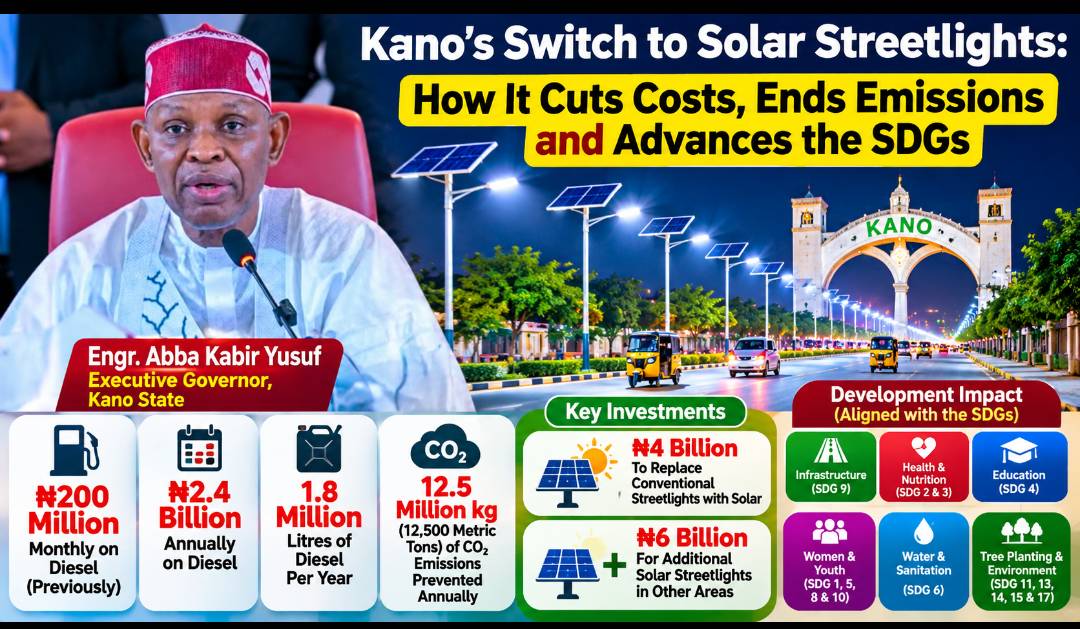
According to figures presented by Sustainable Development Goals (SDGs) advocate Kamaluddeen Ahmad, the state previously spent approximately ₦200 million monthly on diesel to power conventional streetlights across Kano City.
This translates to an estimated ₦2.4 billion annually.
Using the historical diesel price of approximately ₦1,300 per litre, the expenditure would represent roughly 1.85 million litres of diesel annually.
Research indicates that burning one litre of diesel produces approximately 2.68 kilograms of carbon dioxide (CO₂). Based on this emission factor, the estimated annual emissions from consuming that quantity of diesel would be approximately 4.95 million kilograms of CO₂.
This highlights the potential environmental benefits of replacing diesel-powered streetlighting with solar alternatives.
A ₦10 Billion Investment in Solar Streetlighting
The Kano State Government reportedly invested ₦4 billion in replacing conventional streetlights with solar-powered alternatives.
The government subsequently committed another ₦6 billion to procuring additional solar streetlights to illuminate areas that previously lacked adequate streetlighting.
Beyond improving visibility at night, these investments are expected to support public safety, urban development and the state’s transition towards cleaner energy.
The initiative aligns with Sustainable Development Goal 7 (Affordable and Clean Energy), which seeks to ensure access to affordable, reliable, sustainable and modern energy for all.
It also supports SDG 16 (Peace, Justice and Strong Institutions), particularly through efforts to create safer communities.
Potential Environmental Benefits
The replacement of diesel-powered streetlights with solar systems could significantly reduce emissions associated with conventional streetlighting.
Based on the historical diesel consumption estimate, approximately five million kilograms of carbon dioxide emissions could potentially be avoided annually from the original streetlighting operations, subject to verification of the actual energy requirements and operational performance of the solar installations.
The additional ₦6 billion investment in solar streetlights could extend these environmental benefits if it replaces an equivalent level of diesel-powered electricity generation.
However, determining the total annual emissions avoided requires verified information about the number of installations, their energy capacity, the diesel consumption they replace and their operational efficiency.
The initiative therefore has potential relevance to SDG 13 (Climate Action), which calls for urgent measures to combat climate change and its impacts.
Redirecting Public Resources Towards Development
Another important argument presented by the SDG advocate is the potential financial savings associated with moving away from diesel-powered streetlighting.
At current diesel prices, maintaining conventional streetlights could involve substantial recurring expenditure. However, the actual annual savings would depend on the quantity of diesel previously consumed, the number of functioning streetlights and the costs of maintaining the solar installations.
If verified savings are realised, they could provide additional fiscal space for other development priorities.
Among the areas highlighted in the advocate’s assessment are:
1. Infrastructure Development
Investments in roads and other public infrastructure could support economic growth, improve connectivity and strengthen the state’s development capacity. These priorities align with SDG 9, which promotes resilient infrastructure, sustainable industrialisation and innovation.
2. Healthcare and Child Nutrition
The advocate highlighted interventions targeting more than three million children aged between one and 59 months, alongside efforts to improve maternal healthcare and the availability of essential medicines in public hospitals.
He also cited a reported 45 per cent reduction in maternal mortality in Kano State in 2026. This figure requires supporting health-sector data and independent verification.
These priorities align with SDG 2 (Zero Hunger) and SDG 3 (Good Health and Well-being).
3. Education and Human Capital Development
The administration’s education initiatives reportedly include free education, school feeding programmes, expanded digital literacy opportunities and efforts to reduce the number of out-of-school children.
The advocate also cited an 11 per cent reduction in out-of-school children and improved performance by Kano State in the 2026 National Examinations Council (NECO) examinations.
These claims require supporting education statistics and official examination records.
The initiatives are consistent with SDG 4, which promotes inclusive and equitable quality education and lifelong learning opportunities.
4. Women’s and Youth Economic Empowerment
Small-business support, youth empowerment and poverty-reduction programmes were also identified as important areas of government intervention.
These efforts relate to SDG 1 (No Poverty), SDG 5 (Gender Equality), SDG 8 (Decent Work and Economic Growth) and SDG 10 (Reduced Inequalities).
5. Water Supply and Sanitation
The rehabilitation and upgrading of water treatment facilities, alongside efforts to expand access to basic sanitation, are among the development priorities highlighted in the assessment.
These initiatives support SDG 6, which seeks to ensure the availability and sustainable management of water and sanitation for all.
6. Environmental Protection and Tree Planting
The advocate also highlighted the reported planting of more than eight million trees across Kano State in collaboration with the Federal Government, the World Bank and other partners.
Tree planting can contribute to improved environmental quality, urban beautification, biodiversity conservation and efforts to combat desertification, provided the trees survive and are properly maintained.
These interventions align with SDG 11 (Sustainable Cities and Communities), SDG 13 (Climate Action), SDG 14 (Life Below Water), SDG 15 (Life on Land) and SDG 17 (Partnerships for the Goals).
7. Monitoring Healthcare Delivery in Private Facilities
The governor’s visits to private healthcare facilities, including Best Choice Specialist Hospital, were also cited as part of efforts to monitor healthcare delivery beyond government-owned hospitals.
According to the advocate, such visits could encourage improved service standards, strengthen collaboration between public and private healthcare providers and promote accountability in healthcare delivery.
These objectives are consistent with SDG 3 and SDG 17.
A Broader Question of Sustainable Development
Kano State’s transition to solar-powered streetlighting offers an opportunity to examine how renewable energy investments can contribute to environmental protection, public safety and more efficient public expenditure.
However, the long-term success of the initiative will depend not only on the initial investment but also on proper maintenance, the durability of installed equipment, reliable performance monitoring and transparent reporting of financial and environmental outcomes.
The actual savings, avoided carbon emissions and wider development benefits should be supported by independently verifiable data.
Ultimately, the transition to solar streetlighting could serve as an important example of how investments in clean energy can contribute to sustainable urban development and the achievement of the United Nations Sustainable Development Goals.
Source: Information and figures presented by Kamaluddeen Ahmad, UN Sustainable Development Goals Advocate.
📢 FOLLOW ALFIJIR LABARAI
Stay connected with Alfijir Labarai / Alfijir News for credible news, reports, investigative journalism, and important updates from Kano, Nigeria, and around the world.
📩 CONTACT US & PARTNERSHIP ENQUIRIES
Call/WhatsApp: +234 701 1 11 3809
+234 803 207 7835
🌐 OUR SOCIAL MEDIA PLATFORMS
X: https://twitter.com/Musabestseller?s=09
Facebook: https://www.facebook.com/profile.php?id=100089640289165
Threads: https://www.threads.net/@alfijirlabarai
YouTube: https://www.youtube.com/@BestsellerChannel12
Instagram: https://www.instagram.com/musa_bestseller?utm_source=qr&r=nametag
📲 JOIN OUR WHATSAPP GROUP
https://chat.whatsapp.com/Ilj1iz8v3sa3nBfrCz9U6f
ALFIJIR LABARAI MEDIA SERVICES
Truth • Timeliness • Trust
© 2026 Alfijir Labarai Media Services