
Exploring Europe. Understanding Perspectives. Telling the Stories That Matter.
EDITION 006 | 24 NOVEMBER 2026
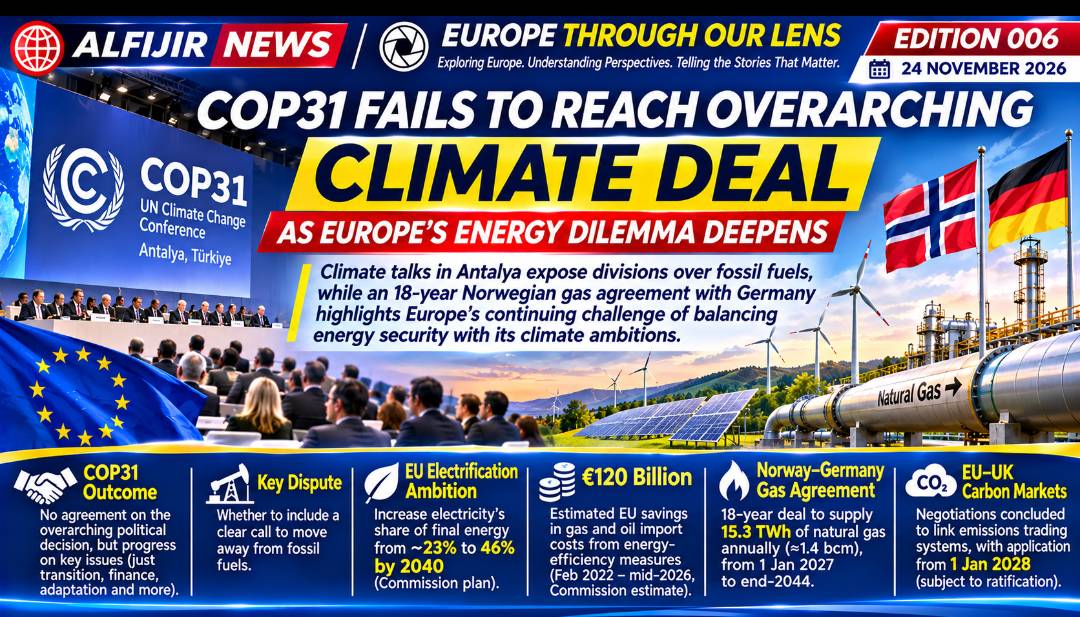
Climate negotiations in Antalya expose divisions over fossil fuels, while an 18-year Norwegian gas agreement with Germany highlights Europe’s continuing challenge of balancing energy security with its climate ambitions.
—
COP31 ends without an overarching political agreement
The United Nations Climate Change Conference, COP31, concluded in Antalya, Türkiye, on Sunday, 22 November 2026, without agreement on its proposed overarching political decision.
The negotiations continued beyond the scheduled closing date as governments struggled to resolve differences over fossil fuels, climate finance and the pace of global climate action.
The United Nations Framework Convention on Climate Change (UNFCCC) confirmed that participating countries failed to reach agreement on the Presidency-Led Cover Decision, a proposed political text intended to provide a broader direction for international climate action.
UN Secretary-General António Guterres described the outcome as deeply disappointing, while stressing that the absence of political consensus did not change the scientific evidence or the urgency of the climate crisis.
The failure to adopt the proposed decision represents a setback for international climate diplomacy. However, it is important to distinguish this failure from the wider work of the conference: COP31 did not end without all progress or agreements.
Fossil fuels remain at the centre of the disagreement
The main political dispute concerned whether the proposed final text should explicitly recognise the need to transition away from fossil fuels.
The European Union formally objected to the proposed Cover Decision because it did not include a reference to fossil fuels or the need to move away from them.
Ireland’s Environment Minister Darragh O’Brien, speaking on behalf of the EU, said the bloc could not endorse a decision that failed to respond adequately to the scientific evidence and did not even mention fossil fuels.
The disagreement reflected different national interests and economic circumstances. Countries with significant fossil-fuel production and export interests have been reluctant to support language that could be interpreted as requiring faster changes to their energy systems.
According to Carbon Brief’s reporting from the closing plenary, at least 32 countries rejected the proposed Cover Decision. The publication also reported objections from the EU, Norway, Panama, the Marshall Islands, Belize and Vanuatu, among others.
The dispute demonstrates the continuing difficulty of reaching a common international position when countries have different energy needs, economic structures and development priorities.
Not everything at COP31 failed
Although the conference did not produce an overarching political agreement, the UNFCCC confirmed progress in several areas of formal negotiations and practical climate cooperation.
Almost 200 countries represented at the conference reached agreements on a range of mandated issues relating to climate finance, adaptation, mitigation, technology, transparency and the second Global Stocktake.
One important outcome concerned the Just Transition Work Programme.
Countries agreed to continue the programme for another three years, with strengthened arrangements. They also decided to operationalise the Just Transition Mechanism through a phased approach.
The mechanism is intended to improve international cooperation, technical assistance, capacity building and knowledge-sharing to support fair and inclusive transitions.
Its adoption is expected at COP32.
These outcomes matter because climate policies affect workers, communities, industries and countries differently. A transition that does not address employment, affordability and social protection risks creating additional inequalities.
The conference also recorded progress under its Global Climate Action Agenda, including new investment and practical initiatives aimed at accelerating electrification.
The Paris Agreement and previously adopted climate commitments remain in force. The failure to agree on the proposed Cover Decision does not cancel those existing obligations.
Europe’s electrification ambitions face practical challenges
The European Union has been developing a strategy to reduce dependence on imported fossil fuels by increasing the use of electricity across industry, transport and buildings.
On 17 July 2026, the European Commission presented its Electrification Action Plan.
The plan aims to increase electricity’s share of final energy consumption from approximately 23 per cent to 46 per cent by 2040.
The Commission estimates that achieving this ambition could reduce the EU’s fossil-fuel import costs by up to €260 billion annually by 2040.
The plan focuses on electric vehicles, heat pumps, electricity networks, batteries and other technologies capable of replacing fossil-fuel equipment.
However, the Commission acknowledges that important barriers remain.
Electricity can cost substantially more than gas in some markets, while connecting new projects to electricity networks can take years. Businesses also face financial and technical obstacles when replacing existing fossil-fuel systems.
This means that the transition requires more than political commitments. It requires investment in infrastructure, affordable electricity and technologies that households and businesses can realistically adopt.
The €260 billion figure is a projected potential saving, not an amount already achieved.
Energy efficiency has saved billions in import costs
A separate development reported by Reuters on 23 November provides an indication of the economic benefits of reducing energy consumption.
The European Commission estimates that energy-efficiency measures saved the EU approximately €120 billion in gas and oil import costs between February 2022 and mid-2026.
The estimate reflects the effects of measures introduced between 2015 and 2021, according to Commission spokesperson Anna-Kaisa Itkonen, speaking to Reuters.
It should therefore not be interpreted as savings generated exclusively by policies introduced after Russia’s full-scale invasion of Ukraine in 2022.
The Commission also estimates that energy-efficiency measures saved approximately 195 million tonnes of oil equivalent between 2005 and 2024.
Energy efficiency can reduce overall demand while allowing households and businesses to maintain or improve the services they receive. It can therefore complement the expansion of renewable electricity and electrification.
The €120 billion figure is a Commission estimate reported by Reuters, rather than an independently audited total.
Norway and Germany sign an 18-year natural-gas agreement
While Europe continues to pursue cleaner energy, natural gas remains an important part of its current energy system.
On Tuesday, 24 November, Norwegian energy company Equinor signed an 18-year natural-gas supply agreement with German gas company VNG.
Under the agreement, Equinor will supply 15.3 terawatt-hours of natural gas annually, equivalent to approximately 1.4 billion cubic metres.
Deliveries are scheduled to begin on 1 January 2027 and continue until the end of 2044.
The gas will be delivered to Trading Hub Europe, Germany’s gas-market area.
Equinor described the agreement as its longest-term natural-gas sales contract since the Troll field supply agreement signed in 1986.
The companies said the sales terms would reflect market prices, while other commercial details would remain confidential.
The agreement is significant for Germany because VNG supplies gas to customers including municipal utilities, industrial companies and power-plant operators.
It also demonstrates the continuing importance of Norwegian pipeline gas in Europe’s energy supply arrangements.
The contract specifies an annual volume of 15.3 TWh. It does not mean that the entire volume will necessarily be consumed in Germany every year.
Europe’s gas-storage position adds urgency
The agreement comes as Europe approaches the winter heating season with relatively low gas-storage levels.
Reuters, citing Gas Infrastructure Europe data, reported on 24 November that European gas storage was approximately 69 per cent full.
Germany’s storage facilities were reported to be 56.5 per cent full, compared with 71.2 per cent at the same time a year earlier.
These figures help explain why long-term supply agreements remain attractive to European energy companies.
Norway supplied approximately 44 per cent of Germany’s gas in 2025, becoming its largest supplier after Germany and other European countries reduced their reliance on Russian energy following the 2022 invasion of Ukraine.
The Equinor–VNG agreement therefore strengthens the commercial relationship between two European countries at a time when energy security remains a major policy concern.
However, long-term gas contracts also raise questions about how Europe will manage its transition towards cleaner energy while maintaining reliable supplies during the coming decades.
Norway is European, but not an EU member
The Equinor–VNG agreement illustrates why it is important to distinguish Europe from the European Union.
Norway is a European country but is not an EU member state.
It participates in the European Economic Area alongside Iceland and Liechtenstein, extending much of the EU internal market to those countries.
This arrangement allows extensive economic cooperation without making Norway part of the EU’s political institutions or customs union.
Norway’s role in European energy security is therefore significant even though it remains outside the Union.
EU and UK move towards linking carbon markets
Another important development came from the EU–United Kingdom summit held in Brussels on 20 November.
The European Commission confirmed that EU and UK leaders had concluded negotiations on an agreement to link their respective Emissions Trading Systems.
The two sides have committed to applying the agreement from 1 January 2028, subject to ratification and the completion of the necessary legal processes in both jurisdictions.
The linking of the systems is intended to create a larger carbon market, improve liquidity and support more consistent carbon-pricing arrangements for businesses on both sides of the Channel.
The United Kingdom will also expand its emissions-trading system to include aviation and maritime activities, bringing more than 10 million additional tonnes of CO₂ emissions into the system.
The agreement is an important example of climate cooperation extending beyond EU membership.
The United Kingdom left the EU in 2020, but remains a European country and an important partner in trade, security and climate policy.
The emissions-trading agreement has concluded its negotiation phase; it should not yet be described as fully implemented.
What these developments mean for Europe’s future
The developments of the past few days reveal a central challenge facing Europe.
On one side, European institutions are pursuing ambitious plans to increase electrification, reduce fossil-fuel imports and strengthen climate action.
On the other, companies and governments continue to rely on natural gas to maintain industrial activity, electricity generation and reliable energy supplies.
The new Norwegian–German agreement illustrates that this dependence will not disappear immediately.
At the international level, the failure to agree on COP31’s overarching political decision raises questions about how quickly climate diplomacy can translate existing commitments into practical action.
For European policymakers, the challenge is not simply to choose between energy security and climate protection. It is to develop an energy system that can deliver both.
That requires reliable supply, stronger electricity networks, affordable technologies, greater efficiency and credible support for workers and communities affected by the transition.
COP31 did not deliver the overarching political agreement many countries wanted. Yet the conference’s other outcomes, Europe’s electrification plans and the new gas agreement all demonstrate that the continent’s energy future will be shaped by difficult choices between affordability, security and environmental responsibility.
Europe’s challenge is to ensure that its climate ambitions remain achievable while protecting households, businesses and the wider economy.
—
SOURCES AND FURTHER READING
1. UNFCCC: “COP31 delivers progress across negotiations but fails to agree on the Presidency-Led Decision” (https://unfccc.int/news/cop31-delivers-important-progress-across-negotiations-and-action-agenda-advancing-implementation-but)
2. United Nations: “COP31 ends without climate pact as UN Secretary-General expresses disappointment” (https://www.un.org/en/node/250808)
3. Carbon Brief: “COP31: Key outcomes agreed at the UN climate talks in Antalya” (https://www.carbonbrief.org/cop31-key-outcomes-agreed-at-the-un-climate-talks-in-antalya)
4. European Commission: “A plan to make Europe the first electro-continent” (https://commission.europa.eu/news-and-media/news/plan-make-europe-first-electro-continent-2026-07-17_en)
5. Reuters: “EU says efficiency measures saved €120 billion in gas and oil import costs” (https://www.reuters.com/business/energy/eu-says-efficiency-measures-saved-120-billion-gas-oil-import-costs-since-ukraine-2026-11-23/)
6. Reuters: “Norway’s Equinor signs 18-year gas supply deal with Germany’s VNG” (https://www.reuters.com/business/energy/norways-equinor-signs-18-year-gas-supply-deal-with-germanys-vng-2026-11-24/)
7. European Commission: “Negotiations finalised to link EU and UK Emissions Trading Systems” (https://climate.ec.europa.eu/news-other-reads/news/negotiations-finalised-link-eu-and-uk-emissions-trading-systems-2026-11-20_en)
8. Council of the European Union: “EU–United Kingdom summit, 20 November 2026” (https://www.consilium.europa.eu/en/meetings/international-summit/2026/11/20/)
EDITORIAL NOTE
This report distinguishes between adopted COP31 decisions and the proposed overarching political text that failed to secure consensus.
The €120 billion energy-efficiency savings and €260 billion potential electrification savings are estimates or projections attributed to the European Commission. The Equinor–VNG agreement is a confirmed commercial contract, with deliveries scheduled to begin in January 2027. The EU–UK emissions-trading agreement remains subject to ratification and entry into force.
The report covers European developments involving both EU and non-EU countries. Europe and the European Union are not interchangeable terms.
📢 FOLLOW ALFIJIR LABARAI
Stay connected with Alfijir Labarai / Alfijir News for credible news, reports, investigative journalism, and important updates from Kano, Nigeria, and around the world.
📩 CONTACT US & PARTNERSHIP ENQUIRIES
Call/WhatsApp: +234 701 1 11 3809
+234 803 207 7835
🌐 OUR SOCIAL MEDIA PLATFORMS
X: https://twitter.com/Musabestseller?s=09
Facebook: https://www.facebook.com/profile.php?id=100089640289165
Threads: https://www.threads.net/@alfijirlabarai
YouTube: https://www.youtube.com/@BestsellerChannel12
Instagram: https://www.instagram.com/musa_bestseller?utm_source=qr&r=nametag
📲 JOIN OUR WHATSAPP GROUP
https://chat.whatsapp.com/Ilj1iz8v3sa3nBfrCz9U6f
ALFIJIR LABARAI MEDIA SERVICES
Truth • Timeliness • Trust
© 2026 Alfijir Labarai Media Services