
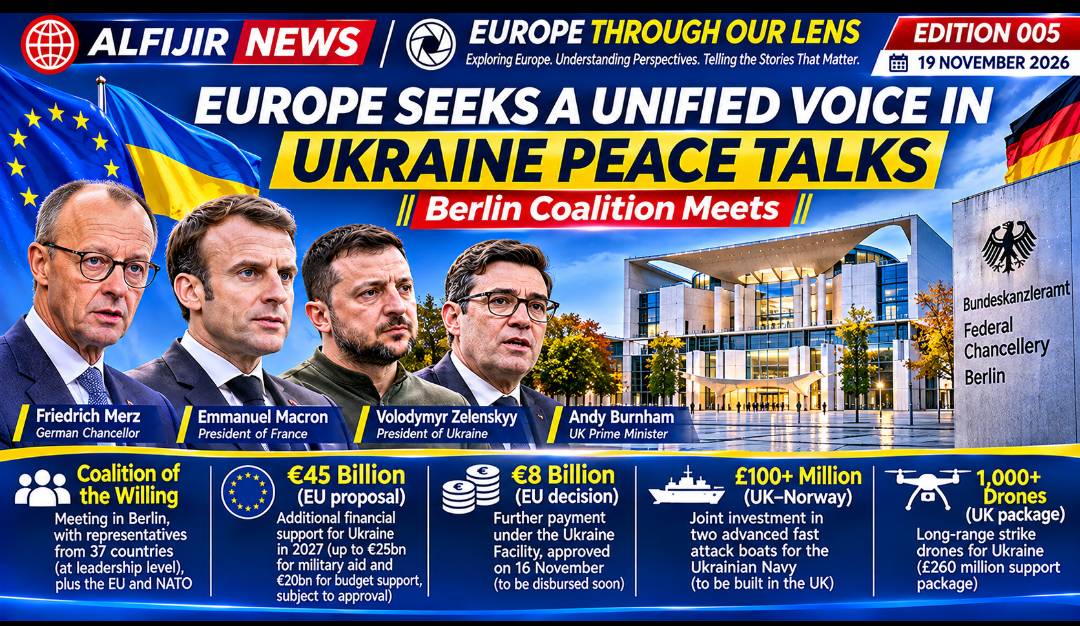
EDITION 005 | 19 NOVEMBER 2026
EUROPE SEEKS A UNIFIED VOICE IN UKRAINE PEACE TALKS AS BERLIN COALITION MEETS
European leaders gather in Berlin to coordinate diplomatic efforts and continued support for Ukraine, while new British, Norwegian and EU announcements underline Europe’s wider security commitments.
—
Berlin meeting puts European diplomacy in focus
European leaders and Ukraine’s international partners gathered in Berlin on Thursday, 19 November 2026, for a meeting of the Coalition of the Willing, as diplomatic efforts to end Russia’s war against Ukraine continue.
The meeting was hosted by German Chancellor Friedrich Merz, alongside French President Emmanuel Macron and British Prime Minister Andy Burnham. Ukrainian President Volodymyr Zelenskyy also took part, with representatives of European institutions, NATO and other partner countries.
According to the German Federal Government, representatives from 37 countries at head-of-state or government level were expected to attend, alongside senior representatives of the European Union and NATO. The wider coalition brings together almost 40 countries, most of them European.
The Coalition of the Willing is a separate international partnership. It is neither an EU institution nor a NATO summit, although both organisations participate in discussions.
Its importance extends beyond the battlefield. The meeting forms part of a wider effort by European governments to coordinate their diplomatic positions, maintain support for Ukraine and establish a meaningful role in decisions that could shape the continent’s future security arrangements.
A major-power meeting raises questions about Europe’s role
The Berlin gathering followed a three-way meeting involving United States President Donald Trump, Chinese President Xi Jinping and Russian President Vladimir Putin in Shenzhen, China.
Reuters and other international news organisations reported that the three leaders issued a joint declaration reaffirming that nuclear war cannot be won and must never be fought. The declaration also referred to dialogue on nuclear risks and non-proliferation.
However, the declaration did not establish a peace agreement for Ukraine, set a timetable for nuclear disarmament or announce a settlement of Russia’s war against Ukraine.
It should therefore not be interpreted as a breakthrough in the Ukraine peace process.
The meeting attracted attention among European governments because decisions involving major powers can have direct consequences for European security, even when European countries are not central participants.
European leaders have repeatedly argued that Ukraine must be involved in decisions concerning its own future and that Europe’s security interests cannot be separated from the outcome of the war.
The reactions among European officials have not been identical. Some have expressed concern about the possibility of major powers making decisions that affect European security without sufficient European participation. Others have defended continued diplomatic engagement between Washington, Beijing and Moscow.
These differences demonstrate that European governments do not always share the same assessment of diplomatic tactics, even where they agree on the importance of Ukraine’s sovereignty and European security.
Team Europe: a proposed common negotiating voice
One of the central issues surrounding the Berlin meeting is European representation in negotiations involving Ukraine and Russia.
At the European Political Community summit in Dublin on 13 November, European leaders discussed a proposed European negotiating team known as Team Europe.
According to the German Federal Government, the proposed team comprises representatives of European institutions and the E5 countries: France, Germany, Italy, Poland and the United Kingdom.
The inclusion of the United Kingdom is significant. Britain left the European Union in 2020 but remains a major European security partner and a member of NATO.
This arrangement illustrates an important distinction: Europe is a continent, while the European Union is a political and economic organisation whose membership does not include every European country.
European security cooperation therefore extends beyond EU membership.
The proposed Team Europe arrangement reflects an effort to coordinate European positions. It should not, however, be described as a final negotiating agreement unless participating governments formally confirm that status.
Britain and Norway announce new maritime support
One of the concrete announcements associated with the Berlin meeting came from the United Kingdom and Norway.
On 19 November, the British government announced that the two countries would jointly invest more than £100 million in two advanced fast attack boats for the Ukrainian Navy.
The vessels are to be built in the United Kingdom, measure approximately 30 metres and receive equal funding from Britain and Norway through the Maritime Capability Coalition, which the two countries jointly lead.
According to the British government, the boats will be equipped with air-defence, missile and self-defence systems.
They are intended to strengthen Ukraine’s maritime capabilities, protect its coastline and help secure the Black Sea Grain Corridor, an important route for Ukrainian exports.
The announcement is significant because maritime security in the Black Sea has implications beyond Ukraine. Disruption to shipping and agricultural exports can affect international trade and food supply chains.
However, the announcement does not mean that the vessels have already been built or delivered. A confirmed delivery timetable was not established in the information reviewed.
UK announces more than 1,000 long-range drones
The British government also announced a further £260 million support package, including more than 1,000 long-range strike drones for Ukraine.
According to the announcement published on 18 November, some of the drones are capable of travelling more than 1,000 kilometres. The package also includes maritime, logistical and surveillance drones.
The UK government said more than 80 per cent of the funding would be spent within the United Kingdom, including through small and medium-sized businesses in Scotland, Wales and Northern Ireland.
The announcement illustrates how military assistance to Ukraine is also connected to industrial production, defence technology and employment within European partner countries.
Nevertheless, the announcement confirms a commitment, not the completed manufacture or delivery of every drone included in the package.
EU proposes an additional €45 billion for Ukraine
Financial support is another major part of Europe’s response.
On 18 November, the European Commission proposed up to €45 billion in additional financial support for Ukraine in 2027.
The proposal is intended to help address an estimated €70 billion financing gap for the country next year.
Under the Commission’s proposal:
– Up to €25 billion would support military assistance.
– Up to €20 billion would provide general budget support.
– Ukraine would be required to repay the principal only after receiving reparations from Russia for war damage.
The proposed loan would be financed through borrowing by the European Union on international capital markets and guaranteed by the EU budget.
The Commission said the proposed package would cover around two-thirds of Ukraine’s additional financing needs for 2027, with international partners expected to provide the remaining support.
Importantly, this proposal is additional to the existing €90 billion Ukraine Support Loan for 2026–2027. It is not the same funding and should not be treated as an already approved or disbursed payment.
The new proposal must still be considered and adopted by the European Parliament and the Council of the European Union.
EU approves a further payment under the Ukraine Facility
Separately, on 16 November, the Council of the European Union adopted a decision allowing Ukraine to receive just under €8 billion under the existing Ukraine Facility.
The Council said the payment followed Ukraine’s completion of more than 20 reform-related steps.
This is different from the proposed €45 billion package. The Council has approved the payment under the existing facility, while the announcement indicated that Kyiv would receive the funds soon.
It would therefore be inaccurate to claim that the entire amount had already been transferred at the time of the announcement.
Security guarantees remain a central question
The German government’s published agenda identified three broad priorities for the Berlin discussions: coordinating diplomatic efforts, continuing support for Ukraine and considering security guarantees that could apply after a ceasefire.
The possibility of a multinational force for Ukraine was also identified as a subject for discussion, including support for rebuilding the country’s armed forces.
The German government said any such security arrangements would require close coordination with the United States.
These discussions concern possible arrangements after a ceasefire. They do not establish that a ceasefire has been agreed, that a multinational force has been deployed or that participating countries have adopted a final security-guarantee agreement.
For Ukraine, the issue is particularly important because any settlement would need to address not only the immediate cessation of fighting but also the risk of renewed military aggression.
What this means for Europe’s future security
The Berlin meeting highlights a wider question facing European governments: how to coordinate their diplomatic, financial and military influence when the outcome of the war will have long-term consequences for the continent.
The European Union has a significant role through its financial instruments, diplomatic institutions and member states. However, Europe’s security architecture also includes countries outside the EU, notably the United Kingdom and Norway, as well as NATO and other international partners.
Recent announcements show that European cooperation is taking practical forms, from military equipment and maritime security to financial support and discussions about post-war guarantees.
Yet supporting Ukraine and securing an agreed peace are not the same thing. Financial commitments, weapons announcements and diplomatic meetings do not by themselves establish the conditions for ending the war.
The central challenge is whether continued coordination can produce a settlement that respects Ukraine’s sovereignty, provides credible security arrangements and addresses the wider security concerns of European countries.
For Europe, the Berlin meeting is another step in an ongoing diplomatic process. Its longer-term significance will depend on what participating countries formally agree, what they deliver and whether Ukraine remains fully involved in decisions about its own future.
—
SOURCES AND FURTHER READING
1. German Federal Government: “Coalition of the Willing meeting in Berlin – Ukraine and European security” (https://www.bundesregierung.de/breg-de/aktuelles/koalition-der-willigen-in-berlin-2461162)
2. Reuters: “Ukraine’s European allies wary as Trump meets ‘friend’ Putin in China” (https://www.reuters.com/world/china/ukraines-european-allies-meet-berlin-show-support-2026-11-19/)
3. Reuters: “Trump, Xi and Putin release ‘peace declaration’ from unprecedented summit” (https://www.reuters.com/world/china/trumps-historic-meeting-with-xi-putin-headlines-asia-trip-2026-11-18/)
4. UK Government: “UK and Norway further boost Ukrainian Navy at Coalition of the Willing meeting” (https://www.gov.uk/government/news/uk-and-norway-further-boost-ukrainian-navy-at-coalition-of-the-willing-meeting–2)
5. UK Government: “More than 1,000 long-range strike drones announced for Ukraine” (https://www.gov.uk/government/news/1000-long-range-strike-drones-announced-for-ukraine-as-prime-minister-co-chairs-coalition-of-the-willing-in-berlin)
6. European Commission: “Commission proposes €45 billion in additional financial support for Ukraine in 2027” (https://enlargement.ec.europa.eu/news/commission-proposes-eur45-billion-additional-financial-support-ukraine-2027-2026-11-18_en)
7. Council of the European Union: “Council approves further payment under the Ukraine Facility” (https://www.consilium.europa.eu/en/press/press-releases/2026/11/16/ukraine-facility-council-approves-largest-ever-payment-of-8-billion-to-kyiv/)
EDITORIAL NOTE
This report distinguishes between official announcements, proposed financial support and measures that have not yet been delivered or implemented. The €45 billion proposal remains subject to approval. The British and Norwegian naval and drone announcements are commitments, not confirmation of completed deliveries. The discussions on security guarantees and a possible multinational force should not be interpreted as a final agreement.
The report focuses on European countries and institutions, including both EU and non-EU partners. Europe and the European Union are not interchangeable terms.
📢 FOLLOW ALFIJIR LABARAI
Stay connected with Alfijir Labarai / Alfijir News for credible news, reports, investigative journalism, and important updates from Kano, Nigeria, and around the world.
📩 CONTACT US & PARTNERSHIP ENQUIRIES
Call/WhatsApp: +234 701 1 11 3809
+234 803 207 7835
🌐 OUR SOCIAL MEDIA PLATFORMS
X: https://twitter.com/Musabestseller?s=09
Facebook: https://www.facebook.com/profile.php?id=100089640289165
Threads: https://www.threads.net/@alfijirlabarai
YouTube: https://www.youtube.com/@BestsellerChannel12
Instagram: https://www.instagram.com/musa_bestseller?utm_source=qr&r=nametag
📲 JOIN OUR WHATSAPP GROUP
https://chat.whatsapp.com/Ilj1iz8v3sa3nBfrCz9U6f
ALFIJIR LABARAI MEDIA SERVICES
Truth • Timeliness • Trust
© 2026 Alfijir Labarai Media Services