
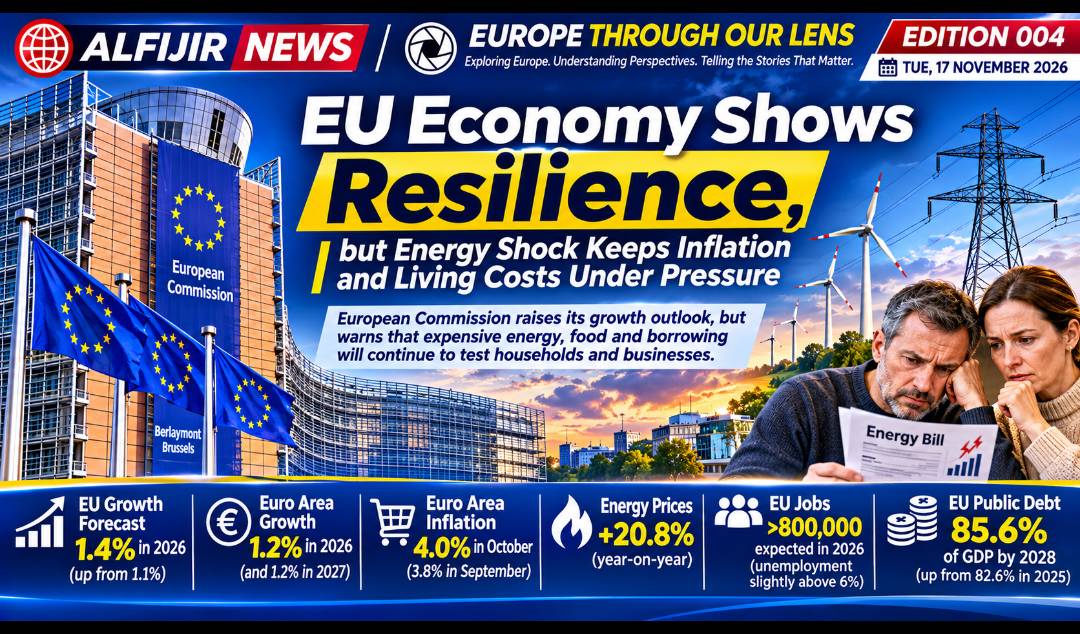
EDITION 004 | 17 NOVEMBER 2026
EU Economy Shows Resilience, but Energy Shock Keeps Inflation and Living Costs Under Pressure
The European Commission has upgraded its growth outlook for 2026, but persistent energy-price pressures, rising public debt and uneven economic performance continue to challenge households and businesses.
A stronger growth outlook, but no easy recovery
The European Union’s economy is performing better than previously expected, according to the European Commission’s Autumn 2026 Economic Forecast published on 17 November. However, the improved growth outlook comes alongside renewed inflationary pressure, higher financing costs and continuing uncertainty in international energy markets.
The Commission now forecasts that the EU economy will grow by 1.4 per cent in 2026, up from the 1.1 per cent projected in its Spring 2026 forecast. It expects growth to remain at 1.4 per cent in 2027 before increasing to 1.5 per cent in 2028.
For the euro area — the group of EU member states that use the euro — economic growth is forecast at 1.2 per cent in both 2026 and 2027, rising to 1.3 per cent in 2028.
The Commission says stronger-than-expected activity during the first three quarters of 2026, particularly a rebound in exports, helped improve the outlook. European companies supplying equipment for artificial-intelligence data centres and electricity networks have also benefited from stronger international demand.
These figures are forecasts, not final measurements of the full-year economic performance.
Inflation remains a serious concern
Despite the improved growth outlook, inflation remains a major challenge.
Eurostat’s flash estimate, published on 4 November, put annual inflation in the euro area at 4.0 per cent in October, up from 3.8 per cent in September.
Energy recorded the highest annual price increase, at 20.8 per cent. Services inflation stood at 3.3 per cent, while the broader category of food, alcohol and tobacco recorded 1.6 per cent.
Within that broader category, unprocessed food prices rose by 4.6 per cent year-on-year. This distinction matters because the 4.6 per cent figure refers specifically to unprocessed food, not all food products.
The Commission attributes the renewed inflationary pressure largely to disruption in international energy supplies linked to the conflict in the Middle East.
Its forecast reports that Brent crude oil prices exceeded 100 US dollars per barrel in October. European wholesale gas prices also traded above €95 per megawatt-hour towards the end of that month.
The Commission further reports that diesel prices had doubled year-on-year, reflecting pressure on refining capacity, transport and insurance costs.
For the EU as a whole, the Commission forecasts annual inflation of 3.3 per cent in 2026 and 3.2 per cent in 2027, before easing to 2.3 per cent in 2028. For the euro area, the corresponding projections are 3.2 per cent, 3.1 per cent and 2.1 per cent.
Why households may feel the pressure more sharply
Higher energy costs affect more than petrol, diesel and electricity bills. They can also increase the cost of transporting goods, manufacturing products, operating businesses and producing food.
The Commission warns that higher energy and fertiliser costs, alongside the effects of summer heatwaves and drought on agricultural production, could intensify food-price pressures.
Lower-income households are particularly vulnerable because food and household energy account for a larger share of their spending.
The Commission expects private consumption growth in the EU to slow to 1.3 per cent in 2026 and 1.1 per cent in 2027, before recovering to 1.3 per cent in 2028.
This suggests that economic growth alone may not immediately translate into a stronger sense of financial security for households.
Economic performance differs across countries
The recovery is not evenly distributed across the European Union.
The Commission’s country forecasts, as reported by Euronews, project Spain’s economy to grow by 2.6 per cent in 2026. Germany is forecast to expand by 1.3 per cent, Italy by 1.0 per cent and France by 0.4 per cent.
These differences reflect varying economic conditions, including domestic demand, investment, exports and public-finance pressures.
The figures are projections rather than final annual results. They also illustrate why the EU-wide growth rate should not be treated as a description of the economic experience of every member state.
Employment: more jobs, but emerging weaknesses
The Commission expects the EU labour market to add more than 800,000 workers in 2026. It forecasts that the unemployment rate will remain slightly above 6 per cent over the forecast period.
However, the Commission also identifies weaknesses beneath the headline figures. Unemployment among younger people is increasing, while a growing share of young workers are working fewer hours than they would prefer.
The Commission cautions that it is too early to establish a link between these developments and the possible labour-market effects of artificial-intelligence adoption.
Separately, Eurostat’s flash estimates for the third quarter of 2026 show that employment remained unchanged in both the EU and the euro area compared with the previous quarter. Compared with the same quarter of 2025, employment increased by 0.4 per cent in both areas.
The distinction between quarterly stability and annual growth is important when interpreting the labour-market picture.
Public finances face growing pressure
The Commission also warns that government finances are coming under increasing pressure.
The EU’s combined government deficit is forecast to rise from 3.1 per cent of gross domestic product in 2025 to 3.6 per cent in 2026, 3.7 per cent in 2027 and 3.8 per cent in 2028.
The increase is linked to higher defence spending, rising interest payments and measures introduced by governments to protect households and businesses from expensive energy.
EU public debt is projected to increase from 82.6 per cent of GDP in 2025 to 85.6 per cent in 2028.
The Commission also expects interest expenditure to rise to 2.4 per cent of GDP by 2028, its highest share in more than a decade.
These projections raise questions about how governments can continue supporting households, investing in infrastructure and strengthening defence while maintaining sustainable public finances.
Could lower energy prices change the outlook?
There is an important qualification to the Commission’s inflation forecast.
The market assumptions underpinning the Autumn 2026 forecast were based on information available up to 29 October. In its report on 17 November, Euronews noted that oil and gas prices had subsequently fallen by around 20 per cent from the levels used in the forecast.
The Commission indicated that, if lower prices are sustained, inflation in 2027 and 2028 could be materially lower than currently projected, while economic activity could receive a modest boost.
This is a conditional possibility, not a confirmed outcome. Energy markets remain exposed to geopolitical developments, supply disruptions and changes in global demand.
What the figures mean for Europe
The Commission’s latest forecast presents a mixed picture of economic resilience and continuing vulnerability.
The EU economy has performed better than expected, with stronger exports and industrial activity helping to support growth. Yet inflation remains elevated, energy markets remain exposed to international shocks, and public debt is projected to rise.
The challenge for European policymakers is therefore not simply to maintain economic growth. It is to ensure that the recovery improves living standards, strengthens industrial competitiveness and reduces dependence on vulnerable energy supply routes.
For households, the central concern remains whether wages and purchasing power can keep pace with the cost of living. For businesses, the question is whether higher energy and financing costs will limit investment and expansion.
Europe’s economic resilience is evident in the latest projections. Whether that resilience can become a more inclusive and sustainable recovery will depend on the decisions governments and institutions make in the months ahead.
—
Sources and further reading
1. European Commission: “Autumn 2026 Economic Forecast” (https://economy-finance.ec.europa.eu/economic-forecast-and-surveys/economic-forecasts/autumn-2026-economic-forecast-shows-continued-growth-amid-higher-inflation_en)
2. Eurostat: “Euro area annual inflation up to 4.0% — October 2026 flash estimate” (https://ec.europa.eu/eurostat/en/web/products-euro-indicators/w/2-04112026-ap)
3. Eurostat: “GDP up by 0.4% and employment stable in the euro area — Q3 2026” (https://ec.europa.eu/eurostat/en/web/products-euro-indicators/w/2-13112026-ap)
4. Euronews: “EU economy beats expectations but energy shock keeps inflation higher for longer” (https://www.euronews.com/2026/11/17/eu-economy-beats-expectations-but-energy-shock-keeps-inflation-higher-for-longer)
Editorial note: This report focuses primarily on the European Union and the euro area. These are not interchangeable with Europe as a whole. EU statistics do not automatically describe non-EU European countries such as the United Kingdom, Norway and Switzerland.
📢 FOLLOW ALFIJIR LABARAI
Stay connected with Alfijir Labarai / Alfijir News for credible news, reports, investigative journalism, and important updates from Kano, Nigeria, and around the world.
📩 CONTACT US & PARTNERSHIP ENQUIRIES
Call/WhatsApp: +234 701 1 11 3809
+234 803 207 7835
🌐 OUR SOCIAL MEDIA PLATFORMS
X: https://twitter.com/Musabestseller?s=09
Facebook: https://www.facebook.com/profile.php?id=100089640289165
Threads: https://www.threads.net/@alfijirlabarai
YouTube: https://www.youtube.com/@BestsellerChannel12
Instagram: https://www.instagram.com/musa_bestseller?utm_source=qr&r=nametag
📲 JOIN OUR WHATSAPP GROUP
https://chat.whatsapp.com/Ilj1iz8v3sa3nBfrCz9U6f
ALFIJIR LABARAI MEDIA SERVICES
Truth • Timeliness • Trust
© 2026 Alfijir Labarai Media Services