
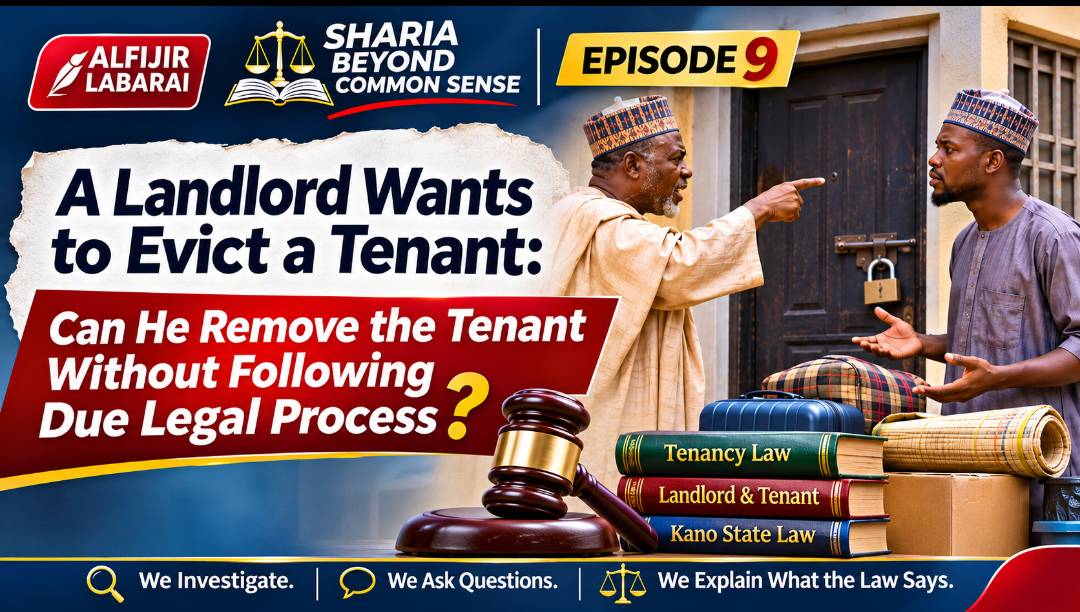
EPISODE 9
An Investigative Legal Report by Alfijir Labarai
A disagreement between a landlord and a tenant can quickly escalate into a serious dispute, particularly when the landlord wants the tenant to vacate the property. In some cases, landlords may threaten tenants, change the locks, remove their belongings or attempt to force them out of the premises.
But what does the law actually say?
Can a landlord simply decide that a tenant must leave and proceed to remove them? Does the landlord always need a court order before recovering possession? What rights does a tenant have when faced with eviction, and what legal remedies are available to both parties?
In this edition of SHARIA BEYOND COMMON SENSE, we examine the legal principles governing the recovery of rented premises, with particular attention to the legal framework applicable in Kano State.
1. Can a landlord use force to evict a tenant?
A landlord has a legal right to recover possession of a property when the tenancy has lawfully come to an end. However, that right does not automatically authorise the landlord to use violence, intimidation or unlawful force against a tenant.
The Supreme Court of Nigeria considered the issue of self-help in Eloichin (Nigeria) Ltd v. Mbadiwe (1986). The case addressed the limits of a landlord’s actions when seeking to recover possession.
However, it is important to clarify that the statutory provisions considered in that case were from Lagos State. They should not be presented as though they are provisions of Kano State law.
The broader legal lesson is that disputes over possession must be handled in accordance with the applicable law, rather than through unlawful force or intimidation.
2. Must a landlord always obtain a court order before recovering possession?
This question requires careful legal distinction.
It would be inaccurate to state that a landlord must obtain a court order in every circumstance before taking possession of a property.
In Akinkugbe v. Ewulum Holdings Nigeria Ltd & Anor (2008), the Supreme Court recognised that a landlord may peacefully recover possession after a tenancy has lawfully ended.
However, this does not give a landlord unlimited authority to use force or take the law into their own hands.
The circumstances matter. Where a dispute is already before a court, or where a landlord uses unlawful self-help to interfere with the tenant’s possession, the action may attract legal consequences, including liability in damages.
Therefore, the key questions are whether the tenancy was lawfully terminated, whether the applicable procedures were followed and whether the recovery of possession was carried out lawfully.
3. What if the tenant refuses to pay rent?
Failure to pay rent may constitute a breach of the tenancy agreement and can provide a lawful basis for seeking to recover possession.
However, non-payment of rent does not automatically authorise a landlord to remove the tenant by force, throw out their belongings or take other unlawful measures.
The landlord should establish the rent owed, examine the tenancy agreement and follow the applicable statutory and contractual procedures for terminating the tenancy and recovering possession.
The tenant, on the other hand, should not assume that failure to pay rent has no legal consequences. A landlord may pursue the remedies available under the law.
4. What notice must a landlord give a tenant in Kano State?
The applicable notice period is an important part of any eviction dispute.
The Rent Control and Recovery of Residential Premises Law of Kano State 1996, commonly cited as Cap. 121, contains provisions on the recovery of residential premises.
A legal reference to section 8 of that law indicates that, where there is no express agreement providing otherwise, a yearly tenancy requires six months’ notice to quit.
However, there is an important qualification: Alfijir Labarai has not yet obtained and independently examined the complete official Gazette copy of the Kano law. The six-month provision is therefore being reported with reference to an available legal compendium, not as a final confirmation of the current amended text.
The notice period may also differ depending on the type of tenancy and the terms of the agreement.
Furthermore, a notice to quit and a notice of intention to apply to recover possession are separate procedural steps where the applicable law requires both. They should not be confused or treated as interchangeable.
Alfijir Labarai has contacted the relevant tribunal and expects to receive a copy of the law, although we understand that amendments are currently being made to it. We will examine the document when received and update this report where necessary.
5. Can a landlord change the locks or remove a tenant’s belongings?
A landlord should not assume that changing the locks, removing a tenant’s belongings or physically forcing the tenant out is automatically lawful simply because rent is unpaid or a notice has been issued.
The legality of such action depends on the circumstances, the status of the tenancy and the applicable law.
The Supreme Court’s decision in Akinkugbe v. Ewulum Holdings Nigeria Ltd & Anor (2008) is particularly relevant because it distinguishes peaceful recovery of possession after lawful termination from unlawful self-help.
In a dispute, tenants should preserve relevant evidence, including:
– The tenancy agreement.
– Rent payment receipts and bank transfer records.
– Notices received from the landlord.
– Text messages and other communications.
– Photographs or videos showing any alleged unlawful eviction or removal of belongings.
Landlords should also retain evidence of rent arrears, notices served and steps taken to comply with the law.
6. What rights do landlords and tenants have?
The law does not give tenants an unlimited right to remain in a property indefinitely. Equally, it does not give landlords unlimited power to remove tenants whenever they wish.
A landlord has the right to seek recovery of property in accordance with the law.
A tenant has the right to lawful treatment and protection against unlawful eviction, intimidation and other violations of their legal rights.
Both parties are expected to respect the tenancy agreement and the applicable laws.
Where a disagreement cannot be resolved amicably, the parties may seek legal advice and approach the appropriate court or legally authorised institution.
7. What should the public understand?
The central issue is not simply whether a landlord owns a property or whether a tenant has failed to pay rent.
The important questions are:
1. Has the tenancy lawfully come to an end?
2. Was the appropriate notice given?
3. Were the applicable legal procedures followed?
4. Was possession recovered peacefully and lawfully?
5. Did either party engage in conduct that violated the rights of the other?
These questions must be answered by examining the facts, the tenancy agreement and the applicable law.
Alfijir Labarai will continue examining the Kano State legal framework, including the amended law expected from the relevant tribunal, to ensure that the final legal position is accurately represented.
QUESTIONS FOR THE PUBLIC
– Can a landlord remove a tenant’s belongings without following the law?
– What should a tenant do after receiving a notice to quit?
– What legal options are available to a landlord when a tenant refuses to pay rent?
– How effectively are tenancy laws enforced in Kano State?
CONCLUSION
Ownership of a property gives a landlord important legal rights, but those rights must be exercised within the law. Similarly, tenants have rights, but they must also fulfil their obligations under the tenancy agreement.
The law should not be replaced by threats, intimidation or force.
We investigate. We ask questions. Then we explain what the law says.
—
SOURCES AND LEGAL REFERENCES
1. Akinkugbe v. Ewulum Holdings Nigeria Ltd & Anor (2008) — Supreme Court of Nigeria.
https://nigerialii.org/akn/ng/judgment/ngsc/2008/8/eng%402008-04-11
2. Eloichin (Nigeria) Ltd v. Mbadiwe (1986) — Supreme Court of Nigeria.
https://nigerialii.org/akn/ng/judgment/ngsc/1986/6/eng%401986-01-10
3. Ihenacho v. Uzochukwu (1997) — Supreme Court of Nigeria. The case concerns Plateau State law and should not be treated as establishing Kano’s statutory notice periods.
https://lawcarenigeria.com/ben-i-ihenacho-anor-v-ume-uzochukwu-anor1997/
4. Rent Control and Recovery of Residential Premises Law of Kano State 1996, Cap. 121, particularly section 8. The full official text and current amendments remain subject to verification.
5. Nigerian State Law Compendium — summary of the statutory notice period for yearly tenancies in Kano State.
https://nigerianstatelaws.aalawsng.com/propositions/kano-statutory-notice-period-yearly-tenancy
Editorial note: This report will be reviewed against the copy of the Kano State law expected from the tribunal. Any relevant amendments will be reflected before the report is treated as the final statement of the current statutory position.
ALFIJIR LABARAI
Investigative Journalism. Public Interest. Accountability
📢 FOLLOW ALFIJIR LABARAI
Stay connected with Alfijir Labarai / Alfijir News for credible news, reports, investigative journalism, and important updates from Kano, Nigeria, and around the world.
📩 CONTACT US & PARTNERSHIP ENQUIRIES
Call/WhatsApp: +234 701 1 11 3809
+234 803 207 7835
🌐 OUR SOCIAL MEDIA PLATFORMS
X: https://twitter.com/Musabestseller?s=09
Facebook: https://www.facebook.com/profile.php?id=100089640289165
Threads: https://www.threads.net/@alfijirlabarai
YouTube: https://www.youtube.com/@BestsellerChannel12
Instagram: https://www.instagram.com/musa_bestseller?utm_source=qr&r=nametag
📲 JOIN OUR WHATSAPP GROUP
https://chat.whatsapp.com/Ilj1iz8v3sa3nBfrCz9U6f
ALFIJIR LABARAI MEDIA SERVICES
Truth • Timeliness • Trust
© 2026 Alfijir Labarai Media Services