
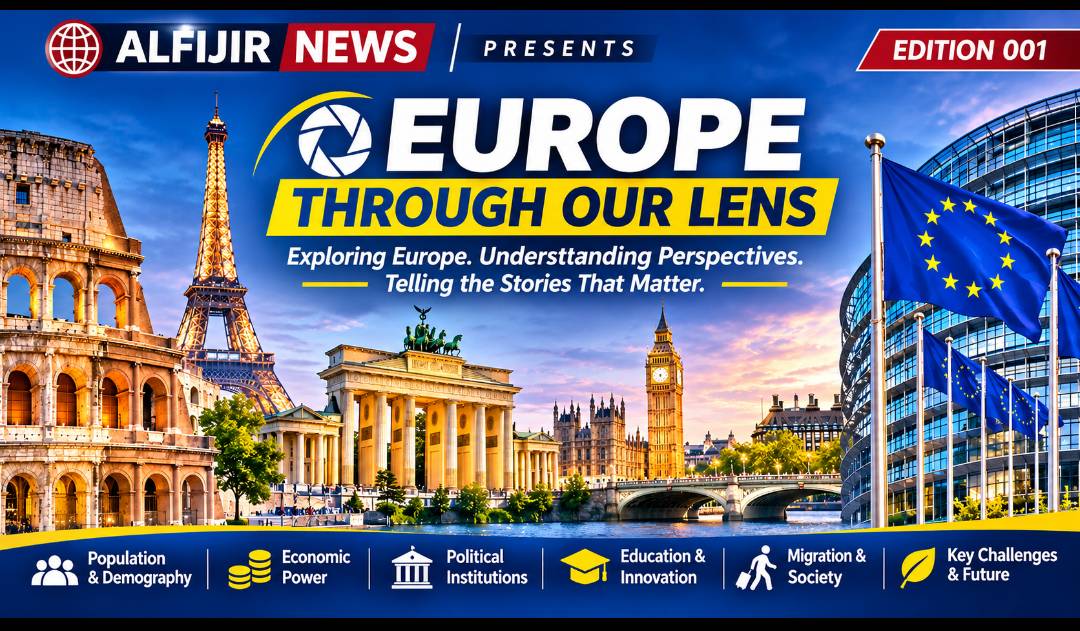
EUROPE THROUGH OUR LENS
EDITION 001 | NOVEMBER 2026
EUROPE: THE CONTINENT, ITS PEOPLE, ITS POWER AND ITS FUTURE
Understanding Europe’s diversity, economic influence, political institutions and the challenges shaping its future.
By Alfijir Labarai
—
INTRODUCTION: UNDERSTANDING A CONTINENT THAT SHAPES THE WORLD
Europe remains one of the most influential regions in global affairs, with a long history of political transformation, scientific advancement, economic development and cultural exchange.
From the industrial revolution and the development of modern democratic institutions to contemporary technological innovation and international diplomacy, European nations have played significant roles in shaping the modern world.
Today, Europe continues to influence global trade, international relations, scientific research, financial markets and discussions about democracy, human rights and climate change.
However, Europe is not a single political entity. It is a continent made up of different countries, governments, languages, cultures and economic systems.
Understanding these differences is essential to understanding the continent itself.
In this first edition of EUROPE THROUGH OUR LENS, Alfijir Labarai examines Europe’s geographical identity, population, political institutions, economic strength, demographic developments and the challenges likely to influence its future.
1. EUROPE: A CONTINENT OF DIVERSE NATIONS
Europe is geographically one of the world’s seven continents. It stretches from the Atlantic Ocean in the west towards the eastern boundaries traditionally associated with the Ural Mountains and the Caucasus region.
The continent includes countries with different geographical characteristics, political traditions, economic structures and cultural identities.
From the Nordic countries of Northern Europe to the Mediterranean region in the south, and from Western Europe to Eastern Europe, the continent presents a remarkable range of societies and experiences.
Countries such as Germany, France, Italy, Spain, Poland, Sweden, Norway, Switzerland and the United Kingdom have distinct national identities and political arrangements.
It is also important to recognise that some countries have territories extending across geographical boundaries between Europe and Asia. This makes the definition of Europe’s eastern and south-eastern boundaries a subject of geographical discussion.
Europe should therefore be understood as a geographical and cultural continent, rather than simply as the territory covered by one political organisation.
2. HOW MANY PEOPLE LIVE IN EUROPE?
According to the United Nations Statistics Division’s World Statistics Pocketbook 2025, Europe’s estimated population stood at approximately 744.4 million people in 2025.
This makes Europe a significant population centre in the global demographic landscape.
However, this figure covers the wider European geographical region and should not be confused with the population of the European Union.
The European Union, which represents only part of the continent, has approximately 450 million inhabitants according to its official statistical overview.
Population distribution varies considerably across European countries. Some nations have large populations and major metropolitan centres, while others have relatively small populations and lower population densities.
These differences influence national economic policies, public services, infrastructure development and labour markets.
3. THE EUROPEAN UNION: 27 COUNTRIES, SHARED INSTITUTIONS
One of the most important political and economic organisations in Europe is the European Union.
The EU currently consists of 27 member states. Its origins can be traced to the post-Second World War period, when six countries established the foundations of European economic cooperation.
The founding countries were Belgium, France, Germany, Italy, Luxembourg and the Netherlands.
Over subsequent decades, the organisation expanded through several rounds of membership enlargement.
The European Union operates through common institutions and policies, with cooperation covering areas such as trade, agriculture, competition, environmental protection and economic development.
Its single market facilitates the movement of goods, services, capital and people among participating countries.
However, EU membership should not be confused with membership of the European continent.
Countries such as Norway, Switzerland, the United Kingdom and Serbia are European countries but are not members of the European Union.
Another important institution is the Council of Europe, which has 46 member states and focuses particularly on human rights, democracy and the rule of law.
The European Union and the Council of Europe are separate organisations with different responsibilities.
4. EUROPE’S ECONOMIC POWER
Europe remains a major centre of global economic activity.
According to Eurostat, the European Union’s gross domestic product reached approximately €18.8 trillion in 2025.
Germany accounted for the largest share of the EU economy, with a GDP of approximately €4.5 trillion, representing 23.8% of the total.
France and Italy followed as other major contributors.
Eurostat also reported that the EU’s real GDP increased by 1.5% in 2025, compared with growth of 1.1% in 2024.
These figures demonstrate the scale of economic activity within the European Union.
The EU economy is supported by manufacturing, financial services, technology, transport, agriculture, tourism, international trade and a large services sector.
Nevertheless, economic performance differs considerably between countries.
Some economies have experienced stronger growth, while others continue to face challenges involving industrial competitiveness, productivity, energy costs and public finances.
Understanding these differences is important when examining Europe’s position in the global economy.
5. AN AGEING POPULATION: A MAJOR DEMOGRAPHIC CHALLENGE
One of Europe’s most significant long-term challenges is population ageing.
Eurostat’s 2026 demographic publication reports that the median age of the European Union’s population reached 44.9 years in 2025.
This reflects a long-term demographic transformation involving lower birth rates, longer life expectancy and an increasing proportion of older people.
Population ageing has important implications for European societies.
Governments must consider how to finance pension systems, maintain healthcare services, support older citizens and ensure that labour markets have sufficient workers.
It also creates questions about productivity, retirement ages, migration policies and the future sustainability of public services.
Although these challenges are not identical in every European country, demographic change is becoming an increasingly important issue across the continent.
6. MIGRATION AND EUROPE’S CHANGING SOCIETIES
Migration is another major issue shaping contemporary Europe.
According to Eurostat, almost six million people immigrated to European Union countries in 2024.
Of this figure, approximately 4.2 million came from countries outside the EU, while around 1.5 million moved between EU member states.
Spain and Germany recorded the largest numbers of immigrants among EU countries during that year.
Migration contributes to changes in population structures, labour markets, cultural diversity and social development.
It also raises important policy questions concerning border management, asylum procedures, integration, employment, housing and access to public services.
A balanced understanding of migration requires looking beyond political debates and examining the economic, humanitarian and social dimensions of the issue.
7. EUROPE’S EDUCATION, SCIENCE AND TECHNOLOGICAL DEVELOPMENT
Europe has a long-established presence in global education and scientific research.
Its universities, research institutions and innovation centres contribute to developments in medicine, engineering, artificial intelligence, renewable energy, transport and other scientific fields.
European countries also participate in international research partnerships and educational exchange programmes.
The Erasmus+ programme, for example, supports education, training, youth development and mobility across participating countries.
Scientific research and technological innovation remain important to Europe’s economic competitiveness.
As global competition increases, European governments and institutions face the challenge of maintaining strong research systems, attracting skilled professionals and supporting the development of emerging technologies.
8. THE CHALLENGES SHAPING EUROPE’S FUTURE
Despite its economic strength and institutional influence, Europe faces several important challenges.
These include:
Economic competitiveness: European industries face increasing competition from major global economies, alongside pressure to improve productivity and innovation.
Energy security: Ensuring affordable, reliable and sustainable energy remains a major policy concern.
Geopolitical security: Russia’s war against Ukraine and wider international tensions continue to influence European security discussions and defence policies.
Migration and integration: Governments must balance border management, humanitarian responsibilities and the social and economic implications of migration.
Climate change: European countries are working towards environmental sustainability while managing the economic costs of the energy transition.
Demographic change: Ageing populations and low fertility rates are placing increasing pressure on pension systems, healthcare and labour markets.
These issues will play an important role in shaping political decisions and economic strategies across Europe in the coming years.
9. WHY UNDERSTANDING EUROPE MATTERS
Europe’s influence extends beyond its geographical boundaries.
Its economic relationships, diplomatic partnerships, technological developments and international policies have implications for countries across Africa, Asia and the Americas.
For European audiences, understanding these developments is important for informed public discussion and civic participation.
For international observers, Europe also provides an opportunity to examine how countries with different histories and political systems address common challenges.
The continent’s future will depend not only on its economic strength but also on how effectively its societies respond to demographic, technological, environmental and geopolitical changes.
CONCLUSION: A CONTINENT STILL EVOLVING
Europe is a continent of remarkable diversity, historical significance and global influence.
Its countries have different experiences, priorities and political systems, yet they remain connected through geographical proximity, economic relationships, international institutions and shared global challenges.
From its ageing population and migration debates to economic competitiveness, technological development and international security, Europe continues to experience changes that will shape its future.
Understanding these developments requires accurate information, independent reporting and a willingness to examine different perspectives.
This is the purpose of EUROPE THROUGH OUR LENS.
Through this programme, Alfijir Labarai will continue exploring the continent, examining important developments and telling stories that matter to European audiences.
EUROPE THROUGH OUR LENS
Exploring Europe. Understanding Perspectives. Telling the Stories That Matter.
Published by Alfijir Labarai.
—
SOURCES AND REFERENCES
1. United Nations Statistics Division — World Statistics Pocketbook 2025.
2. Eurostat — Key Figures on Europe 2026.
3. Eurostat — Demography of Europe 2026.
4. Eurostat — EU GDP Statistics, 2025.
5. Eurostat — EU Immigration Statistics, 2024.
6. European Union — Official Facts and Figures.
7. Council of Europe — Member States and Institutional Information.
📢 FOLLOW ALFIJIR LABARAI
Stay connected with Alfijir Labarai / Alfijir News for credible news, reports, investigative journalism, and important updates from Kano, Nigeria, and around the world.
📩 CONTACT US & PARTNERSHIP ENQUIRIES
Call/WhatsApp: +234 701 1 11 3809
+234 803 207 7835
🌐 OUR SOCIAL MEDIA PLATFORMS
X: https://twitter.com/Musabestseller?s=09
Facebook: https://www.facebook.com/profile.php?id=100089640289165
Threads: https://www.threads.net/@alfijirlabarai
YouTube: https://www.youtube.com/@BestsellerChannel12
Instagram: https://www.instagram.com/musa_bestseller?utm_source=qr&r=nametag
📲 JOIN OUR WHATSAPP GROUP
https://chat.whatsapp.com/Ilj1iz8v3sa3nBfrCz9U6f
ALFIJIR LABARAI MEDIA SERVICES
Truth • Timeliness • Trust
© 2026 Alfijir Labarai Media Services