
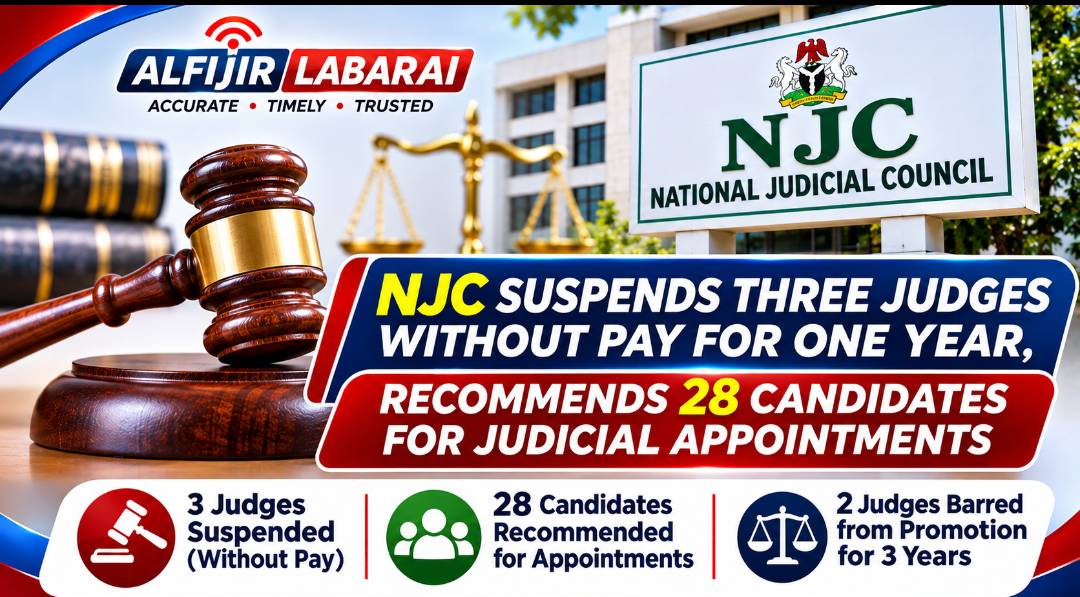
NJC
Council also bars two judges from promotion for three years and takes disciplinary action against other judicial officers.
The National Judicial Council (NJC) has suspended three judges for one year without pay following investigations into complaints concerning their handling of judicial proceedings.
The Council also recommended 28 candidates for judicial appointments across several states, including Kano, Ebonyi, Edo, Adamawa, Ogun and Plateau.
These decisions were reached at the Council’s 112th meeting held on November 3, 2026, under the chairmanship of the Chief Justice of Nigeria, Justice Kudirat Motonmori Olatokunbo Kekere-Ekun.
THREE JUDGES SUSPENDED
The affected judicial officers are:
1. Justice Hannatu Mohammed Kabir of the Nasarawa State High Court.
2. Grand Kadi Mohammed Sani Salihu of the Jigawa State Sharia Court of Appeal.
3. Justice Sobere Biambo of the Rivers State High Court.
Justice Hannatu Mohammed Kabir
The NJC approved her suspension for one year without pay and barred her from promotion for three years.
The disciplinary action followed findings that she ordered the arrest and detention of a litigant for 58 days over alleged disobedience of a court order without complying with the required procedures for contempt proceedings.
According to the Council, Forms 48 and 49, which are required in contempt proceedings, were neither issued nor served on the affected litigant. The proper contempt procedure was also not initiated.
The investigation further found that the alleged contempt did not occur in the presence of the court during proceedings. The Council therefore considered the direct punishment inappropriate and a violation of the litigant’s right to fair hearing.
Grand Kadi Mohammed Sani Salihu
Grand Kadi Mohammed Sani Salihu was suspended for one year without pay following his involvement in reopening a matter that had already been decided by an Upper Area Court of the Federal Capital Territory.
The investigation found that he constituted a committee to review the earlier judgment, after which the matter was referred to another Sharia Court judge who received fresh evidence and delivered a new judgment.
The NJC held that the process amounted to an unauthorised appeal against a decision already delivered by a court, rather than following the legally prescribed appellate procedure.
The High Court of Jigawa State subsequently set aside the new judgment. The Council also found that the conduct violated Rule 3.3.1 of the Revised Code of Conduct for Judicial Officers, 2016.
The NJC directed the most senior Grand Kadi of the Jigawa State Sharia Court of Appeal to perform the functions of the suspended Grand Kadi during the period of suspension.
Justice Sobere Biambo
Justice Sobere Biambo was also suspended for one year without pay and barred from promotion for three years.
The Council found that he ordered the arrest of litigants over alleged disobedience of an interim court order and imposed a fine of ₦300,000 on each of them in a civil dispute.
The investigation found that proper contempt proceedings had not been initiated and that Forms 48 and 49 had not been served on the affected persons.
The Council also noted that the alleged contempt did not occur in the presence of the court during proceedings, making direct punishment inappropriate.
WARNINGS AND OTHER DISCIPLINARY MEASURES
In addition to the suspensions, the NJC took disciplinary measures against other judicial officers, including issuing warning letters and placing some officers on a six-month watch list.
Among those mentioned were:
– Justice Kayode Agunloye: He was issued a warning over his handling of garnishee proceedings involving First Bank of Nigeria Plc. The Council found that he entertained a fresh application for a Garnishee Order Nisi after an earlier similar application had been withdrawn and struck out, while other applications remained pending.
– Justice Bello Kawu: The Council directed that he be issued a warning letter and placed on a watch list after finding that he granted interim bail to former Attorney-General of the Federation, Abubakar Malami, despite an existing remand order issued by another judge.
– Justices Danjuma A. Oyigbenu and Isa Ebini Kana: The Council directed that warning letters be issued to them after finding that they failed to deliver judgments in an appeal within the constitutionally prescribed 90-day period.
– Justice Mohammed Zubairu: He was directed to receive a warning letter and be placed on a watch list after proceeding with an application and issuing an order despite being informed that an appeal had already been filed before the Court of Appeal.
– Justice C. A. Ogbuagor: He was warned for proceeding with a case despite the existence of an appeal and an outstanding application seeking a stay of proceedings.
– Justice Chibuike L. Azuama: He was warned and placed on a watch list after issuing an order freezing the bank accounts of Puma Energy, a company that was not a party to the substantive suit.
The Council also directed that warning letters be issued to other judicial officers following the findings of its investigations.
NJC RECOMMENDS 28 CANDIDATES FOR JUDICIAL APPOINTMENTS
At the same meeting, the NJC recommended 28 candidates for judicial appointments across various states.
Of this number, 24 candidates were recommended for appointment to the State High Courts of Kano, Ebonyi, Edo, Adamawa and Ogun.
The four candidates recommended for appointment to the Kano State High Court are:
1. Nafisah Yusuf Hassan.
2. Halima Yahuza Ahmad.
3. Abdullahi Abdulsalam Bature.
4. Musa Ibrahim Umar.
Other recommendations include:
– One candidate for appointment as Grand Kadi of the Plateau State Sharia Court of Appeal.
– One candidate for appointment as a Kadi of the Adamawa State Sharia Court of Appeal.
– Two candidates for appointment as judges of the Adamawa State Customary Court of Appeal.
The NJC stated that the respective state governors are expected to swear in the recommended candidates.
Important clarification: The NJC’s recommendation does not mean that the appointments have already been completed. The necessary formal procedures must still be concluded before the candidates can officially assume their judicial offices.
35 PETITIONS REVIEWED BY THE NJC
The Council also considered 35 petitions presented by its committees responsible for reviewing complaints against judicial officers.
According to the Council:
– 24 petitions were dismissed.
– Four petitions were recommended for further investigation.
– One petition was held in abeyance because the matter was pending before a court.
The NJC also directed that an investigation into a petition against Justice G. N. Ugbala of the Ebonyi State High Court should continue, despite the petitioner’s decision to withdraw the complaint.
RETIREMENT OF SIX JUDICIAL OFFICERS
The Council also approved retirement notifications involving six judicial officers, including two Justices of the Supreme Court of Nigeria.
Those mentioned include:
– Justice Ibrahim Mohammed Musa Saulawa of the Supreme Court, who retired on September 29, 2026.
– Justice Uwani Musa Abba Aji of the Supreme Court, whose retirement is scheduled for November 7, 2026.
– Justice O. F. Omoleye of the Court of Appeal, who retired on October 6, 2026.
– Justice Ogechi Okehielem of the Abia State High Court, who voluntarily retired on September 15, 2026.
– Justice Theresa Isidore Obot of the Akwa Ibom State High Court, whose voluntary retirement is scheduled for December 30, 2026.
– Justice Munir Muhammad Ladan of the Kaduna State High Court, whose voluntary retirement is scheduled for December 31, 2026.
DEATH OF NINE JUDICIAL OFFICERS
The NJC also expressed condolences over the death of nine judicial officers between May 1 and September 26, 2026.
Among those who died was Justice Mohammed Nasir Yunusa of the Federal High Court, Kano Division.
The Council extended its condolences to the bereaved families and the wider judicial community in Nigeria.
WHAT THE NJC’S DECISIONS MEAN
The decisions highlight the importance of accountability in the judiciary and the need for judicial officers to comply with established legal procedures when handling cases.
The suspension of three judges, the three-year promotion restrictions imposed on two of them, and the warnings issued to other judicial officers form part of the disciplinary measures adopted by the Council following its investigations.
Meanwhile, the recommendation of 28 candidates for judicial appointments could strengthen judicial capacity in the affected states. However, the actual impact will only become clear after the appointments have been formally completed.
In Kano State, the recommendation of four candidates deserves further examination to establish whether the appointments are intended to fill existing vacancies or increase the overall capacity of the state’s judiciary.
SOURCE: National Judicial Council (NJC), official statement following its 112th meeting, November 4, 2026; BarristerNG.com, November 4, 2026.
📢 FOLLOW ALFIJIR LABARAI
Stay connected with Alfijir Labarai / Alfijir News for credible news, reports, investigative journalism, and important updates from Kano, Nigeria, and around the world.
📩 CONTACT US & PARTNERSHIP ENQUIRIES
Call/WhatsApp: +234 701 1 11 3809
+234 803 207 7835
🌐 OUR SOCIAL MEDIA PLATFORMS
X: https://twitter.com/Musabestseller?s=09
Facebook: https://www.facebook.com/profile.php?id=100089640289165
Threads: https://www.threads.net/@alfijirlabarai
YouTube: https://www.youtube.com/@BestsellerChannel12
Instagram: https://www.instagram.com/musa_bestseller?utm_source=qr&r=nametag
📲 JOIN OUR WHATSAPP GROUP
https://chat.whatsapp.com/Ilj1iz8v3sa3nBfrCz9U6f
ALFIJIR LABARAI MEDIA SERVICES
Truth • Timeliness • Trust
© 2026 Alfijir Labarai Media Services