
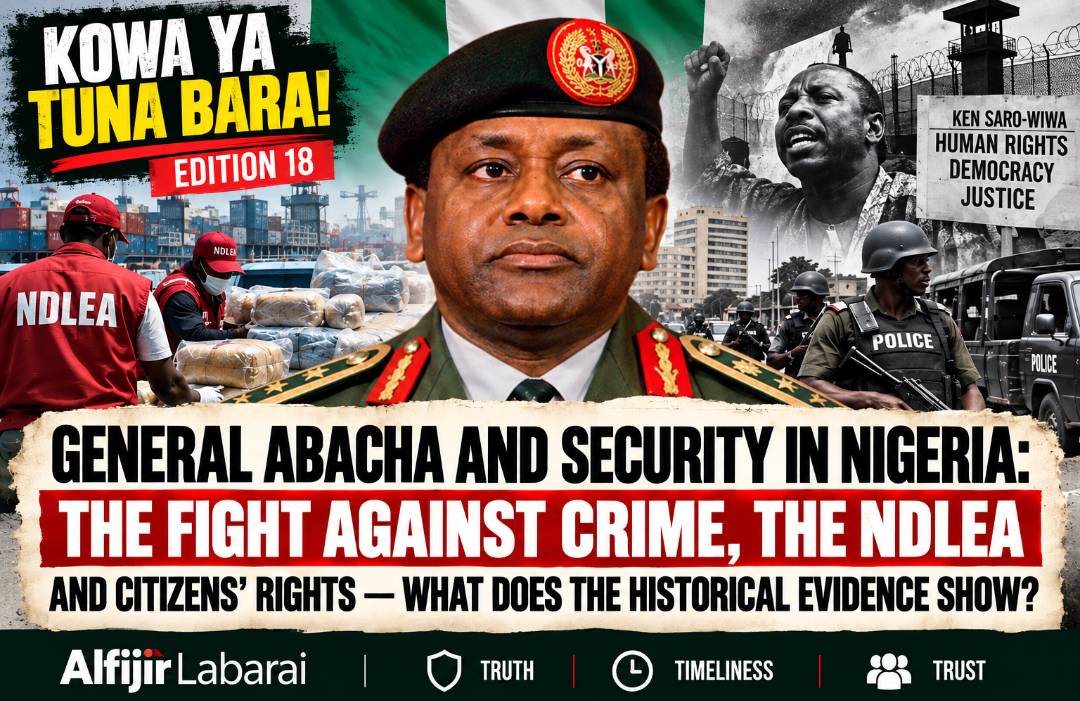
KOWA YA TUNA BARA! — EDITION 18
GENERAL ABACHA AND SECURITY IN NIGERIA: THE FIGHT AGAINST CRIME, THE NDLEA AND CITIZENS’ RIGHTS — WHAT DOES THE HISTORICAL EVIDENCE SHOW?
Alfijir Labarai | Special Investigative Series
Security is one of the most important responsibilities of any government. During the military administration of General Sani Abacha, from November 1993 to June 1998, the government stated that it was taking measures to combat drug trafficking, armed robbery, vehicle theft and other crimes.
However, assessing the record of any government requires more than relying on official speeches. Government claims must be compared with institutional records, academic research and reports from independent human rights organisations.
In this 18th edition of KOWA YA TUNA BARA!, Alfijir Labarai examines the role of the National Drug Law Enforcement Agency (NDLEA), efforts to combat crime and the questions left by Nigeria’s security history during that period.
The NDLEA: Strengthening the Fight Against Drug Trafficking
In his Independence Day address of 1 October 1997, General Abacha outlined measures his government said it had taken to strengthen the NDLEA and combat drug trafficking. He also referred to economic and financial crimes, including money laundering.
The speech records the government’s position. To assess the impact of these measures, it is necessary to examine data collected by the relevant agencies and independent researchers.
A 2004 academic study by Isidore S. Obot, titled Assessing Nigeria’s Drug Control Policy, 1994–2000, examined Nigeria’s drug-control policies, including data from the NDLEA.
The figures presented in the study show that arrests for drug-related offences increased from 798 in 1995 to 1,187 in 1996 and 2,372 in 1997.
The number of people convicted also increased, from 333 in 1995 to 537 in 1996 and 1,088 in 1997.
These figures indicate an increase in arrests and convictions for drug-related offences. However, they do not establish that drug trafficking was eliminated or that it declined across the country. An increase in arrests may reflect stronger enforcement activity, but determining whether crime itself declined requires additional evidence about the prevalence of offences over time.
Operation Sweep and the Fight Against Armed Robbery
During Nigeria’s military era, various security measures were introduced to combat crime. Operation Sweep is among the initiatives associated with joint security operations against armed robbery in Lagos.
Nevertheless, the stated purpose of a security initiative must be distinguished from its proven results. The existence of a special security operation does not, by itself, establish that crime rates fell or that the operation succeeded in every respect.
To determine Operation Sweep’s impact during the Abacha years, further historical records are needed, including crime statistics before and after its operations, details of the offences addressed and information on investigations and prosecutions.
This investigation has not established sufficient statistical evidence to conclude that armed robbery or vehicle theft declined throughout Nigeria as a direct result of these measures.
Security and the Protection of Citizens’ Rights
Another important aspect of Nigeria’s security history under Abacha concerns how security agencies exercised their powers.
Human Rights Watch and Amnesty International published reports documenting arbitrary detention, torture, concerns about fair-trial standards and allegations of unlawful killings during the military era.
Human Rights Watch’s 1995 report on the Ogoni crisis examined security operations in Ogoniland, Rivers State, including allegations of civilian killings and arbitrary arrests.
The trial and execution of Ken Saro-Wiwa and other Ogoni activists in November 1995 also became a major part of this period’s history. Human rights organisations criticised the proceedings and raised serious concerns about due process and the defendants’ right to a fair trial.
These reports do not mean that every security operation involved abuse. They do, however, show why the assessment of security during this period cannot be limited to whether suspects were arrested. It must also examine whether the law was followed, whether accused persons had a fair opportunity to defend themselves and whether allegations of misconduct by security personnel were investigated.
What Has the Investigation Established, and What Remains Unclear?
Alfijir Labarai’s investigation has identified three important findings.
First, the Abacha government stated that it had taken steps to strengthen the NDLEA and combat drug trafficking and other crimes.
Second, NDLEA data presented in academic research show an increase in arrests and convictions for drug-related offences between 1995 and 1997. These figures alone, however, do not prove that crime declined nationwide.
Third, human rights reports raised serious concerns about the use of security powers, arbitrary detention and compliance with due-process standards under military rule.
What remains insufficiently established is the overall impact of anti-crime measures on armed robbery, vehicle theft and other offences across Nigeria. Reliable comparative statistics are needed to determine whether crime rates actually declined.
Conclusion
Nigeria’s security record under General Sani Abacha includes efforts to combat drug trafficking and other offences, but it also raises serious questions about the rule of law and the protection of citizens’ rights.
Security success cannot be measured by arrest figures alone. Equally, the history of security agencies cannot be understood solely through reports of abuse. A balanced assessment requires examining policies, crime statistics, court outcomes and the conduct of security operations.
Alfijir Labarai is committed to presenting what the evidence establishes, distinguishing official statements from independent research and acknowledging where further documentation is required. Where the evidence is insufficient, we will say so rather than present assumptions as established history.
📢 FOLLOW ALFIJIR LABARAI
Stay connected with Alfijir Labarai / Alfijir News for credible news, reports, investigative journalism, and important updates from Kano, Nigeria, and around the world.
📩 CONTACT US & PARTNERSHIP ENQUIRIES
Call/WhatsApp: +234 803 207 7835
🌐 OUR SOCIAL MEDIA PLATFORMS
X: https://twitter.com/Musabestseller?s=09
Facebook: https://www.facebook.com/profile.php?id=100089640289165
Threads: https://www.threads.net/@alfijirlabarai
YouTube: https://www.youtube.com/@BestsellerChannel12
Instagram: https://www.instagram.com/musa_bestseller?utm_source=qr&r=nametag
📲 JOIN OUR WHATSAPP GROUP
https://chat.whatsapp.com/Ilj1iz8v3sa3nBfrCz9U6f
ALFIJIR LABARAI MEDIA SERVICES
Truth • Timeliness • Trust
© 2026 Alfijir Labarai Media Services