
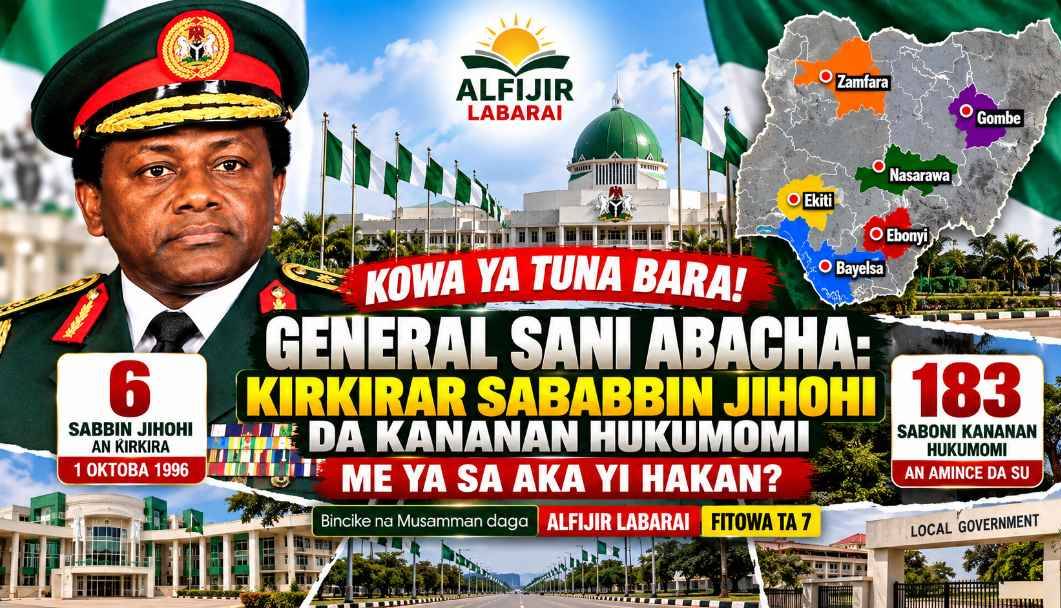
KOWA YA TUNA BARA!
A Special Investigation by Alfijir Labarai
EDITION 7
Introduction
On 1 October 1996, the government of General Sani Abacha announced the creation of six new states and approved the creation of 183 additional local government areas in Nigeria.
The decision represented a major change in Nigeria’s administrative structure. It affected the distribution of governmental authority, public administration and the relationship between government and communities.
But the key questions for this investigation are:
Why were the new states created? Which states were created? What reasons did the Abacha administration give for the decision? And what arrangements were made for the new states to begin functioning?
1. The Demand for New States Did Not Begin Under Abacha
An important point that should be established from the outset is that demands for the creation of new states and local governments existed before the Abacha administration.
In his Independence Day address on 1 October 1996, Abacha said his administration had inaugurated a committee on 13 December 1995 to examine demands for new states, local governments and boundary adjustments.
According to the speech, the committee received:
72 requests for new states
2,369 requests for new local governments
286 requests for boundary adjustments
The committee subsequently submitted its recommendations to the government for consideration.
Therefore, the accurate historical description is that the demands predated the Abacha administration, while the administration reviewed them and implemented the creation of six new states in 1996.
2. Six New States Were Created
On 1 October 1996, the government approved six new states, one from each of the country’s six geopolitical zones.
They were:
Bayelsa State
Created from the former Rivers State, with Yenagoa as its capital.
Ebonyi State
Created from parts of the former Abia and Enugu States, with Abakaliki as its capital.
Ekiti State
Created from the former Ondo State, with Ado-Ekiti as its capital.
Gombe State
Created from the former Bauchi State, with Gombe as its capital.
Nasarawa State
Created from the former Plateau State, with Lafia as its capital.
Zamfara State
Created from the former Sokoto State, with Gusau as its capital.
The creation of these six states brought Nigeria’s total number of states to 36. The 1999 Constitution subsequently listed all 36 states, including the six created in 1996.
3. Why Did the Abacha Government Create the States?
According to Abacha’s 1996 speech, the government considered several factors when making its decision.
These included the need for a fairer spread and balance among the geopolitical zones, as well as criteria such as population and land mass, among others.
The administration also said the exercise responded to demands from different parts of the country and that state and local-government creation had been one of the major issues considered by the National Constitutional Conference and subsequently passed to the administration for resolution.
4. 183 Additional Local Governments Were Also Approved
The 1996 exercise was not limited to state creation.
The Provisional Ruling Council also approved 183 additional local government areas.
The government said the number was based on a 30 per cent increase over the existing number of local governments in each state.
This meant that the exercise involved both the restructuring of the state level and an expansion of the local-government structure.
5. Did the Government Present State Creation as the Solution to Development Problems?
This is where the historical record requires careful reading.
The Abacha administration itself stated that the proliferation of states and local governments was not the ultimate answer to Nigeria’s socioeconomic development problems.
It also said state creation was not intended to encourage the separation of communities that had lived together peacefully for many years. Instead, the administration presented the exercise largely in terms of administrative convenience and necessity.
This distinction is important.
The creation of a state is an administrative and constitutional change. It does not, by itself, establish that economic or social development will automatically follow.
6. What Was Planned for the New States to Begin Operating?
Creating a state on paper was only the beginning.
The 1996 speech acknowledged that the exercise involved a considerable amount of administrative work to ensure a smooth take-off.
The government therefore established implementation committees to monitor and coordinate the administrative work associated with the new states and local governments.
The administration also instructed that issues involving the sharing of assets and the movement of personnel should be handled responsibly and orderly.
But there was another important financial point.
The government stated that the Federal Government would not provide a special take-off grant beyond what was budgeted for in the Federation Account for states and local governments. It also warned against creating the impression that additional resources would automatically be channelled to the newly created states.
That is an important part of the historical record because it shows that state creation also came with financial and administrative responsibilities.
7. The Government Also Warned About Waste
The administration called for care in the management of resources during the creation and administration of the new states and local governments.
It specifically referred to the need to avoid wastage and loss of resources.
The government also linked the success of the new states to realistic development and production plans, rather than simply creating new administrative boundaries.
In other words, the official position was that the new states had to demonstrate their ability to translate administrative creation into practical development.
8. What Happened After the States Were Created?
This is where the next stage of the investigation becomes important.
The fact that a state was created on 1 October 1996 is a documented historical event.
But determining the actual impact requires a different set of evidence.
We need to examine:
When were government ministries and departments established?
When were secretariats and other government buildings constructed?
How were government workers transferred?
How were assets divided between the old and new states?
What federal resources were made available?
What development projects were initiated?
How did the new states finance their governments?
And what measurable changes occurred in the years following their creation?
These questions allow us to distinguish between the creation of a state and the results produced after its creation.
9. What the Historical Record Confirms
The historical record is clear on the central point: six states were created on 1 October 1996.
Contemporary documentation identifies them as Bayelsa, Ebonyi, Ekiti, Gombe, Nasarawa and Zamfara.
Official state-government histories also continue to identify 1996 as the year of their creation. For example, Bayelsa’s government states that the state was created on 1 October 1996 from Rivers State, while Gombe’s government records its creation on the same date from the former Bauchi State.
Ebonyi’s official government profile similarly records that it was created in 1996 from parts of Abia and Enugu States.
WHAT SHOULD WE REMEMBER?
Our investigation establishes several important points:
First: The demand for additional states and local governments existed before the Abacha administration.
Second: The Abacha administration established a committee in December 1995 to examine the demands.
Third: Six new states were created on 1 October 1996.
Fourth: The six states were Bayelsa, Ebonyi, Ekiti, Gombe, Nasarawa and Zamfara.
Fifth: An additional 183 local government areas were approved.
Sixth: The government presented the exercise partly as a response to administrative demands and the need to address certain grievances, while also stating that proliferation of states and local governments was not, by itself, the ultimate solution to socioeconomic development.
Seventh: Implementation committees were established, while the government said there would be no special federal take-off grant beyond what was provided for through the Federation Account.
CONCLUSION
The history of Nigeria’s six-state creation in 1996 did not begin with the announcement of 1 October.
There was a process:
Demand → Committee → Review → Recommendations → Government Decision → Implementation.
The Abacha administration was responsible for the 1996 decision and implementation of the six-state creation, but the demands themselves had existed earlier.
Therefore, if we want to understand the full significance of the exercise, we should not stop at the statement that “six states were created.”
The next question is:
After the six states were created, what did the Abacha administration do to help them establish functioning governments, and which major development projects were implemented in those states before 1998?
That is the next stage of our investigation.
KOWA YA TUNA BARA!
A Special Investigation by Alfijir Labarai
CONNECT WITH ALFIJIR LABARAI
Stay connected with Alfijir Labarai / Alfijir News for the latest news, reports, investigations, programmes and important updates from Kano, Nigeria and around the world.
📞 CONTACT US
For enquiries, news tips, partnership, advertising, sponsorship and more information:
+234 803 207 7835
📰 Have a story, development or important information to share?
Send your news tips, press releases, announcements and community stories to Alfijir Labarai.
🤝 PARTNER WITH US
We welcome individuals, organisations, institutions and businesses interested in:
• Media Partnership
• Advertising
• Programme Sponsorship
• Corporate Partnerships
• Special Reports & Features
• Event & Programme Promotion
📞 Contact us:
+234 803 207 7835
🌐 FOLLOW ALFIJIR LABARAI
🐦 X (Twitter):
“Follow us on X” https://twitter.com/Musabestseller?s=09
📘 Facebook:
“Follow us on Facebook” https://www.facebook.com/profile.php?id=100089640289165
🧵 Threads:
“Follow us on Threads”https://www.threads.net/@alfijirlabarai
▶️ YouTube:
“Subscribe on YouTube” https://www.youtube.com/@BestsellerChannel12
📸 Instagram:
“Follow us on Instagram” https://www.instagram.com/musa_bestseller?utm_source=qr&r=nametag
📲 JOIN OUR WHATSAPP GROUP
Get our latest news updates, programmes, reports and important announcements directly on WhatsApp.
👇👇 Join the Alfijir Labarai / Alfijir News WhatsApp Group:
“Join our WhatsApp Group” https://chat.whatsapp.com/Ilj1iz8v3sa3nBfrCz9U6f?s=cl&p=a&mlu=4&ilr=4
ALFIJIR LABARAI MEDIA SERVICES
Accurate • Timely • Trusted
📰 News • Reports • Investigations • Programmes • Public Awareness
© 2026 Alfijir Labarai Media Services