
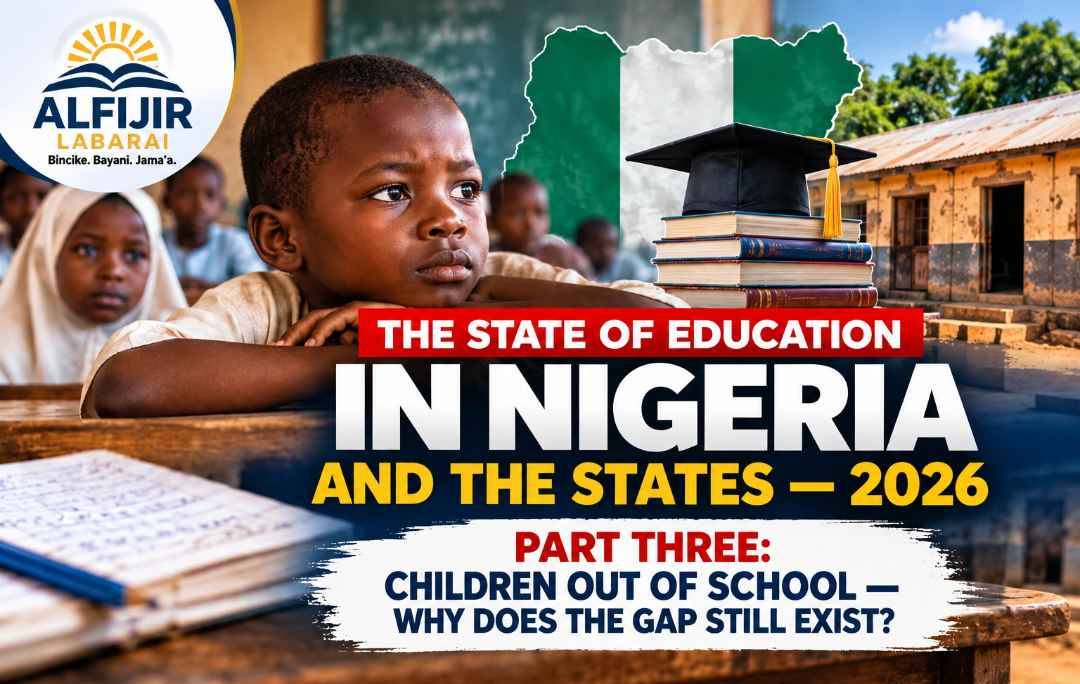
CHILDREN OUT OF SCHOOL — WHY DOES THE GAP STILL EXIST?
BY ALFIJIR LABARAI — SUNDAY INVESTIGATION
Nigeria continues to face a major challenge in ensuring that every child has access to education.
UNICEF currently reports that about 10.5 million children aged 5–14 are out of school in Nigeria, despite primary education being officially free and compulsory. UNICEF also reports that regular primary-school attendance is significantly lower in northern Nigeria.
The situation becomes clearer when recent state-level data are examined.
KANO: 875,593 CHILDREN OUT OF SCHOOL
A 2026 Kano State Out-of-School Children Survey found that an estimated 875,593 children aged 5–18 are out of school across the state’s 44 Local Government Areas.
The assessment was conducted in March 2026 and has been described as Kano’s first statistically representative out-of-school-children evaluation in more than a decade. It estimated that 13.4 per cent of the state’s projected 6.6 million school-age children were out of school.
The Kano State Ministry of Education separately described the 875,593 figure as the state’s new verified figure, based on a statewide survey providing data disaggregated by local government area, age and gender.
One of the survey’s notable findings is that 99.6 per cent of parents or caregivers surveyed regarded formal education as important or very important.
This finding is significant because it indicates that the reasons children remain out of school cannot simply be explained by a lack of parental interest in education.
WHAT IS KEEPING CHILDREN OUT OF SCHOOL?
The reasons are complex and vary from one community to another.
Economic difficulties, distance to schools, household responsibilities, child labour, insecurity and challenges affecting vulnerable children can all influence whether a child enters school, remains in school or drops out.
UNICEF also identifies challenges in northern Nigeria involving Qur’anic education. In some areas, children may receive Qur’anic education without acquiring basic literacy and numeracy skills. UNICEF notes that children in such circumstances are considered officially out of school within the government’s education framework.
This makes the issue more complicated than simply counting how many children are physically outside school buildings.
ALMAJIRI AND TSANGAYA: ANOTHER PART OF THE CHALLENGE
The Almajiri and Tsangaya education system is another area requiring attention.
In September 2026, the Kano State Government inaugurated a 20-member advisory committee on Almajiri Education and Welfare Reform.
According to the state government statement reported by PUNCH, the committee is expected to work towards a framework for regulating and integrating the Tsangaya education system while safeguarding the welfare, dignity and future of children within it.
For education planning, an important question is therefore how religious education and foundational literacy, numeracy and other relevant skills can be provided in a way that protects children’s educational opportunities and welfare.
FROM ENROLMENT TO RETENTION AND COMPLETION
Counting children who are out of school is only one part of the challenge.
In September 2026, Kano SUBEB, in collaboration with UBEC, launched the 2026/2027 Statewide Enrolment Drive Campaign.
The campaign is aimed at mobilising parents and communities to enrol children aged 6–11 and support the return of out-of-school children to classrooms across the state’s 44 Local Government Education Authorities.
The campaign also gives particular attention to girls, children with disabilities and other vulnerable groups.
Importantly, the campaign emphasises not only enrolment, but also regular attendance, retention and completion of basic education.
THE QUESTIONS THAT NOW MATTER
Once a child is enrolled, several questions remain important:
Is the child attending school regularly?
Does the school have enough qualified teachers?
Are learning materials available?
Is the child actually learning to read, write and calculate?
Can the child remain in school until completion?
And are education resources reaching the communities and schools where the needs are greatest?
These questions are important because access to school and learning outcomes are related, but they are not the same thing.
WHAT ALFIJIR LABARAI WILL CONTINUE TO INVESTIGATE
As this investigation continues, Alfijir Labarai will examine:
• The number of children out of school and how the figures are produced.
• Where out-of-school children are concentrated.
• The reasons children leave school or never enrol.
• The availability and distribution of teachers.
• Classroom conditions and learning materials.
• The effects of poverty, child labour and household responsibilities.
• The Almajiri and Tsangaya education system.
• Challenges affecting girls, children with disabilities and other vulnerable groups.
• Education funding and the implementation of education programmes.
• Whether interventions are reaching the children and communities that need them most.
CONCLUSION
The number of children outside the formal education system is an important indicator, but it does not tell the whole story.
A complete response requires attention to enrolment, attendance, retention, learning and completion.
The evidence from Kano’s 2026 survey also shows that parental support for education is very high among the surveyed population. This means that understanding why children remain out of school requires a closer examination of the economic, social, geographic, security and educational conditions affecting families and communities.
The questions remain:
How many children are out of school?
Where are they?
Why are they out?
What is being done to bring them into school?
And, once enrolled, are they learning and completing their education?
The investigation continues.
BY ALFIJIR LABARAI
Evidence-based investigation.
Not praise alone. Not criticism alone.
We investigate. We ask questions. We reveal what we find.
CONNECT WITH ALFIJIR LABARAI
Stay connected with Alfijir Labarai / Alfijir News for the latest news, reports, investigations, programmes and important updates from Kano, Nigeria and around the world.
📞 CONTACT US
For enquiries, news tips, partnership, advertising, sponsorship and more information:
+234 803 207 7835
📰 Have a story, development or important information to share?
Send your news tips, press releases, announcements and community stories to Alfijir Labarai.
🤝 PARTNER WITH US
We welcome individuals, organisations, institutions and businesses interested in:
• Media Partnership
• Advertising
• Programme Sponsorship
• Corporate Partnerships
• Special Reports & Features
• Event & Programme Promotion
📞 Contact us:
+234 803 207 7835
🌐 FOLLOW ALFIJIR LABARAI
🐦 X (Twitter):
“Follow us on X” https://twitter.com/Musabestseller?s=09
📘 Facebook:
“Follow us on Facebook” https://www.facebook.com/profile.php?id=100089640289165
🧵 Threads:
“Follow us on Threads”https://www.threads.net/@alfijirlabarai
▶️ YouTube:
“Subscribe on YouTube” https://www.youtube.com/@BestsellerChannel12
📸 Instagram:
“Follow us on Instagram” https://www.instagram.com/musa_bestseller?utm_source=qr&r=nametag
📲 JOIN OUR WHATSAPP GROUP
Get our latest news updates, programmes, reports and important announcements directly on WhatsApp.
👇👇 Join the Alfijir Labarai / Alfijir News WhatsApp Group:
“Join our WhatsApp Group” https://chat.whatsapp.com/Ilj1iz8v3sa3nBfrCz9U6f?s=cl&p=a&mlu=4&ilr=4
ALFIJIR LABARAI MEDIA SERVICES
Accurate • Timely • Trusted
📰 News • Reports • Investigations • Programmes • Public Awareness
© 2026 Alfijir Labarai Media Services