
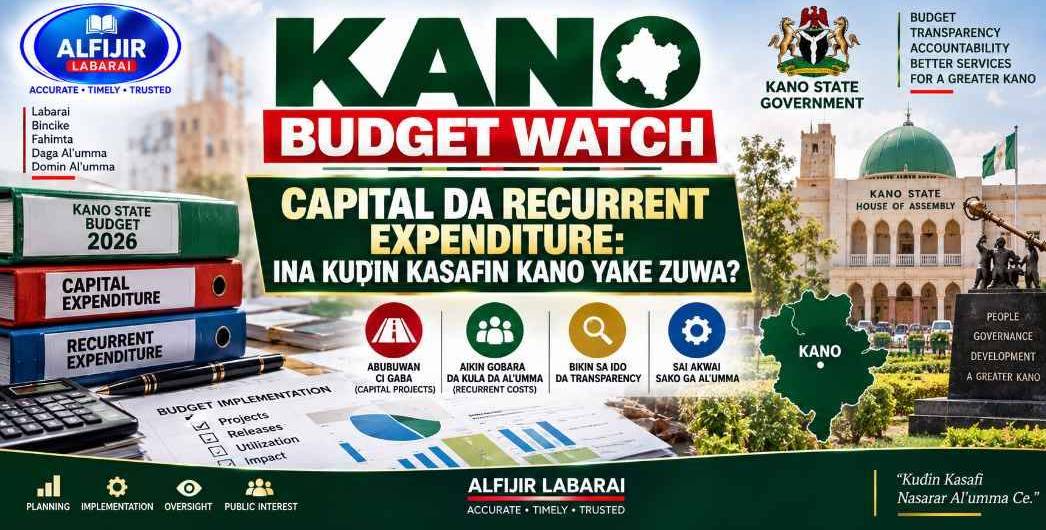
KANO BUDGET WATCH
CAPITAL AND RECURRENT EXPENDITURE: WHERE IS KANO’S BUDGET MONEY GOING?
A Special Investigation by Alfijir Labarai
We Investigate. We Ask Questions. We Tell You What We Find.
INTRODUCTION
The Kano State Government has commenced the 2027 budget bilateral discussions between the Ministry of Planning and Budget and various Ministries, Departments and Agencies (MDAs) of government.
The discussions began with MDAs responsible for infrastructure as part of the process of preparing the 2027 state budget.
According to the Ministry of Planning and Budget, the discussions are aimed at reviewing the implementation of the 2026 budget while assessing the proposals submitted by MDAs for the 2027 budget.
The government also said the 2027 budget process is being guided by the Medium-Term Expenditure Framework (MTEF) 2027–2029, with emphasis on completing ongoing projects, ensuring realistic project costing through Bills of Quantities (BoQ), and aligning projects with the Kano State Development Plan.
2026 BUDGET: N1.478 TRILLION
Kano State’s approved budget for 2026 stands at N1,477,829,666,130.71.
The Kano State Government said the budget was approved to support development programmes, particularly infrastructure, education, healthcare and social welfare.
But the budget implementation figures raise an important question:
How much of the approved budget had actually been spent by the end of the first half of the year?
HOW MUCH WAS SPENT BY JUNE 2026?
According to the Kano State Government’s Q2 2026 Budget Implementation Report, total government expenditure from January to June 2026 stood at N401,060,473,207.98.
This represents 27.1 per cent of the annual budget.
Meanwhile, total revenue recorded during the same period stood at N424,447,518,164.44, representing 28.7 per cent of the budgeted revenue.
The report compares the implementation figures with the Original Approved Budget for 2026.
CAPITAL EXPENDITURE: N1.048 TRILLION
Of the 2026 budget, N1,048,111,244,596.98 was allocated to Capital Expenditure.
This is the portion of the budget intended for major development projects and government assets, including roads, water projects, schools, hospitals, public buildings, agriculture and other infrastructure.
However, by the end of June 2026, the state government’s report showed Capital Expenditure implementation of N267,748,246,118.47.
That represents 25.5 per cent of the approved Capital Expenditure budget.
Based on the report, approximately N780.36 billion of the approved Capital allocation had not been reflected as expenditure in the year-to-date implementation figures by the end of June.
RECURRENT EXPENDITURE: N429.7 BILLION
For Recurrent Expenditure, N429,718,421,533.73 was allocated.
The report shows that N133,312,227,089.51 had been implemented by the end of the first half of the year, representing 31.0 per cent.
Within this figure:
Personnel Cost stood at N80,784,027,610.89, representing 41.4 per cent of the Personnel Cost budget.
Other Recurrent Costs, including Overhead and other expenditure classified under this category in the report, stood at N52,528,199,478.62, representing 22.4 per cent of the allocation for the category.
WHAT DOES THIS MEAN?
The Q2 figures do not, by themselves, mean that funds not reflected as expenditure by June were lost or missing.
The report covers budget implementation from January to June and compares actual expenditure with the Original Approved Budget.
The state government also explained that some MDAs recorded over-performance due to changes in estimates and project implementation, and that some of these differences would be addressed through Budget Adjustments and Supplementary Budget processes with the State House of Assembly.
Therefore, the difference between allocation and expenditure should not automatically be interpreted as money that was misappropriated or lost.
What requires further investigation is the reason for the differences and what was actually delivered with the money that was spent.
WATER: AN AREA THAT REQUIRES FURTHER INVESTIGATION
The Q2 figures indicate that the water sector is one of the areas that deserves closer examination in the next stage of this investigation.
The question is not simply how much was allocated.
We will examine:
How much was allocated?
How much was spent?
Which projects were implemented?
Where are the projects located?
How much was paid?
And what is the actual status of the projects?
This approach will allow us to compare budget figures with what residents can actually see on the ground.
AGRICULTURE AND EDUCATION ALSO REQUIRE FURTHER REVIEW
The Q2 report also shows differences in Capital Expenditure implementation across different sectors.
In some areas, implementation was below half of the approved allocation, while some other budget lines recorded expenditure above their original allocations.
The Kano State Government itself stated that such differences could be addressed through Budget Adjustment and Supplementary Budget processes.
This raises an important question for the Alfijir Labarai investigation:
If expenditure exceeded the original allocation in a particular area, when was the budget adjustment made?
What amount was adjusted?
And which authority approved the adjustment?
WHY ARE THE 2027 BUDGET DISCUSSIONS IMPORTANT?
The 2027 Budget Bilateral Discussions provide an opportunity to examine the next stage of the budget process.
The Kano State Government said the discussions are reviewing the implementation of the 2026 budget while assessing proposals submitted by MDAs for 2027.
The 2027 Budget Call Circular issued by the Ministry of Planning and Budget also commenced the process of receiving budget proposals from MDAs in line with the Public Financial Management Law 2020, the MTEF and Medium-Term Sector Strategies.
This therefore raises a central question that Alfijir Labarai will continue to follow:
What has been delivered in 2026 before additional funding is requested for 2027?
WHAT ALFIJIR LABARAI FOUND IN THE FIRST STAGE OF THE INVESTIGATION
Official figures show:
Kano State 2026 Budget: N1.478 trillion
Capital Expenditure: N1.048 trillion
Capital Expenditure implemented by June: N267.75 billion
Recurrent Expenditure: N429.72 billion
Recurrent Expenditure implemented by June: N133.31 billion
Total expenditure by June: N401.06 billion
Total revenue recorded by June: N424.45 billion.
CONCLUSION
The available figures are not, by themselves, sufficient to establish whether every naira was used exactly as approved.
However, they provide an important starting point for a deeper examination of budget implementation in Kano State.
The question for Alfijir Labarai is not simply:
“Was money spent?”
The questions are:
How much was allocated?
How much was spent?
What was it spent on?
Which projects were implemented?
Where are the projects?
Who benefited?
And if additional funding is being requested in 2027, what was delivered with the funds allocated in 2026?
These are the issues Alfijir Labarai will continue to investigate.
SOURCES
Kano State Ministry of Planning and Budget — Kano State 2026 Q2 Budget Implementation Report.
Kano State Ministry of Planning and Budget — 2027 Budget Call Circular.
Kano State Government — 2026 Appropriation Law/Budget.
FAME News — “Kano Begins 2027 Budget Bilateral Discussions with Infrastructure MDAs,” 19 September 2026.
ALFIJIR LABARAI
We Investigate. We Ask Questions. We Tell You What We Find.
Truth • Timely • Trusted